Quick Answer
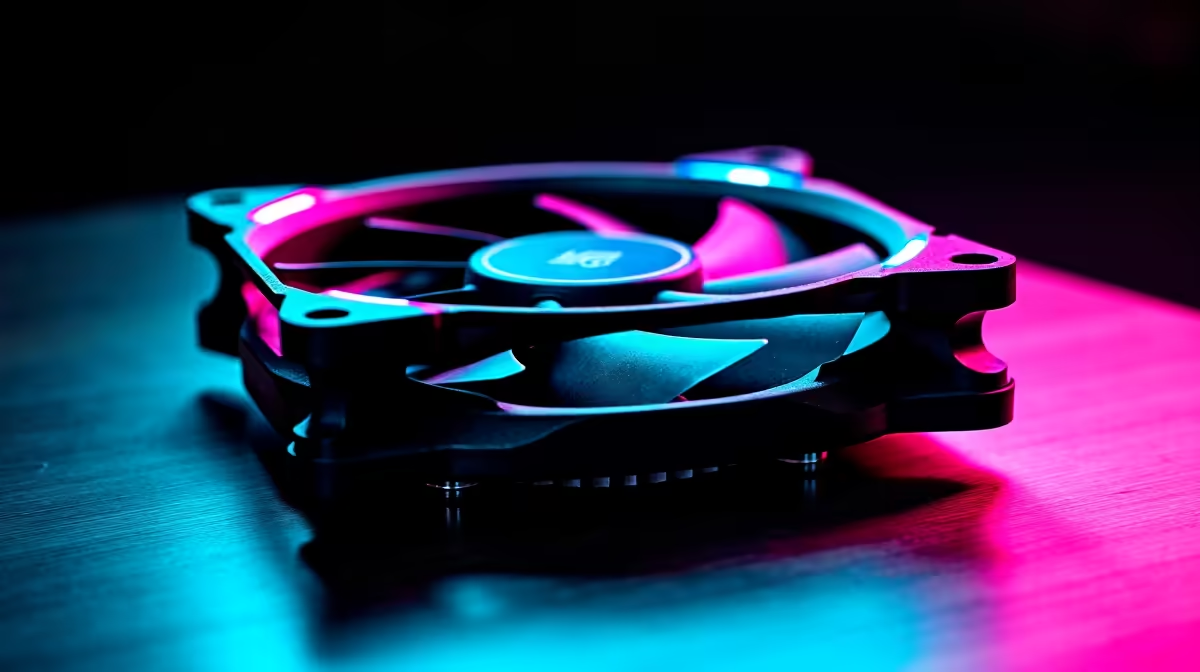
PC fans use five main bearing types: sleeve, rifle, hydraulic, ball, and fluid dynamic. Fluid dynamic bearings (FDB) offer the best overall combination of low noise, long lifespan (40,000-plus hours), and performance across all orientations, making them the correct choice for quality gaming and workstation builds.
Sleeve and Rifle Bearings: Budget Tier 🔧
Sleeve bearings are the simplest and cheapest design. The spindle rotates inside a metal cylinder lubricated with grease that wears rapidly, typically becoming audibly noisy within 12 to 18 months of daily use. They are also orientation-sensitive; horizontal mounting can accelerate wear. Rifle bearings improve on this: spiral grooves pump oil toward the shaft centre under rotation, improving lubricant retention. They last 20 to 30% longer than plain sleeve bearings and tolerate multi-directional mounting better. Both types retail at R80 to R150 per 120mm fan in the South African market and are suitable for secondary exhaust positions where fans run infrequently.
Hydraulic and Ball Bearings: Mid Tier 🖥️
Hydraulic bearings extend the sleeve concept with a larger oil reservoir and sealing design that slows lubricant migration significantly, reaching 25,000 to 30,000 hours of service life. They run quieter than rifle bearings and are fully multi-directional. Ball bearings use steel balls in precision races to eliminate spindle contact. They are durable (40,000-plus hours) and handle high-temperature operation well, but produce a characteristic mid-frequency rolling hum. For builds where fans run at 80 to 100% duty frequently, ball bearings are reliable. For quiet builds, their acoustic signature is a drawback compared to FDB.
Fluid Dynamic and Magnetic Levitation: Premium Tier ✨
Fluid dynamic bearings use machined grooves to pump oil into a pressurised film, lifting the spindle off the bearing surface during operation. The result is near-zero mechanical noise, a lifespan of 40,000 to 50,000 hours, and consistent acoustics across the fan's entire life. They cost R300 to R480 per 120mm fan. Magnetic levitation (maglev) fans use opposing magnetic fields to float the rotor with zero mechanical contact, achieving below 20 dBA for some 120mm units, but cost R500 to R800-plus. For most SA gaming and creator builds, FDB is the practical ceiling of value; maglev is for specialist silent builds.
Match Bearing to Mounting Position ⚡
Use FDB or maglev fans in primary airflow positions where they run most of the time. Sleeve or rifle bearings are acceptable for secondary positions like top exhaust where fans idle below 30% duty cycle. This hybrid approach cuts costs without sacrificing primary cooling quality.
FAQ
Can I identify bearing type from a fan's appearance?
No. All bearing types look identical from the outside. Bearing type is only determinable from the manufacturer's specification sheet. Listings at Evetech include bearing type in the technical specifications tab.
Does bearing type affect PWM control accuracy?
Yes. FDB bearings have very low starting friction, allowing fans to respond accurately to PWM signals at 15 to 20% duty cycle. Sleeve bearings have higher starting torque and may stall or spin erratically below 40 to 50% duty.
How long do ball-bearing fans typically last in a hot SA environment?
Ball bearings handle heat well since they have no oil to migrate, but their steel races expand at elevated temperatures, increasing rolling resistance. In a Gauteng summer home office, ball-bearing fans typically last 30,000 to 35,000 hours, slightly less than published MTBF for temperate conditions.
Choosing fans based on bearing type and lifespan? Evetech stocks 120mm and 140mm fans with FDB, hydraulic, and ball bearings across multiple price points. Browse the cooling section to compare and find the right fan for your build.