


550W PSU Planning for RTX 5080 Super Builds in SA
550W for RTX 5080 Super needs a full-build check, not a simple yes. Review GPU guidance, CPU draw, transient load, connectors, PSU quality, and upgrade plans before deciding.
Read moreChoose Galaxy PLA when changing highlights and gloss support the design; pick matte for a quieter finish. ELEGOO Galaxy PLA is R499 for 1kg of 1.75mm filament and creates a dynamic shimmer with vibrant colour shifts across viewing angles.
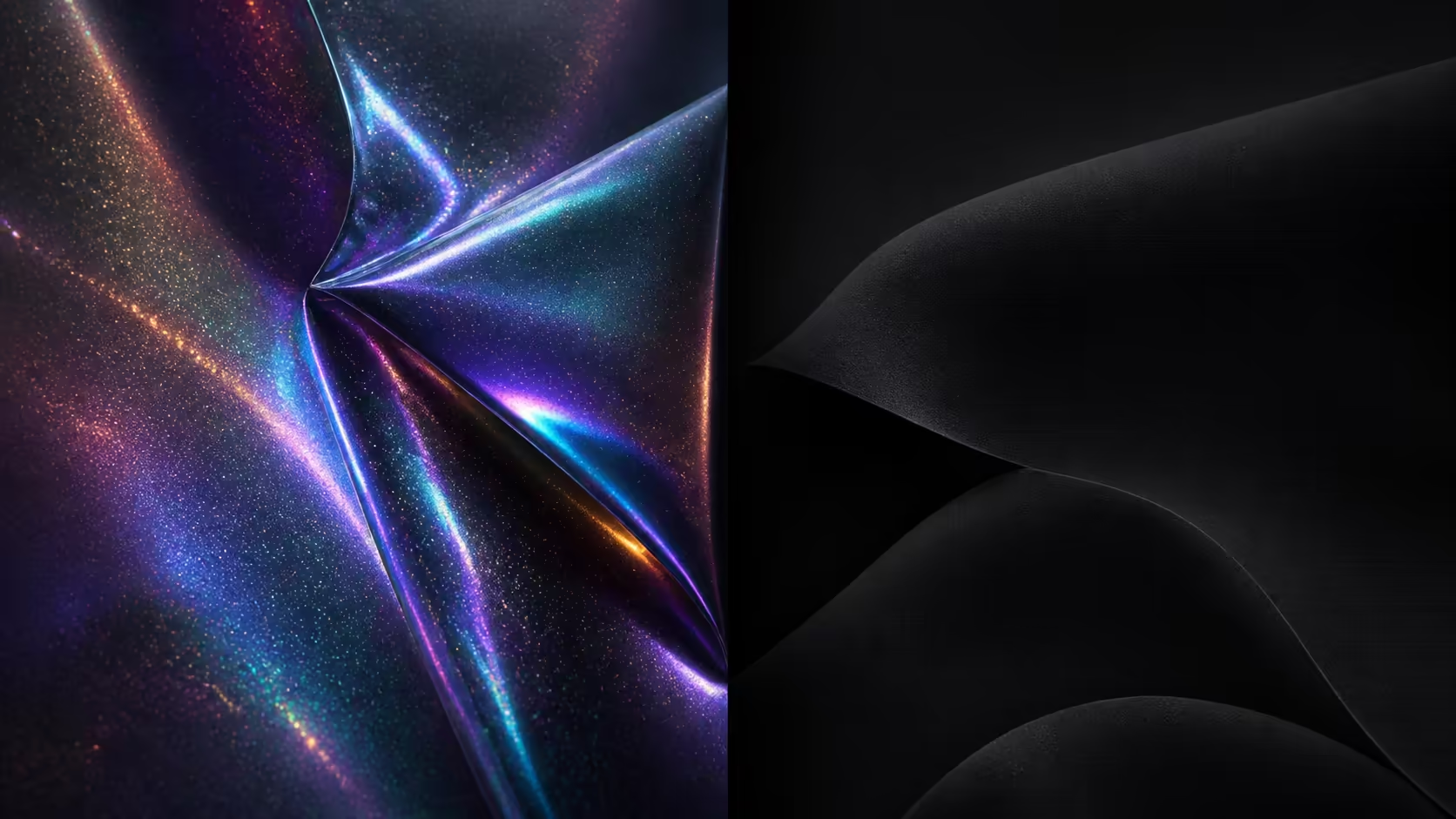
The same model can feel theatrical under moving light or calm under diffuse light, even when its geometry never changes. Galaxy PLA vs matte PLA is therefore a design decision about attention. One finish amplifies highlights and colour movement; the other lets silhouette and fine form carry more of the visual weight.
Choose Galaxy PLA for display work that should change as the viewer moves, and choose matte PLA when subdued reflection better serves the shape. The ELEGOO option pairs a R499 price with 1kg of 1.75mm material, gloss and vibrant angle-dependent shimmer. A matte candidate needs its own product details before any other property is compared.
Galaxy PLA turns light into part of the object. Broad curves, facets and exposed edges can show different colours from one viewing position to the next. That makes the finish useful for ornaments, fantasy pieces and models intended to be handled or viewed from several sides.
A matte surface has a quieter visual role. It may make contours easier to read under broad light because strong reflections do not dominate the form. This is not automatically better detail; it is simply a different relationship between the model, its surroundings and the viewer.
The 3D printer filament selection helps buyers compare finishes before assigning one to a final design.
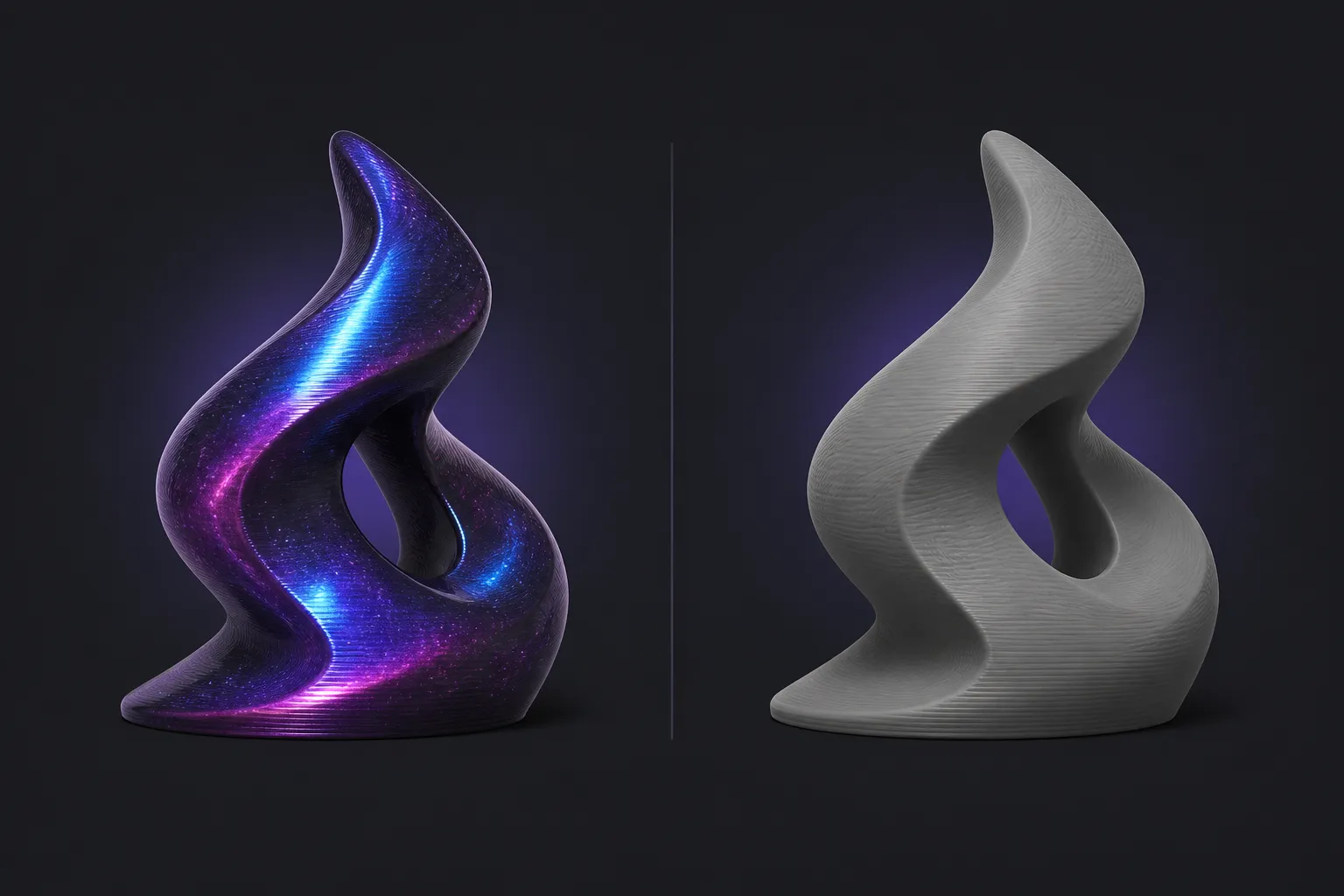
Print the same small curved sample in each real candidate and place it where the finished piece will live. Turn it slowly rather than judging one photograph. Galaxy material should be assessed for the way gloss and colour shifts travel across the form, while matte should be assessed for consistent shape readability.
Keep the printer, model orientation and evaluation distance as stable as possible. A finish comparison loses value when one sample also changes layer height, geometry or lighting. Photographing both under the same lamp can preserve a useful reference, but the moving object still reveals more than a single frame.
The ELEGOO Galaxy option is plant-based, biodegradable and friendly to both beginner and professional users. Its premium visual character is best used on exposed faces. Internal supports, hidden brackets and enclosed prototypes cannot show changing highlights, so a quieter material may be the more efficient choice there.
Review printer formats through the Evetech 3D printer range if a new machine is also part of the project. Existing users should retain a sound PLA baseline and let the finish test answer the aesthetic question.
Surface choice does not end with the print. A dark shelf, bright wall or crowded desk can change which finish reads most clearly. Place the sample against the intended background and view it from the normal room position. Galaxy highlights may stand out strongly against one setting and become visually busy against another.
Matte material can create useful separation where the surrounding scene already contains many reflections. Conversely, a quiet display space may benefit from the changing Galaxy surface. Testing background, light and object together keeps the decision connected to the final presentation instead of judging an isolated sample in ideal conditions.
If the project will be photographed, test the camera angle at the same stage. Gloss can create a strong highlight that attracts the eye away from fine geometry, while matte can preserve shape with less visual movement. Take one neutral frame and one angled frame of each sample. The pair reveals whether the finish supports both physical display and the way the work will be shared online.
The difference becomes clearest on geometry that gives light somewhere to travel. Galaxy PLA produces dynamic reflections and rich colour changes from shifting viewpoints, while its high-gloss surface adds depth to broad faces and curved shells. Matte material serves the opposite presentation choice by reducing prominent highlights. Neither finish is universally better; the model should decide whether moving lustre or quieter shape definition carries the design.
Before choosing, place both samples beside the model sketch and turn them through the intended viewing arc. That comparison shows whether a travelling highlight strengthens the concept or hides the form that should lead.
It works best on visible geometry that catches light from several directions, allowing the dynamic shimmer to change as the model turns.
Use a real matte candidate and print the same representative shape. A category label alone cannot establish how that spool will look or behave.
Yes. Matching geometry and lighting keeps the comparison focused on finish instead of mixing in shape or setup changes.
Yes. The ELEGOO material is beginner and professional friendly, and a compact surface test keeps the decision approachable.
Ready to choose the surface that carries your design? Compare PLA finishes and 3D printer options at Evetech, then judge two real samples in the light where the model will be seen.
It works best on visible geometry that catches light from several directions, allowing the dynamic shimmer to change as the model turns.
Use a real matte candidate and print the same representative shape. A category label alone cannot establish how that spool will look or behave.
Yes. Matching geometry and lighting keeps the comparison focused on finish instead of mixing in shape or setup changes.
Yes. The ELEGOO material is beginner and professional friendly, and a compact surface test keeps the decision approachable.
550W for RTX 5080 Super needs a full-build check, not a simple yes. Review GPU guidance, CPU draw, transient load, connectors, PSU quality, and upgrade plans before deciding.
Read more
8000Hz polling is overrated for most SA gamers because gains can be tiny next to battery drain and monitor limits. Mbombela players should weigh mouse feel, game support, and system stability before chasing the number.
Read more
Magnetic switches are taking over SA gaming keyboards because actuation can be tuned. For Sandton gamers, rapid trigger, reset control, and profile depth can help, but layout, key feel, and software quality still matter.
Read more
Polokwane oled monitor value questions need cautious SA context because pricing can move with availability, exchange rates, specs, and warranty support. Treat the trend as a planning signal, not a fixed price promise.
Read more
Arc B580 budget builds for Midrand gamers can shift with exchange rates, supply, specs, and model tier. Treat the title as a buying prompt, then compare SA warranty, timing, and build priorities.
Read more
ROG Ally X may beat the LCD Steam Deck for SA gamers who value stronger handheld performance, more memory, and Windows flexibility. Compare battery life, controls, game libraries, and Polokwane support needs before deciding.
Read more
Minisforum's M2 Pro pairs Core Ultra X7, Arc B390 graphics and 32GB onboard memory in 1.8 litres. SA buyers should weigh its fixed memory and $1,439 launch offer against local mini PCs.

Lenovo says Legion Go failures linked to BIOS N3CN42WW are not user error. Affected SA owners should stop retrying the update, preserve proof and open a support case.

Smart monitors can add apps and convenience, but they also add privacy settings and unwanted-software risk. SA buyers should audit the operating system before paying for extras.

A fake 113GB GTA VI ISO reportedly used empty padding around a small malware payload. SA gamers should delete unofficial builds, keep Windows security active and wait for official channels.

ASUS calls the ROG GT-BN98 the first Wi-Fi 8 gaming router. SA buyers should fix coverage and client limits before paying for a future wireless standard.

Apple's M6 Mac mini adds faster AI, graphics and networking in the same compact format. SA buyers should wait for a rand listing before comparing value.

The Vulcan II XP adds hot-swappable switches, sound damping and gaming controls to a full-size wired board. SA buyers should compare feel before features.

Microsoft says Windows on Arm now has over 7,000 verified apps and games. SA buyers should still check each driver, game and work tool before switching.

Xbox Insiders can test disc-to-digital from 31 August 2026. Supported Xbox One and Series X discs gain a digital entitlement, but older discs, regions and title coverage still need exact checks.

ViewSonic's XG2738 pairs QHD QD-OLED with 240Hz and automatic panel care. SA buyers should compare warranty, brightness, ports and burn-in protection against today's R9,999-plus OLED shelf.

NVIDIA's final Windows 10 Game Ready driver is due in October 2026. SA gamers can keep using their GPU, but new game optimisations move on while critical security fixes continue quarterly.

JBL's new Quantum 520, 520X and 120 headsets cover wireless, Xbox-certified and wired use. SA buyers should compare connection, comfort and microphone needs before paying for a new badge.