


550W PSU Planning for RTX 5080 Super Builds in SA
550W for RTX 5080 Super needs a full-build check, not a simple yes. Review GPU guidance, CPU draw, transient load, connectors, PSU quality, and upgrade plans before deciding.
Read moreGenlock aligns a system to a timing reference, while Frame Lock coordinates frames across graphics hardware. The R19,599 PNY RTX Pro Sync card provides both, with Mosaic and support for eight RTX Pro GPUs driving up to 32 synchronised displays.
Two locks appear in professional display conversations because they solve different coordination problems. Genlock vs Frame Lock is not a choice between a good and bad feature: it is a question of whether the system needs a shared timing reference, coordinated frames across graphics hardware, or both.
Genlock supplies common timing to the installation; Frame Lock coordinates frame presentation across the graphics hardware that participates in the display surface.
A common reference is Genlock's domain; cross-GPU frame agreement is Frame Lock's. PNY RTX Pro Sync provides both for R19,599 and adds NVIDIA Mosaic. The design limits are eight professional graphics processors and 32 coordinated screens.
Choose Genlock when the signal design calls for equipment to follow the same timing reference. This is a system-level requirement that should be drawn into the signal plan. It is not a promise about content layout, bezel correction or a particular response-time result.
Ask where the reference originates, which equipment must follow it and how the result will be observed during acceptance. Those questions belong with the integrator because the exact connection and setup depend on the completed system. The sync card provides the function; the project supplies the architecture.
Frame Lock is the relevant term when frames produced through participating graphics resources must remain coordinated. That role becomes especially important in a multi-GPU visual design, where independent frame progression could become visible at display boundaries.
PNY allows eight NVIDIA RTX Pro processors at the outer edge of this architecture. Review suitable hardware in the workstation graphics cards section after deciding how applications and outputs will be distributed.
NVIDIA Mosaic manages the multi-display arrangement. It can sit beside either lock requirement, but it does not turn Genlock and Frame Lock into interchangeable names. The R19,599 PNY synchronization card combines Mosaic with both locks for designs topping out at 32 synchronised screens.
Think in three columns: reference timing, cross-GPU frame coordination and canvas arrangement. A project review should give each column its own answer. That structure also makes overbuying less likely because a small independent-screen setup may not require every capability.
Write a pass condition for each chosen feature. For reference timing, observe whether the participating equipment follows the intended source. For multi-GPU frame coordination, run motion across the relevant output boundaries. For Mosaic, confirm that the planned visual surface is arranged as expected.
Screens and surrounding parts should follow the same requirement-led method. Compare PC monitors using the final canvas and review graphics card accessories only after the core architecture is approved.
If disagreement appears across equipment that should follow one reference, begin with the Genlock requirement and its reference path. If the visible break follows the boundary between two graphics processors, examine the Frame Lock plan and the outputs owned by each GPU. This is a diagnostic starting point, not a replacement for end-to-end testing.
Keep a small set of repeatable test clips for both cases. One should make reference disagreement easy to observe across the screen group; another should carry motion across the highlighted GPU boundary. Saving the active configuration with each passing clip gives technicians a useful baseline after maintenance.
Some installations switch between one Mosaic canvas and several display regions. Treat every approved layout as a separate acceptance state. The lock roles may stay the same, but content boundaries and GPU ownership can move when the arrangement changes.
RTX PRO Sync packages the primary synchronisation card with four 12-inch cables and two 24-inch alternatives, allowing different internal spans between components. The completed system can include two such cards and as many as eight GPUs. Those physical facts matter when the lock roles cross a large chassis, because selecting the right function still requires a connection layout capable of carrying it.
Yes. The PNY RTX Pro Sync card includes both functions, so a system can address shared reference timing and coordinated frames where both are required.
Neither lock is the canvas tool. NVIDIA Mosaic handles the multi-display arrangement, while the locks cover timing and frame coordination.
The largest version pairs 32 synchronised displays with an eight-processor RTX Pro boundary.
No. R19,599 buys the PNY sync card. Panels, graphics processors and installation items need separate budget entries.
Use the system diagram and a repeatable visual test. A reference relationship supports the Genlock case, while a visible cross-GPU boundary supports the Frame Lock case. If both conditions exist, document and test them separately so one passing observation does not hide a failure in the other role.
Ready to choose the correct lock role? Map reference timing, GPU ownership and screen arrangement, then compare the matching professional display components at Evetech.
Yes. The PNY RTX Pro Sync card includes both functions, so a system can address shared reference timing and coordinated frames where both are required.
Neither lock is the canvas tool. NVIDIA Mosaic handles the multi-display arrangement, while the locks cover timing and frame coordination.
The largest version pairs 32 synchronised displays with an eight-processor RTX Pro boundary.
No. R19,599 buys the PNY sync card. Panels, graphics processors and installation items need separate budget entries.
Use the system diagram and a repeatable visual test. A reference relationship supports the Genlock case, while a visible cross-GPU boundary supports the Frame Lock case. If both conditions exist, document and test them separately so one passing observation does not hide a failure in the other role.
550W for RTX 5080 Super needs a full-build check, not a simple yes. Review GPU guidance, CPU draw, transient load, connectors, PSU quality, and upgrade plans before deciding.
Read more
8000Hz polling is overrated for most SA gamers because gains can be tiny next to battery drain and monitor limits. Mbombela players should weigh mouse feel, game support, and system stability before chasing the number.
Read more
Magnetic switches are taking over SA gaming keyboards because actuation can be tuned. For Sandton gamers, rapid trigger, reset control, and profile depth can help, but layout, key feel, and software quality still matter.
Read more
Polokwane oled monitor value questions need cautious SA context because pricing can move with availability, exchange rates, specs, and warranty support. Treat the trend as a planning signal, not a fixed price promise.
Read more
Arc B580 budget builds for Midrand gamers can shift with exchange rates, supply, specs, and model tier. Treat the title as a buying prompt, then compare SA warranty, timing, and build priorities.
Read more
ROG Ally X may beat the LCD Steam Deck for SA gamers who value stronger handheld performance, more memory, and Windows flexibility. Compare battery life, controls, game libraries, and Polokwane support needs before deciding.
Read more
Minisforum's M2 Pro pairs Core Ultra X7, Arc B390 graphics and 32GB onboard memory in 1.8 litres. SA buyers should weigh its fixed memory and $1,439 launch offer against local mini PCs.

Lenovo says Legion Go failures linked to BIOS N3CN42WW are not user error. Affected SA owners should stop retrying the update, preserve proof and open a support case.

Smart monitors can add apps and convenience, but they also add privacy settings and unwanted-software risk. SA buyers should audit the operating system before paying for extras.

A fake 113GB GTA VI ISO reportedly used empty padding around a small malware payload. SA gamers should delete unofficial builds, keep Windows security active and wait for official channels.
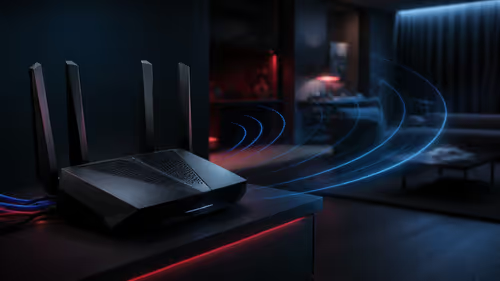
ASUS calls the ROG GT-BN98 the first Wi-Fi 8 gaming router. SA buyers should fix coverage and client limits before paying for a future wireless standard.
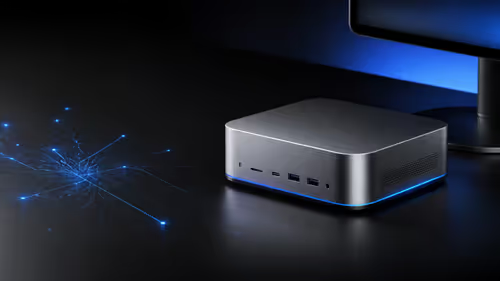
Apple's M6 Mac mini adds faster AI, graphics and networking in the same compact format. SA buyers should wait for a rand listing before comparing value.
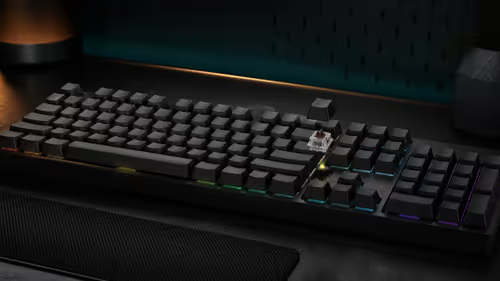
The Vulcan II XP adds hot-swappable switches, sound damping and gaming controls to a full-size wired board. SA buyers should compare feel before features.

Microsoft says Windows on Arm now has over 7,000 verified apps and games. SA buyers should still check each driver, game and work tool before switching.

Xbox Insiders can test disc-to-digital from 31 August 2026. Supported Xbox One and Series X discs gain a digital entitlement, but older discs, regions and title coverage still need exact checks.
ViewSonic's XG2738 pairs QHD QD-OLED with 240Hz and automatic panel care. SA buyers should compare warranty, brightness, ports and burn-in protection against today's R9,999-plus OLED shelf.

NVIDIA's final Windows 10 Game Ready driver is due in October 2026. SA gamers can keep using their GPU, but new game optimisations move on while critical security fixes continue quarterly.

JBL's new Quantum 520, 520X and 120 headsets cover wireless, Xbox-certified and wired use. SA buyers should compare connection, comfort and microphone needs before paying for a new badge.