


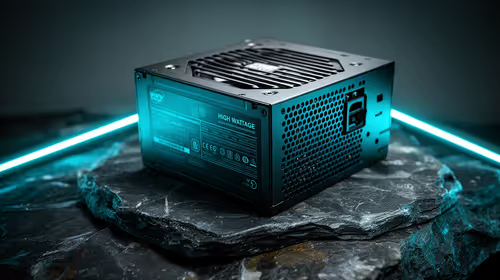
550W PSU Planning for RTX 5080 Super Builds in SA
550W for RTX 5080 Super needs a full-build check, not a simple yes. Review GPU guidance, CPU draw, transient load, connectors, PSU quality, and upgrade plans before deciding.
Read moreGet more from an 8GB workstation GPU by aligning project scope and application settings with available memory. The R12,099 RTX A1000 pairs its GDDR6 capacity with 2304 CUDA cores; Ampere architecture and a 128-bit interface complete the configuration.

Eight gigabytes can be either comfortable working space or a hard ceiling. The difference is not the job title attached to the software; it is the data held by the project at a given moment. To get the most from an 8GB workstation GPU, manage scene complexity, media choices and concurrent GPU tasks before changing random quality settings.
The RTX A1000 supplies 8GB GDDR6 at 192GB/sec and combines it with 2,304 CUDA, 18 RT and 72 Tensor cores for supported professional work.
Manage an 8GB workstation card by tracking the difficult file, closing competing GPU tasks and changing one project setting per test. The R12,099 A1000 starts with 8GB GDDR6 capacity. Its compute side has 2304 CUDA cores on Ampere, while the memory interface measures 128-bit. CAD, rendering and editing still need separate trials.
Start with the heaviest repeatable file rather than a tiny sample. CAD assemblies, texture sets, render assets and high-resolution video timelines can place different demands on graphics memory. Monitor the application during the slow stage and note whether warnings, reduced responsiveness or failed operations coincide with rising GPU memory use.
Do not treat unused memory as wasted money or full memory as proof of failure. Applications cache data differently, and an allocation figure may not equal useful working demand. The practical question is whether the project completes reliably at the settings required for delivery.
If a file approaches the card's capacity, remove temporary views, unused assets or duplicate high-resolution media before lowering the final deliverable. Proxy media can make an editing timeline easier to navigate while preserving a higher-quality export path. In 3D work, sensible texture resolution and scene organisation often make diagnosis clearer.
Change one variable, reopen the project and repeat the same action. This controlled method shows whether the adjustment helped, instead of leaving five altered settings and no explanation. It also creates a repeatable setup for other machines on the team.
The card's 8GB is GDDR6, served by a 128-bit memory interface. Its Ampere design includes 2304 CUDA cores. Those compute resources can matter to supported operations, but they do not increase memory capacity and should not be used as a substitute for checking project size.
South African buyers can compare the R12,099 card with professional workstation GPUs. Capacity, application guidance and the cost of avoidable project changes all belong in that review. The RTX A1000 costs R12,099.
A slow creative task is not automatically a graphics-memory problem. System RAM, CPU work, storage access and codec behaviour can affect what the user sees. Run one representative task while observing the system, then change only the component or setting linked to the bottleneck.
An AI PC selection is useful when the project also includes local AI features and the entire platform needs review. Confirm tool support, model requirements and memory behaviour independently; the presence of Ampere architecture alone does not answer those questions.
Stop tuning when the required project works reliably, output remains correct and further changes no longer improve the measured task. Continued adjustment can consume production time while adding complexity that colleagues must remember.
If the difficult file still exceeds practical capacity after sensible project organisation, document that boundary. The next comparison can then focus on higher-memory cards without repeating every earlier experiment or lowering the delivery standard.
An efficient workflow can also use the card's four Mini DisplayPort 1.4a connectors to separate a main canvas, reference material, preview output and monitoring tools across up to four 5K screens. The 50W single-slot, low-profile design keeps that capacity suitable for a compact workstation. Memory management still matters, but the card's bandwidth and output arrangement provide more substance than capacity alone.
Keep the active scene or timeline organised, close unnecessary GPU-heavy tasks and retest after each meaningful setting change. Preserve the final output requirement while simplifying temporary working data.
No single capacity fits every file. Application version, assembly size, media resolution, effects and concurrent tasks can change the memory requirement.
Supported applications may use CUDA resources for compute work, while VRAM stores active graphics data. They describe separate capabilities and can become constraints at different stages.
The RTX A1000 costs R12,099. Inside the card, 2304 CUDA cores belong to the Ampere design, while its GDDR6 memory uses a 128-bit interface.
Ready to make an 8GB card work around real projects? Browse Evetech's professional GPU choices and compare capacity against the largest files your workstation must handle comfortably.
Keep the active scene or timeline organised, close unnecessary GPU-heavy tasks and retest after each meaningful setting change. Preserve the final output requirement while simplifying temporary working data.
No single capacity fits every file. Application version, assembly size, media resolution, effects and concurrent tasks can change the memory requirement.
Supported applications may use CUDA resources for compute work, while VRAM stores active graphics data. They describe separate capabilities and can become constraints at different stages.
The RTX A1000 costs R12,099. Inside the card, 2304 CUDA cores belong to the Ampere design, while its GDDR6 memory uses a 128-bit interface.
550W for RTX 5080 Super needs a full-build check, not a simple yes. Review GPU guidance, CPU draw, transient load, connectors, PSU quality, and upgrade plans before deciding.
Read more
8000Hz polling is overrated for most SA gamers because gains can be tiny next to battery drain and monitor limits. Mbombela players should weigh mouse feel, game support, and system stability before chasing the number.
Read more
Magnetic switches are taking over SA gaming keyboards because actuation can be tuned. For Sandton gamers, rapid trigger, reset control, and profile depth can help, but layout, key feel, and software quality still matter.
Read more
Polokwane oled monitor value questions need cautious SA context because pricing can move with availability, exchange rates, specs, and warranty support. Treat the trend as a planning signal, not a fixed price promise.
Read more
Arc B580 budget builds for Midrand gamers can shift with exchange rates, supply, specs, and model tier. Treat the title as a buying prompt, then compare SA warranty, timing, and build priorities.
Read more
ROG Ally X may beat the LCD Steam Deck for SA gamers who value stronger handheld performance, more memory, and Windows flexibility. Compare battery life, controls, game libraries, and Polokwane support needs before deciding.
Read more
Minisforum's M2 Pro pairs Core Ultra X7, Arc B390 graphics and 32GB onboard memory in 1.8 litres. SA buyers should weigh its fixed memory and $1,439 launch offer against local mini PCs.

Lenovo says Legion Go failures linked to BIOS N3CN42WW are not user error. Affected SA owners should stop retrying the update, preserve proof and open a support case.

Smart monitors can add apps and convenience, but they also add privacy settings and unwanted-software risk. SA buyers should audit the operating system before paying for extras.

A fake 113GB GTA VI ISO reportedly used empty padding around a small malware payload. SA gamers should delete unofficial builds, keep Windows security active and wait for official channels.
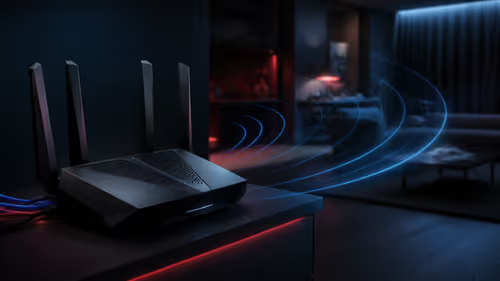
ASUS calls the ROG GT-BN98 the first Wi-Fi 8 gaming router. SA buyers should fix coverage and client limits before paying for a future wireless standard.
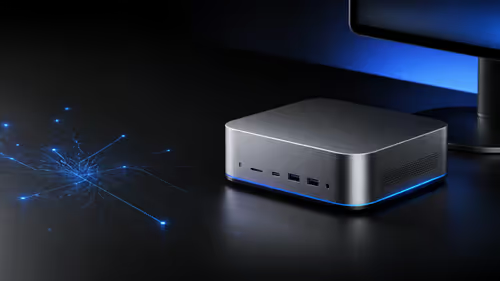
Apple's M6 Mac mini adds faster AI, graphics and networking in the same compact format. SA buyers should wait for a rand listing before comparing value.
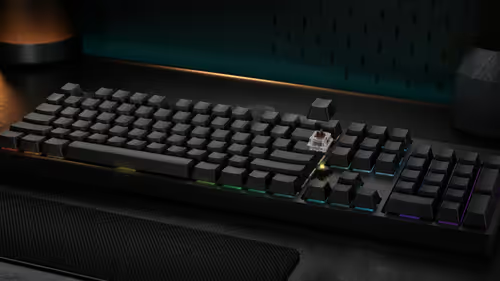
The Vulcan II XP adds hot-swappable switches, sound damping and gaming controls to a full-size wired board. SA buyers should compare feel before features.

Microsoft says Windows on Arm now has over 7,000 verified apps and games. SA buyers should still check each driver, game and work tool before switching.

Xbox Insiders can test disc-to-digital from 31 August 2026. Supported Xbox One and Series X discs gain a digital entitlement, but older discs, regions and title coverage still need exact checks.
ViewSonic's XG2738 pairs QHD QD-OLED with 240Hz and automatic panel care. SA buyers should compare warranty, brightness, ports and burn-in protection against today's R9,999-plus OLED shelf.

NVIDIA's final Windows 10 Game Ready driver is due in October 2026. SA gamers can keep using their GPU, but new game optimisations move on while critical security fixes continue quarterly.

JBL's new Quantum 520, 520X and 120 headsets cover wireless, Xbox-certified and wired use. SA buyers should compare connection, comfort and microphone needs before paying for a new badge.