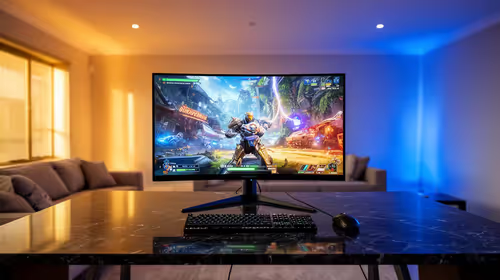
No single GPU drives every game at 1440p 240Hz with every setting intact. Competitive titles can reach the ceiling on current midrange cards, while a ray-traced AAA release may sit below half of it on a flagship. Choose the GPU for a 1440p 240Hz monitor from the hardest game and settings you plan to keep.
Quick Answer
Start with an upper-midrange GPU for esports and tuned mixed gaming. Move into high-end cards when you want ray tracing, strong one-percent lows or fewer settings cuts in new releases. July 2026 put the median of Evetech's in-stock graphics-card sample at R13,299, giving the target a dated price context.
🎯 Define what 240Hz means in your game
Run a full match at 1440p and record one-percent lows. A card that peaks at 260fps but falls to 130fps under pressure will use VRR well, though it does not hold the ceiling.
CPU performance matters at these rates. Watch per-core load beside GPU use before spending on a larger card.
Evetech's monitor category helps you compare 240Hz panels and their VRR range.
🛠️ Tune settings with intent
Lower ray tracing and expensive shadows first. Keep textures within the card's memory. DLSS or FSR can raise base performance, while frame generation changes displayed smoothness rather than base input response.
Save two profiles if your library spans Counter-Strike and cinematic single-player games. The competitive one can chase real frames with restrained effects. The other can keep richer lighting, use VRR and accept that 240Hz is available headroom rather than a nightly quota.
💰 Buy a balanced pair
A better 165Hz monitor can beat a weak 240Hz panel when your budget only covers a modest GPU. Spend on response behaviour and VRR instead of a ceiling you seldom reach.
Read independent response-time measurements where possible. A panel that smears or overshoots at its fastest setting cannot cash the promise printed beside 240Hz. The useful result is clean motion across the refresh range you actually visit.
Evetech's monitor best-sellers provide current local panel context for that trade.
Frequently Asked Questions
What GPU tier drives a 1440p 240Hz monitor without compromise?
No tier guarantees 240fps in every game. High-end cards reduce compromises in demanding titles.
Can a midrange card like the RTX 4070 hit 240Hz?
It can in esports and lighter games with a capable CPU.
Does AMD offer an equivalent option here?
Yes. Compare current Radeon results at 1440p in the exact games you use.
What settings help reach 240Hz consistently?
Reduce ray tracing and heavy effects, then check CPU limits and one-percent lows.
Is DLSS or FSR needed to hit 240Hz on these cards?
It can help in supported games, though competitive titles may already reach high rates natively.
Should I choose a lower refresh monitor if my budget only stretches to a midrange GPU?
Consider a stronger 165Hz panel when it improves the picture and motion you use most.
Does VRAM matter for sustaining 240Hz at 1440p?
It matters when textures and assets fill the card, while CPU and GPU speed still set frame rate.
Building around a 240Hz panel without pretending every game is esports-light?
Compare monitor options at Evetech, then choose the graphics tier from full-match lows at your intended settings.