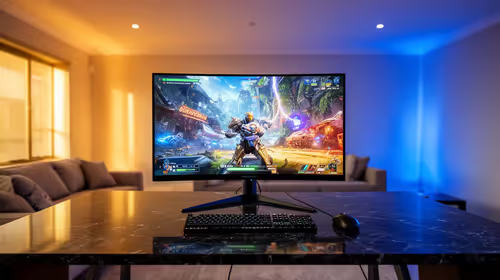
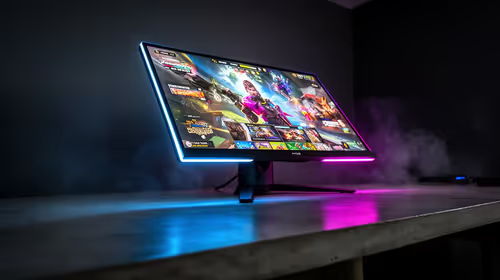
You've upgraded to a OLED gaming monitor and the low FPS you hoped to leave behind is still there. The good news for SA gamers: this is nearly always free to fix, and the steps below pin the cause fast.
Quick Answer
On this build, low FPS after an upgrade points to a config gap - an old display cable forcing a low refresh, V-Sync locking you to 60fps, or in-game settings still on a previous preset. Each is a free fix worth tens of frames. For South African buyers that matters: it tells you whether you actually need to budget for new parts or just spend ten minutes in the right menus.
Find the Real Cause of Low Fps
Confirm the OLED gaming monitor is actually doing the work: in the game's GPU/CPU overlay, check which part is at 95-100% load. If neither is, a power plan or frame cap is throttling you. If the GPU sits idle while frames stay low, the wrong GPU is selected or Resizable BAR is off. Each is a free fix worth real frames.
The OLED gaming monitor Checklist for Smooth Play
OLED panels have near-instant pixel response (~0.03ms), so any lag you feel is upstream - in V-Sync, frame caps, or HDR processing. Turn off any extra processing or overlay; OLED is fast enough that software in the path is the only thing adding delay. Use a DisplayPort 2.1 or certified HDMI 2.1 cable; HDR plus high refresh needs the bandwidth or the panel drops modes. As a yardstick, run the OLED at its native refresh (often 240Hz) and cap frames a few below it so VRR stays in its working window, so use that as your pass/fail line rather than chasing a perfect number.
What's Worth Buying Locally
After two or three controlled tests you'll see the pattern. If the low FPS clears with settings, you've saved the cost of a part - the fix was free. If it only improves with a hardware change, that's your signal to upgrade the one component the test exposed, not the whole rig. For South African buyers that means matching spend to a proven bottleneck: a sub-R2,000 cable or peripheral, a R3,000-R6,000 NVMe drive, or a larger oled gaming monitors purchase only when the numbers justify it.
FAQ
How do I know if it's a network problem causing low FPS?
Run a wired Ethernet test against your Wi-Fi: if the cable removes the issue, it was the wireless link. Watch ping and packet loss during play - under 30ms ping and well under 1% loss is the target for online gaming.
Do I need to buy new parts to fix low FPS?
Rarely. The large majority of cases are settings, drivers, or storage placement - all free. Spend money only once a clean test still falls short, and then buy the one part the test pointed to rather than a full rebuild.
Is it worth booking the build in at Evetech for low FPS?
Only after the free checks. If a clean driver install, verified memory profile and correct sync settings all fail, a workshop test can confirm a faulty part - but most low FPS clears up at the settings stage.
anything, run the baseline test above. Note down which single change fixed the low FPS so you can re-apply it after the next driver or Windows update. Only browse new OLED Gaming Monitors at Evetech if a clean, fully-tuned setup still falls short.