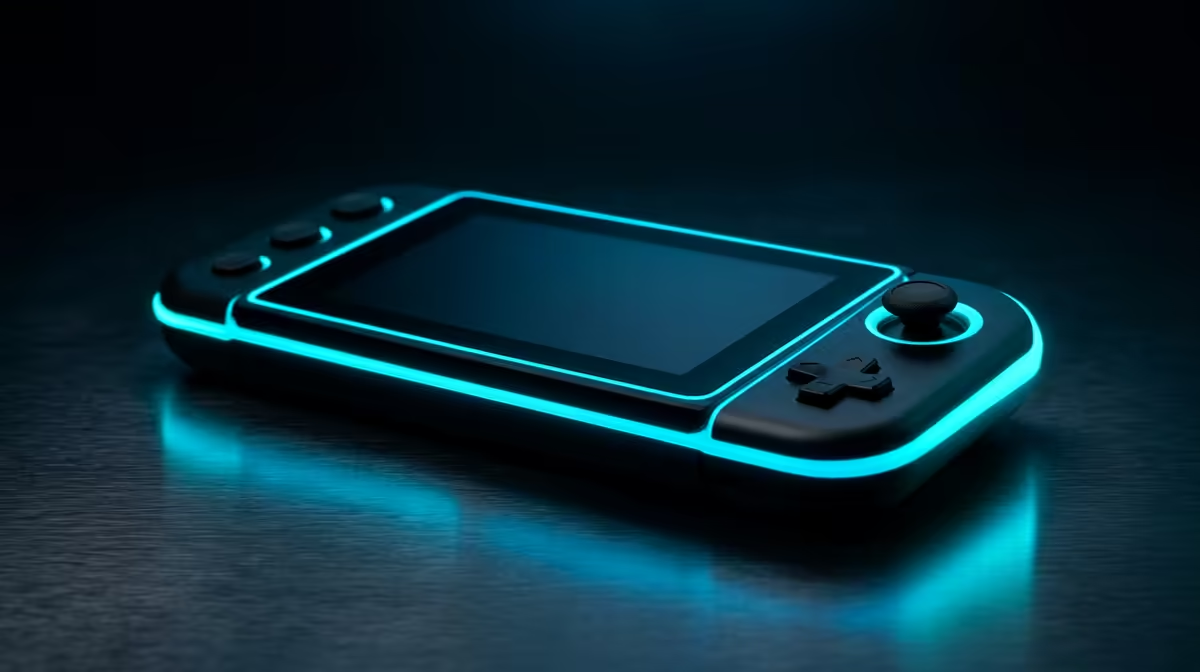
For entry-level upgraders, a handheld gaming PC sits between a phone and a full rig, and the sweet spot depends on the games you actually play.
Quick Answer
Buy the balanced tier near R13,000 now rather than the cheapest unit: the extra RAM (16GB vs 8GB) and a faster APU add years of usable life and 10 to 20 fps in modern games. A premium R18,000-plus handheld only pays off if you push 1080p output to a TV.
Match the tier to your library
For entry-level upgraders, the games decide the tier. Esports and indies (Valorant, CS2, Hollow Knight) run at a smooth 60 fps even on R8,000 units. Modern AAA open-world games need the balanced tier near R13,000 to hold 40 to 50 fps at 720p with upscaling, and even then you tune settings.
Battery, TDP and the wall
Handheld runtime swings with the power draw: at a 25W TDP a demanding game drains a 50Wh battery in about 90 minutes, while a capped 12W esports session can stretch past 3 hours. For travel, pack a 65W USB-C PD power bank so you are not hunting for a plug on a long trip.
Storage and the microSD trap
Games are huge now, so 512GB fills fast. A balanced handheld with 1TB plus a fast UHS-II microSD (R400 to R900 for 256GB to 512GB) keeps a real library on hand. Slow cards bottleneck load times, so check the read speed, not just the capacity.
FAQ
Is the balanced tier worth the extra spend?
Usually yes. Around R13,000 you get 16GB RAM and a faster APU that adds 10 to 20 fps in modern games and years of usable life over an 8GB entry unit.
How long does the battery last while gaming?
At a 25W TDP a demanding game runs about 90 minutes; capped to 12W for esports it can pass 3 hours. A 65W USB-C power bank keeps you going on long trips.
Can a handheld replace my gaming laptop?
For portable play, often yes. For high-refresh 1080p or heavy multitasking it cannot match a laptop, but docked to a TV it covers casual big-screen sessions.
Compare handheld gaming PCs stocked at Evetech by RAM and APU, and pair a 1TB unit with a fast UHS-II microSD so your library travels with you.