


550W PSU Planning for RTX 5080 Super Builds in SA
550W for RTX 5080 Super needs a full-build check, not a simple yes. Review GPU guidance, CPU draw, transient load, connectors, PSU quality, and upgrade plans before deciding.
Read moreA 120Hz portable monitor supports mobile gaming when the source, connection and game can deliver the matching output. At R2,499, its 120Hz and 14ms response sit on an 18.5in 1920x1080 IPS panel.
Mobile gaming becomes a display-chain problem as soon as an external screen is added. A 120Hz portable monitor for mobile gaming helps only when the handset or compact gaming source, connection, power arrangement and game all sustain a compatible output.
The monitor supports mobile gaming with Full HD 120Hz motion, a 14ms response specification, glare reduction and a 2.79-pound travel-ready build.
UPERFECT asks R2,499 for a 120Hz, 1920x1080 IPS panel carrying a 14ms response figure. It can support mobile gaming when the exact source and cable deliver that mode, but broad phone, handheld or console compatibility cannot be assumed.
Read the device's external-display support for the exact model and port. A USB-C connector may handle charging or data without sending video, while wireless casting would be a different route with its own behaviour.
Check the output resolutions and refresh rates the source exposes. If it cannot send Full HD at 120Hz, the screen's refresh capability will not create those frames.
Some games or operating environments may limit external output independently of the hardware. Test the intended title rather than extending one successful application result to all games.
After documenting device requirements, compare possible screens within Evetech's portable monitor selection.
Confirm the monitor input on the exact unit, select a cable proven for external-display video and avoid unnecessary adapter chains. Physical connector fit alone is not a compatibility result.
Map power separately. Mobile devices can have limited power budgets, and a display connection should not be assumed to charge the source or run the screen from one lead.
Secure the cable so player movement does not place force on either socket. Recheck detection after sleep, reconnection and a normal gaming session.
First establish a stable 1920x1080 image. Select 120Hz only when the entire route supports it, then confirm the chosen mode in the operating system or game.
Use a familiar camera pan, menu and control sequence. The 14ms response value describes pixel transition behaviour, while controller-to-screen delay involves other stages. Do not merge them into one speed claim.
Track game frame delivery separately from monitor refresh. A panel capable of 120 updates each second cannot guarantee the source produces 120 distinct frames.
An 18.5-inch diagonal provides a larger viewing area than many mobile-device screens, but exact body size, weight and bag fit still need confirmation. Add screen support, cables, power and protection to the carry test.
The anti-glare surface and 178-degree viewing specification may help flexible placement. Test reflections and posture at the table used for play rather than assuming broad angle or outdoor suitability.
After proving its purpose, choose any required stand, lead or protection from the Evetech monitor accessory range. The setup passes when the game mode, physical stability and packing routine all remain acceptable.
Repeat the game trial after the mobile source has been running for a normal session. Power behaviour, thermal limits or software changes can alter frame delivery later than the first menu test. Record the time and source state so any decline is not assigned automatically to the panel.
Use the same game checkpoint during each run. A repeatable route makes changing frame complexity easier to recognise and keeps the observation tied to real play.
Archive the source mode beside that checkpoint result.
NxtLED is designed to remove ghosting, blurring and trailing during fast scenes, while Omni Visible keeps the action readable in changing South African light. The source device still needs a compatible video connection and enough performance to deliver the intended refresh. The included case protects the 18.5-inch panel between sessions, and the slim bezel maximises useful game area without turning the setup into a fixed desktop monitor.
Save a 60Hz comparison beside the preferred 120Hz mode. The paired result shows whether the mobile game and source actually expose the higher refresh advantage during ordinary play.
The 14ms response remains a separate motion constraint.
No. The exact handset port and software must support compatible external video before a wired monitor route is possible.
Source output, cable capability, selected mode and game frame delivery can each prevent the panel from receiving useful updates.
No. It concerns pixel response, while input, processing, frame creation and connection behaviour add other stages.
Pack the entire screen, support, signal, power and protection kit, then rehearse setup on the smallest expected surface.
Ready to prove the mobile gaming chain before chasing refresh numbers? Check the exact source, then compare portable monitors and route-specific accessories through Evetech.
No. The exact handset port and software must support compatible external video before a wired monitor route is possible.
Source output, cable capability, selected mode and game frame delivery can each prevent the panel from receiving useful updates.
No. It concerns pixel response, while input, processing, frame creation and connection behaviour add other stages.
Pack the entire screen, support, signal, power and protection kit, then rehearse setup on the smallest expected surface.
550W for RTX 5080 Super needs a full-build check, not a simple yes. Review GPU guidance, CPU draw, transient load, connectors, PSU quality, and upgrade plans before deciding.
Read more
8000Hz polling is overrated for most SA gamers because gains can be tiny next to battery drain and monitor limits. Mbombela players should weigh mouse feel, game support, and system stability before chasing the number.
Read more
Magnetic switches are taking over SA gaming keyboards because actuation can be tuned. For Sandton gamers, rapid trigger, reset control, and profile depth can help, but layout, key feel, and software quality still matter.
Read more
Polokwane oled monitor value questions need cautious SA context because pricing can move with availability, exchange rates, specs, and warranty support. Treat the trend as a planning signal, not a fixed price promise.
Read more
Arc B580 budget builds for Midrand gamers can shift with exchange rates, supply, specs, and model tier. Treat the title as a buying prompt, then compare SA warranty, timing, and build priorities.
Read more
ROG Ally X may beat the LCD Steam Deck for SA gamers who value stronger handheld performance, more memory, and Windows flexibility. Compare battery life, controls, game libraries, and Polokwane support needs before deciding.
Read more
Minisforum's M2 Pro pairs Core Ultra X7, Arc B390 graphics and 32GB onboard memory in 1.8 litres. SA buyers should weigh its fixed memory and $1,439 launch offer against local mini PCs.

Lenovo says Legion Go failures linked to BIOS N3CN42WW are not user error. Affected SA owners should stop retrying the update, preserve proof and open a support case.

Smart monitors can add apps and convenience, but they also add privacy settings and unwanted-software risk. SA buyers should audit the operating system before paying for extras.

A fake 113GB GTA VI ISO reportedly used empty padding around a small malware payload. SA gamers should delete unofficial builds, keep Windows security active and wait for official channels.
ASUS calls the ROG GT-BN98 the first Wi-Fi 8 gaming router. SA buyers should fix coverage and client limits before paying for a future wireless standard.
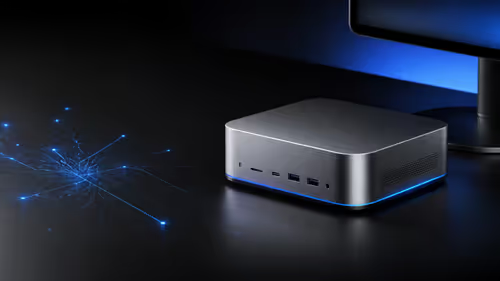
Apple's M6 Mac mini adds faster AI, graphics and networking in the same compact format. SA buyers should wait for a rand listing before comparing value.
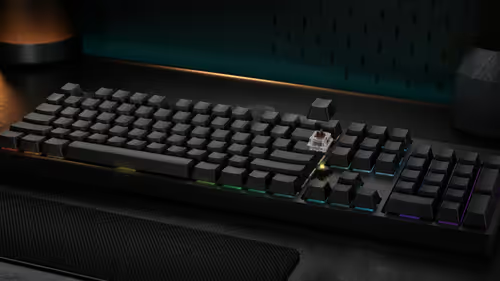
The Vulcan II XP adds hot-swappable switches, sound damping and gaming controls to a full-size wired board. SA buyers should compare feel before features.

Microsoft says Windows on Arm now has over 7,000 verified apps and games. SA buyers should still check each driver, game and work tool before switching.

Xbox Insiders can test disc-to-digital from 31 August 2026. Supported Xbox One and Series X discs gain a digital entitlement, but older discs, regions and title coverage still need exact checks.
ViewSonic's XG2738 pairs QHD QD-OLED with 240Hz and automatic panel care. SA buyers should compare warranty, brightness, ports and burn-in protection against today's R9,999-plus OLED shelf.

NVIDIA's final Windows 10 Game Ready driver is due in October 2026. SA gamers can keep using their GPU, but new game optimisations move on while critical security fixes continue quarterly.

JBL's new Quantum 520, 520X and 120 headsets cover wireless, Xbox-certified and wired use. SA buyers should compare connection, comfort and microphone needs before paying for a new badge.