Quick Answer
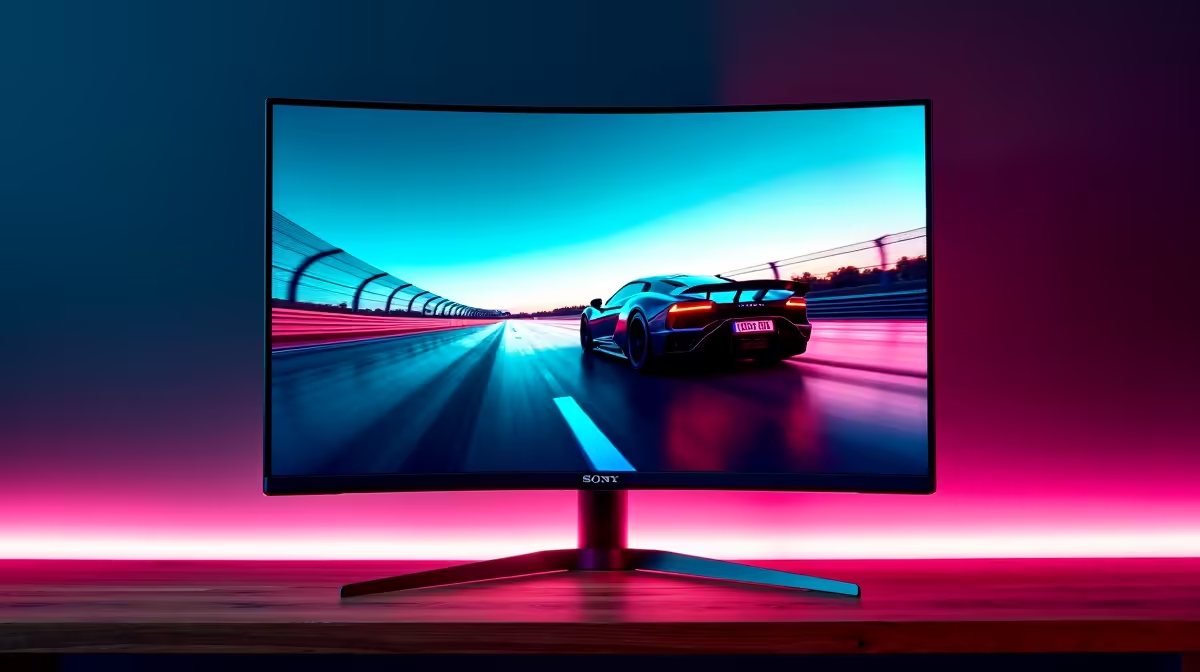
A 0.5ms grey-to-grey response time on a Fast-VA panel drastically reduces pixel transition blur versus traditional VA panels, which measured 4 to 8 ms GtG. At 0.5ms, ghosting and coronas behind moving objects are largely eliminated, placing Fast-VA into the same motion clarity tier as competitive IPS displays while retaining VA's deeper blacks.
Traditional VA vs Fast-VA: The Transition Speed Gap 🖥️
Classic VA panels were notorious for slow dark-to-mid-grey pixel transitions, creating visible ghost trails behind fast-moving characters or cursor movement. Fast-VA overcomes this through overdrive circuitry and improved liquid crystal formulations, achieving 0.5ms GtG. The result: a 165 Hz or 250 Hz Fast-VA monitor fully redraws each pixel before the next frame arrives, eliminating trailing artefacts. At 250 Hz with 4 ms between frames, a 0.5ms transition leaves 3.5 ms of clear display time per frame versus barely any headroom on a legacy 6 ms VA panel.
Overdrive and Inverse Ghosting Risk ⚙️
Fast-VA panels achieve 0.5ms by pushing overdrive voltage aggressively. However, overdrive can overshoot: pixels transition so quickly they exceed target luminance and then correct back, creating a bright halo in front of moving objects. Quality Fast-VA implementations offer multiple overdrive presets in the OSD. A moderate setting typically delivers 1 to 2 ms GtG with no inverse ghosting, while the maximum 0.5ms mode may produce faint halos in dark game scenes. SA gamers who play fast shooters at high refresh rates often settle on Normal or Fast overdrive rather than the maximum setting.
Real-World Impact in Competitive and Immersive Titles 🎮
A 0.5ms Fast-VA monitor at 165 Hz produces motion clarity competitive with most IPS panels at the same refresh rate, while delivering contrast ratios of 3,000:1 to 5,000:1 versus IPS at around 1,000:1. For SA gamers playing darker titles like horror, stealth shooters, or space sims, the deeper blacks on Fast-VA are a significant visual upgrade. In bright competitive titles like Valorant, the motion clarity gap between Fast-VA at 0.5ms and IPS at 1 ms is difficult to perceive in normal play. Fast-VA options typically offer better value in South Africa, with 34-inch WQHD curved models available from around R7,000 to R11,000 at Evetech.
Test Overdrive Modes Before Your Session ⚡
When setting up a Fast-VA monitor, open the OSD and cycle through overdrive settings while watching a fast-scrolling image. Find the highest setting that shows no inverse ghosting on content you play most. This one-time calibration step dramatically improves daily motion clarity.
FAQ
Is 0.5ms on Fast-VA equivalent to 0.5ms on IPS?
Both deliver excellent motion clarity at high refresh rates, though overdrive profiles differ. Fast-VA has the edge in contrast and black depth; IPS generally has more consistent colour across wider viewing angles.
Does response time matter for SA gamers on local servers?
Yes, particularly in competitive titles at 165 Hz or higher. SA players on African nodes experience round-trip latency of 20 to 60 ms, so eliminating display-side latency is one of the few factors directly in your control.
Can Fast-VA be used for colour-accurate creative work?
Modern Fast-VA panels typically cover 95% sRGB or more and some reach 90% DCI-P3. For casual photo editing and content review they are adequate, though professional colourists prefer factory-calibrated IPS or OLED.
Want motion clarity without sacrificing contrast?
Browse Evetech's gaming monitor range and filter by panel type to find Fast-VA options delivering 0.5ms response and deep blacks for immersive and competitive play.