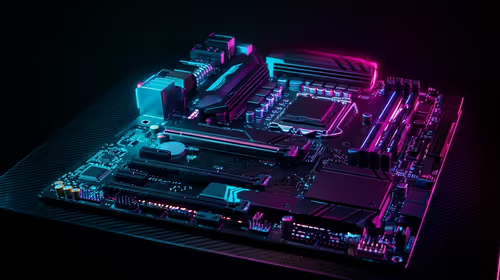
Leaving room for an AMD X3D chip later is a smart way to stretch a build, but only if today's motherboard, power supply and cooler can actually accept one. The mistake SA buyers make is spending the headroom on the wrong part now and then needing a full platform swap anyway.
Quick Answer
To drop in a Ryzen 7 9800X3D or Ryzen 9 9950X3D later, buy an AM5 board (B650 or X670) with a BIOS that supports the chip, a 650W to 850W 80+ Gold PSU, and a cooler rated for at least 120W. On a R8,000 starting build, the cheapest path is a current Ryzen plus a quality AM5 board, leaving the X3D as a clean drop-in upgrade.
The Socket And BIOS Decide Whether The Upgrade Is Even Possible
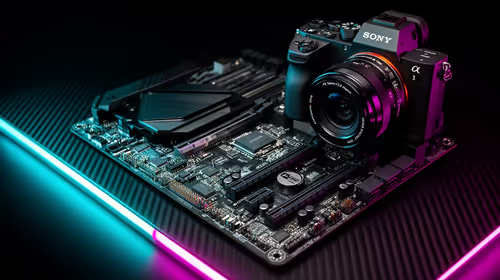
AM5 is the platform that matters: it carries Ryzen 7000, 8000 and 9000 chips including the 9800X3D and 9950X3D, so a B650 or X670 board bought today should accept the X3D part after a BIOS update. Avoid spending the headroom on an AM4 bargain, because that socket caps out at the 5800X3D and forces a board, RAM and CPU swap together. Check the board's CPU support list at Evetech before buying, since a cheap B650 still saves you from a full rebuild.
Power And Cooling Headroom Costs Less Than You Think
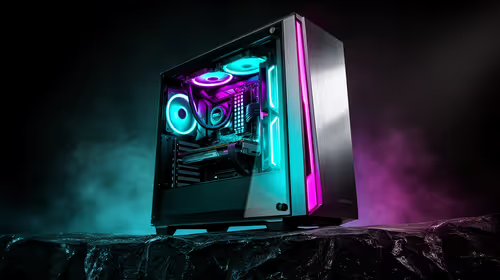
A 9800X3D draws around 120W under gaming load and a 9950X3D peaks near 200W package power, so a 750W 80+ Gold PSU and a 240mm AIO or a strong tower cooler like a Deepcool AK620 cover both. Buying an 850W unit now (commonly R1,800 to R2,800 at this tier) means the PSU never becomes the reason you cannot upgrade. The X3D's stacked cache actually runs cooler than non-X3D flagships, so you are sizing for the 9950X3D's worst case, not a thermal emergency.
Spend The Headroom On The Board And RAM, Not A Placeholder CPU
DDR5-6000 CL30 is the sweet spot for AM5 gaming, and 32GB now is cheaper than buying 16GB twice. A R8,000 plan works best if the board and memory are upgrade-ready while a modest Ryzen handles today's games, then the X3D slots in when prices settle. That sequence avoids paying twice for the same socket.
FAQ
Will any AM5 board take a 9950X3D?
Most B650 and X670 boards do after a BIOS update, but always confirm on the board's CPU support list. A cheap board with weak VRMs can run a 9950X3D, though a mid-tier B650 holds clocks more reliably under sustained load.
How much PSU headroom do I need for a future X3D?
A 750W 80+ Gold unit comfortably runs a 9950X3D with a current GPU, and 850W adds margin for a future RTX upgrade. The X3D chips are efficient, so the GPU usually sets the PSU size, not the CPU.
Is it worth buying the X3D now or waiting?
If gaming is the priority and budget allows, the 9800X3D is the value pick today. If money is tight, an upgrade-ready AM5 board plus a cheaper Ryzen now lets you add the X3D once your budget recovers, with zero platform waste.
Build an X3D-ready AM5 platform at Evetech
Start with a B650 or X670 board, a 750W to 850W 80+ Gold PSU and DDR5-6000 CL30, then drop in a Ryzen 7 9800X3D or 9950X3D when you upgrade.