Quick Answer
Yes, an esports-only gaming PC is still worth building, and it is cheaper than a do-everything rig. A focused esports box with a Ryzen 7 7800X3D and an RTX 5060 Ti, around R18,000-R22,000, pushes 240-400 fps in CS2 and Valorant to feed a high-refresh panel, without paying for GPU power those games do not use.
Build for frames, not excess
Esports titles are CPU and cache bound at high refresh, so the money belongs in the CPU and a fast panel, not a flagship GPU. A Ryzen 7 7800X3D feeding an RTX 5060 Ti clears 240-400 fps in CS2 and Valorant at 1080p or 1440p, saturating a 240-360Hz monitor. A R30,000 GPU would add almost nothing in these engines.
Where the budget should go
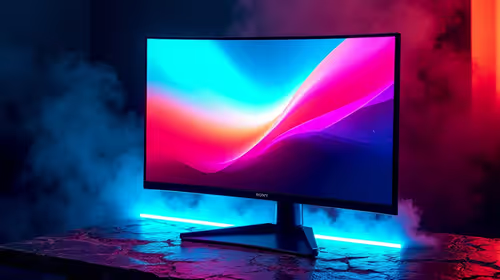
Aim roughly R6,000-R8,000 at the CPU, R7,000-R9,000 at the GPU, and reserve budget for a 240-360Hz panel and a low-latency mouse, since those affect competitive feel more than extra GPU power. Add 32GB DDR5-6000, a 1TB Gen4 SSD and a 650W Gold PSU. This focused build beats a pricier all-rounder for pure competitive play while leaving room to add a stronger GPU later if your library broadens.
FAQ
Is an esports-only gaming PC worth building?
Yes. A focused build around a Ryzen 7 7800X3D and RTX 5060 Ti (about R18,000-R22,000) pushes 240-400 fps in CS2 and Valorant, beating a pricier all-rounder for competitive play while costing less.
What fps can an esports build hit in CS2?
A 7800X3D-class CPU with a mid-range GPU clears 240-400 fps in CS2 at 1080p or 1440p, enough to saturate a 240-360Hz panel where competitive feel matters most.
Should I buy an expensive GPU for esports?
No. Competitive titles barely use a flagship GPU, so a mid-range RTX 5060 Ti is plenty. Put the saving into the CPU, a high-refresh panel and a low-latency mouse instead.
Build for frames, then add GPU later if needed
Spec a Ryzen 7 7800X3D and RTX 5060 Ti from Evetech with a 240-360Hz panel, and you get the highest competitive frame rate per rand, with room to grow the GPU if your library expands.