VRAM is the spec South African gamers most often get wrong at 1440p: too little and textures stutter, too much and you have overspent on a buffer your games never fill. Matching the buffer to 1440p and to a R20,000 budget is the practical goal.
Quick Answer
For 1440p gaming on a R20,000 budget, target 12GB to 16GB. That covers high textures and current titles without paying for capacity you will not use, and it leaves room in the budget for a faster GPU core.
How Much VRAM 1440p Actually Uses
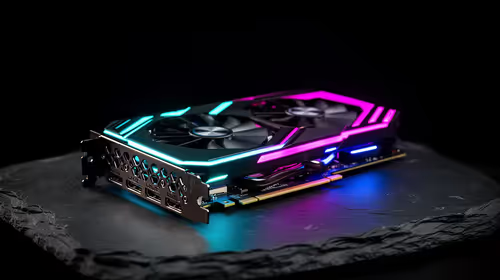
At 1440p VRAM use climbs to roughly 9GB to 13GB with high textures and effects. 12GB is the sensible floor and 16GB gives genuine headroom for heavier open-world games, so cards like the RX 9070 (16GB) or RTX 5070 (12GB) fit the resolution well.
With R20,000 to spend, do not buy VRAM in isolation. A card with a huge buffer but a weak core will still miss frame targets at 1440p. Balance the buffer against raw shading power, and prefer an NVMe SSD so texture streaming never becomes the bottleneck when the buffer fills.
Spending R20,000 Wisely at 1440p
A R20,000 budget comfortably affords a 16GB card, which is the right call for 1440p longevity. Spend the surplus on a stronger GPU core and a quality PSU rather than chasing the largest possible buffer. Evetech stocks options across these tiers with local warranty support, so you can match buffer, core and price in one place.
FAQ
How much VRAM do I need for 1440p gaming?
Target 12GB to 16GB for 1440p. That handles high textures in current titles with enough headroom to avoid the texture stutter you get when a buffer runs out mid-scene.
Is 8GB still enough at 1440p?
For 1440p, 8GB is no longer the comfortable choice; aim for 12GB to 16GB so heavier games have room to breathe.
What can a R20,000 budget get me at 1440p?
It buys a card with 12GB to 16GB plus a balanced core for 1440p, currently stocked at Evetech. Spend any surplus on a better PSU and an NVMe SSD rather than the biggest possible VRAM buffer.
VRAM for your resolution, then put leftover budget into GPU core power and an NVMe SSD. A balanced card beats a buffer you never fill.