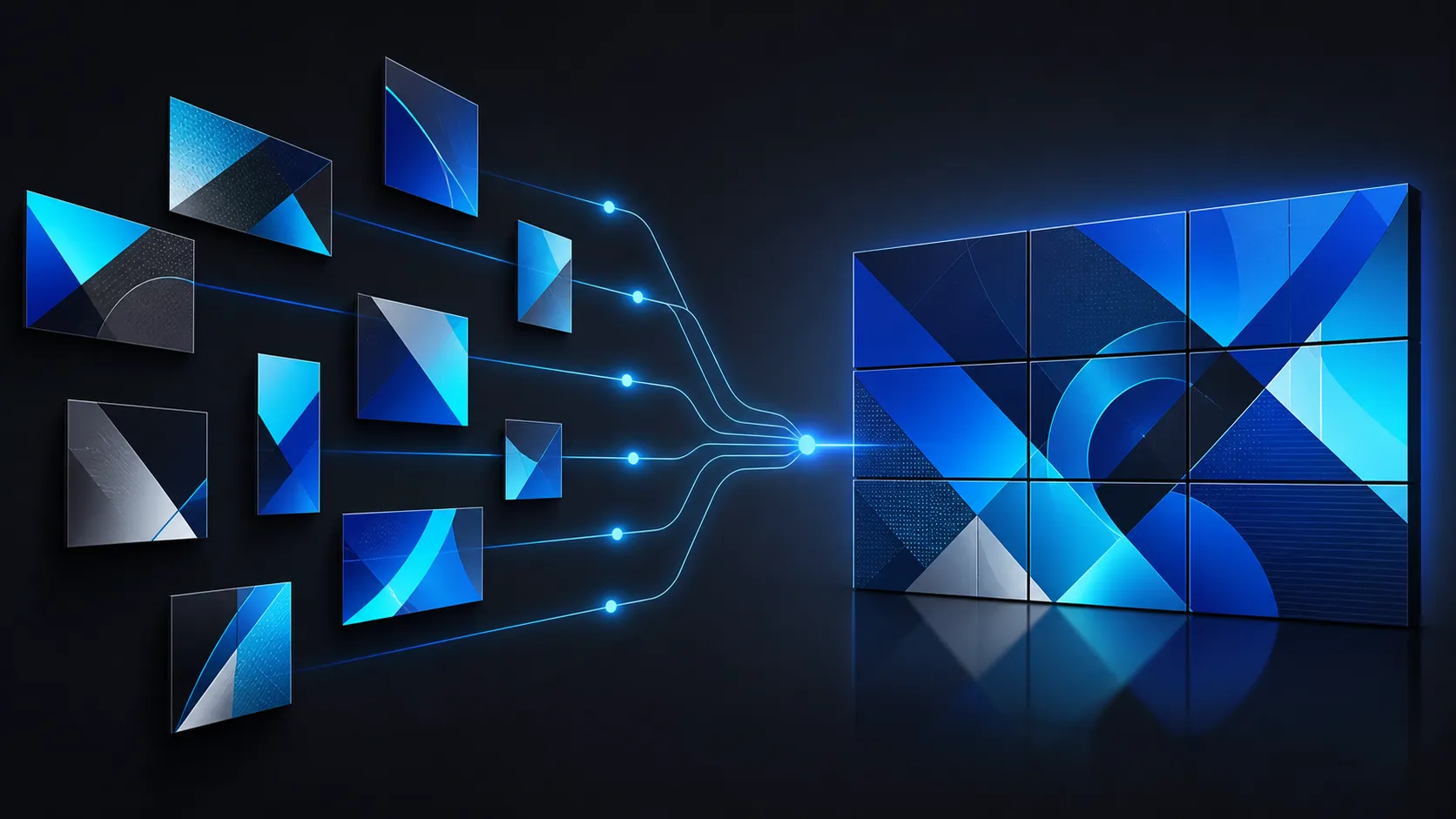
A synchronized wall begins as a content map with graphics ownership and timing roles, not as a finished grid of panels. To build a synchronized video wall in South Africa, decide how the canvas should behave, assign every output and define what a passing motion sequence looks like before ordering the system.
Quick Answer
An NVIDIA RTX PRO and Mosaic video wall can span 32 displays or projectors, with RTX PRO Sync coordinating a system of up to eight GPUs and two cards.
Map the Mosaic canvas, distribute outputs across the necessary RTX Pro GPUs and specify Genlock or Frame Lock where their coordination roles apply. The wall's R19,599 PNY sync card permits 32 synchronised displays and an eight-processor maximum for NVIDIA RTX Pro hardware.
🗺️ Draw the wall around its content
Place each screen on a scaled sketch and overlay the important content regions. Mark bezels, audience positions and the paths moving objects will take. This helps the visual team keep critical details away from awkward physical joins.
Use Evetech's PC monitor range to compare panels against the drawing. The synchronization card does not choose screen size, mounting or room geometry, so those decisions should remain visible in the build plan.
🧠 Assign outputs to professional GPUs
Give every panel group and application an owning graphics processor. With PNY RTX Pro Sync, the architecture reaches its processor boundary at eight NVIDIA RTX Pro GPUs.
Browse Evetech's workstation graphics card category after the workload allocation is complete. The wall may use fewer than eight processors; choose the smallest justified design rather than filling theoretical capacity.
🧩 Connect canvas and synchronization roles
Mosaic gives this build its arranged multi-display surface. The required reference relationship is handled by Genlock. Frame Lock maintains frame agreement among the participating GPUs. For R19,599, the PNY RTX Pro Sync card puts that toolkit into the wall.
Write a separate pass condition for each selected role. Mosaic should demonstrate the intended canvas, while the lock tests should expose the timing or cross-GPU boundaries they address. This prevents one successful visual check from standing in for the whole design.
🧪 Commission before the wall enters service
The supported display ceiling is 32 synchronised screens. Test the actual build with representative moving material and all expected content modes, observing from the audience's normal positions. Save the passing GPU-to-screen map and active functions.
Choose surrounding items through Evetech's graphics card accessories range once the architecture is stable. Cost the R19,599 synchronization component separately from monitors, processors and installation work.
Build and verify the wall in stages
Begin with a representative panel group and the processors that own its outputs. Confirm the physical canvas, run the chosen Mosaic layout and observe the relevant lock functions with simple motion. Save that configuration before adding the next group.
Carry one test sequence across both the established and new sections. The enlarged wall should reproduce the earlier result while passing the additional screen and GPU boundaries. If it fails, return to the saved stage rather than changing several layers at once.
At final handover, include the full display drawing, processor allocation, timing relationship and test material. South African location does not change the technical logic; it makes transparent Rand budgeting and local project ownership especially useful.
The card runs within Windows 10, Windows 11 or Linux installations and arrives with two internal cable lengths. Use the four 12-inch cables for shorter planned links and the pair of 24-inch leads where the chassis arrangement needs more reach. Once the physical GPU map matches the Mosaic canvas, representative moving content can prove synchronisation across every output boundary.
Frequently Asked Questions
What should lead the wall plan?
The intended content canvas and audience experience should come first, followed by output ownership and synchronization requirements.
How many RTX Pro GPUs can be synchronized?
PNY RTX Pro Sync supports up to eight participating professional GPUs in the designed system.
What is the wall's display maximum?
The card's upper boundary is 32 synchronised screens, although a project can use a smaller count.
Which feature arranges the display surface?
NVIDIA Mosaic supports the multi-screen canvas, while Genlock and Frame Lock address separate coordination roles.
What should the final wall handover contain?
Include the panel drawing, GPU-to-output allocation, timing relationship, selected Mosaic layouts and the representative sequence used for acceptance. Add the passing viewing positions and rollback state. Those items help the operating team restore the build and assess later changes without relying on memory. Name the owner of each layer and rehearse one recovery step before the installation is handed over. Store the final pack where the people supporting the wall can reach it during a fault.
Confirm that access during the handover exercise.
Ready to turn a South African wall concept into a tested build?
Use Evetech's professional graphics, monitor and accessory categories after the canvas, GPU map and commissioning sequence are approved.