


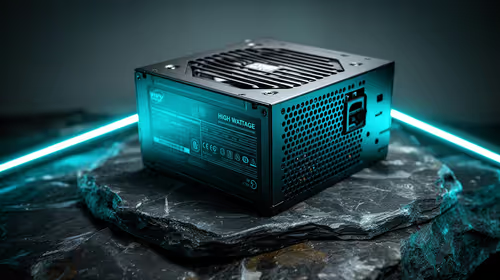
550W PSU Planning for RTX 5080 Super Builds in SA
550W for RTX 5080 Super needs a full-build check, not a simple yes. Review GPU guidance, CPU draw, transient load, connectors, PSU quality, and upgrade plans before deciding.
Read moreChoose a compact workstation GPU by checking dimensions, power and connector fit before performance evidence. The R12,099 A1000 brings 8GB GDDR6 and 2304 CUDA cores on Ampere architecture; confirm its 128-bit memory design and physical fit separately.

Compactness is a physical claim, not a performance category. A card can look modest in a photograph and still conflict with a case, adjacent slot, power connection or airflow plan. Choosing a compact workstation GPU begins with measured space and exact card dimensions, then moves to application testing once the component can actually be installed.
The RTX A1000 is explicitly compact: a low-profile, single-slot PCI Express 4.0 x8 card with only 50W maximum board power.
Measure the chassis, slot area and connector access before deciding that a workstation card is compact. The A1000 costs R12,099 and can be assessed for workload fit through its 8GB GDDR6 capacity and 2304 CUDA cores. Ampere identifies the GPU design; 128-bit describes its memory path. Physical details still need exact confirmation.
Record the usable card length, height and slot area inside the workstation. Include cables, nearby expansion cards and the route used by cooling air. A nominal case category cannot replace these measurements because internal layouts differ.
Next obtain the exact GPU dimensions and connector positions from the current product documentation. Do not assume that the RTX A1000 is compact from its name or resource count. Physical compatibility must be established before performance becomes relevant.
Power capacity, connector type and available leads belong on the fit sheet. The motherboard slot, system firmware and case arrangement also need to suit the chosen card. Keep these checks factual and model-specific; a CUDA count says nothing about them.
Evetech's workstation graphics card selection lets buyers identify candidates, but each physical drawing still needs verification. If a full platform is being reconsidered for modern AI-assisted tools, the AI PC category lets buyers compare complete systems instead of forcing a component into the wrong chassis.
After fit is established, return to the application. Use the same CAD file, render scene or editing project that prompted the upgrade. Confirm software support, required memory and the operation expected to use GPU compute.
The A1000 uses 8GB GDDR6 over a 128-bit interface, plus 2304 CUDA cores on Ampere. R12,099 is the price of that resource set. None of those figures proves that it fits the case or meets a particular performance target, so keep the physical and workload decisions on separate lines.
A tight enclosure can make airflow planning more important, but no temperature or noise result can be inferred without the actual card and chassis data. Follow the case and card installation guidance, maintain clear airflow paths and observe the finished system under a repeatable workload.
If the physical checks and software test both pass, the card can stay on the shortlist. If either fails, use the result to refine the next candidate rather than lowering the workstation's required deliverable. The cheapest mistake is the one rejected on paper.
Before the card arrives, sketch the removal and installation sequence. Identify which panel opens, which cables move and whether another expansion card blocks access. Confirm the workstation can be powered down for the required maintenance window.
A rehearsal can reveal that the nominal clearance is difficult to use once connectors and hands need space. It also helps the team prepare the current driver and application settings for a clean before-and-after test. Physical planning protects both fit and the quality of the performance evidence.
Photograph the empty slot area with a ruler visible before closing the chassis. This creates a practical reference for connector access and future replacements without relying on remembered clearance.
Compactness does not remove the professional resource set. Inside that narrow board are 2,304 CUDA cores, 18 RT units and 72 Tensor units. They work beside 8GB GDDR6 delivering 192GB/sec. Four Mini DisplayPort 1.4a connectors can support as many as four 5K screens. Chassis clearance and cable access still belong to the buyer's own build, but the A1000's dimensions class, slot use, power and output density are known.
Use exact card dimensions, available case clearance, slot space, cable access and the surrounding components. A marketing category is not a measurement.
No. The A1000's 2304 CUDA cores describe compute resources and do not reveal dimensions, cooling design or power connections.
The comparison starts at R12,099. Memory is 8GB GDDR6 over 128 bits, while Ampere contains 2304 CUDA cores.
Keep the workload requirement unchanged, verify application support and test a representative project after confirming physical and power compatibility.
Ready to measure before choosing a smaller workstation card? Compare Evetech GPU candidates with your case drawing, connector plan and real professional workload open beside the shortlist.
Use exact card dimensions, available case clearance, slot space, cable access and the surrounding components. A marketing category is not a measurement.
No. The A1000's 2304 CUDA cores describe compute resources and do not reveal dimensions, cooling design or power connections.
The comparison starts at R12,099. Memory is 8GB GDDR6 over 128 bits, while Ampere contains 2304 CUDA cores.
Keep the workload requirement unchanged, verify application support and test a representative project after confirming physical and power compatibility.
550W for RTX 5080 Super needs a full-build check, not a simple yes. Review GPU guidance, CPU draw, transient load, connectors, PSU quality, and upgrade plans before deciding.
Read more
8000Hz polling is overrated for most SA gamers because gains can be tiny next to battery drain and monitor limits. Mbombela players should weigh mouse feel, game support, and system stability before chasing the number.
Read more
Magnetic switches are taking over SA gaming keyboards because actuation can be tuned. For Sandton gamers, rapid trigger, reset control, and profile depth can help, but layout, key feel, and software quality still matter.
Read more
Polokwane oled monitor value questions need cautious SA context because pricing can move with availability, exchange rates, specs, and warranty support. Treat the trend as a planning signal, not a fixed price promise.
Read more
Arc B580 budget builds for Midrand gamers can shift with exchange rates, supply, specs, and model tier. Treat the title as a buying prompt, then compare SA warranty, timing, and build priorities.
Read more
ROG Ally X may beat the LCD Steam Deck for SA gamers who value stronger handheld performance, more memory, and Windows flexibility. Compare battery life, controls, game libraries, and Polokwane support needs before deciding.
Read more
Minisforum's M2 Pro pairs Core Ultra X7, Arc B390 graphics and 32GB onboard memory in 1.8 litres. SA buyers should weigh its fixed memory and $1,439 launch offer against local mini PCs.

Lenovo says Legion Go failures linked to BIOS N3CN42WW are not user error. Affected SA owners should stop retrying the update, preserve proof and open a support case.

Smart monitors can add apps and convenience, but they also add privacy settings and unwanted-software risk. SA buyers should audit the operating system before paying for extras.

A fake 113GB GTA VI ISO reportedly used empty padding around a small malware payload. SA gamers should delete unofficial builds, keep Windows security active and wait for official channels.
ASUS calls the ROG GT-BN98 the first Wi-Fi 8 gaming router. SA buyers should fix coverage and client limits before paying for a future wireless standard.
Apple's M6 Mac mini adds faster AI, graphics and networking in the same compact format. SA buyers should wait for a rand listing before comparing value.
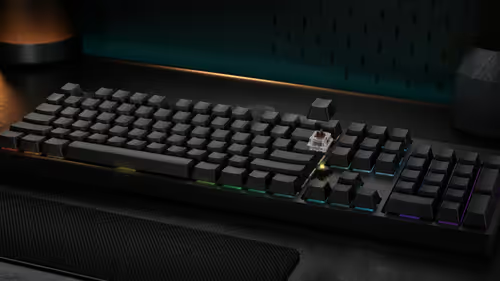
The Vulcan II XP adds hot-swappable switches, sound damping and gaming controls to a full-size wired board. SA buyers should compare feel before features.

Microsoft says Windows on Arm now has over 7,000 verified apps and games. SA buyers should still check each driver, game and work tool before switching.

Xbox Insiders can test disc-to-digital from 31 August 2026. Supported Xbox One and Series X discs gain a digital entitlement, but older discs, regions and title coverage still need exact checks.
ViewSonic's XG2738 pairs QHD QD-OLED with 240Hz and automatic panel care. SA buyers should compare warranty, brightness, ports and burn-in protection against today's R9,999-plus OLED shelf.

NVIDIA's final Windows 10 Game Ready driver is due in October 2026. SA gamers can keep using their GPU, but new game optimisations move on while critical security fixes continue quarterly.

JBL's new Quantum 520, 520X and 120 headsets cover wireless, Xbox-certified and wired use. SA buyers should compare connection, comfort and microphone needs before paying for a new badge.