Quick Answer
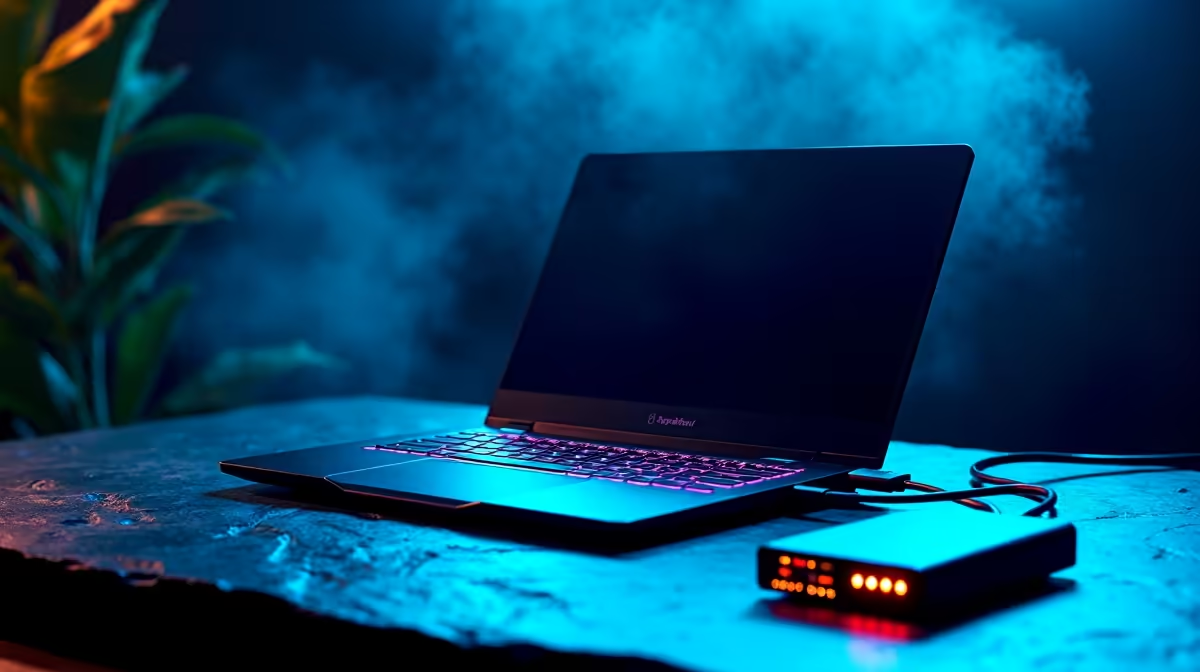
Connecting an MSI Katana laptop to a UPS is straightforward because the laptop's own battery already provides seamless protection from an unexpected outage. The UPS primarily protects the charger brick and upstream power, and can extend total battery-backed runtime significantly. This guide walks through the correct setup for SA conditions.
Why the MSI Katana Benefits from UPS Protection
The MSI Katana series is a popular mid-range gaming laptop in South Africa, known for delivering solid performance from its Intel Core H-series or AMD Ryzen H-series CPU and NVIDIA RTX mobile GPU at a price point that fits many SA gaming budgets. While the laptop's built-in battery is the primary an unexpected outage safeguard, connecting the charger to a UPS adds a second layer of protection and meaningful advantages. Without a UPS, when Eskom kills power, the Katana instantly switches to its internal battery. This works well if the battery is healthy and fully charged. However, if the battery is partially discharged or degraded from age, you may get less runtime than expected during a prolonged Stage 4 or Stage 6 shedding block. A UPS connected to the charger keeps the charger supplying power to the laptop for the duration of the UPS battery runtime, effectively adding 30-90 minutes depending on UPS size and charger draw. Additionally, voltage spikes on power restoration can damage laptop charger bricks over time. A line-interactive UPS regulates incoming voltage continuously, which protects the charger and by extension the laptop's charging circuitry.
Choosing the Right UPS for the MSI Katana
The MSI Katana's charger is typically a 180W to 230W unit depending on the configuration. A 600VA to 900VA line-interactive UPS is more than adequate for running just the charger. If a UPS is required, size it for a controlled shutdown against the measured load of the complete protected setup. For a full desk setup including the Katana charger, a monitor, and a router, step up to a 1000VA to 1500VA UPS. This covers the combined load of roughly 250-350W and keeps your entire gaming station running through shorter shedding blocks while providing clean power throughout. In South Africa, entry-level line-interactive UPS units suitable for this purpose are available from around R1,800 to R3,500 depending on VA rating. This is a worthwhile investment when you consider that replacing an MSI Katana charger costs R600 to R1,200, and the laptop itself represents a significant purchase, typically starting around R12,000 to R18,000 for current Katana models.
Step-by-Step Setup: Connecting the MSI Katana to a UPS
Setup is simple and requires no technical expertise. Start by placing your UPS near your gaming desk with clear ventilation on all sides. UPS units generate heat during charging and discharge cycles, and blocked ventilation shortens battery life. Plug the UPS power cord into a wall socket directly. Do not plug a UPS into a surge protector strip or extension cord, as this can interfere with proper grounding and may cause the UPS to behave erratically during an unexpected outage switchovers. Next, plug the MSI Katana's charger brick into one of the UPS battery-backed output sockets. Most line-interactive UPS units have clearly labelled battery-backed outputs versus surge-only outputs. Use the battery-backed outputs for everything you want powered through shedding. If you are also protecting a monitor and router, plug those into additional battery-backed outputs on the UPS. Power on the UPS according to its manual, typically by pressing and holding the power button for 2-3 seconds. The UPS will display mains status and battery level. Test the setup by unplugging the UPS from the wall while everything is running. Your Katana, monitor, and router should continue operating without interruption. Note how long the UPS sustains the load, as this gives you a real-world runtime figure for your specific setup.
Maintaining UPS and Laptop Battery Health in SA Conditions
An unexpected outage accelerates UPS battery degradation because frequent discharge and recharge cycles reduce battery capacity over time. Most UPS lead-acid batteries last 2-4 years under normal SA conditions with regular an unexpected outage. Budget for replacement batteries every 2-3 years to maintain reliable protection. For the MSI Katana's internal battery, avoid leaving it plugged in at 100% charge for extended periods when an unexpected outage is not expected. Most modern laptop firmware includes battery care modes that cap charging at 80-90% to reduce long-term degradation. Enable this in MSI Center software under the battery settings section. This extends battery health over the laptop's lifespan, keeping it effective as your primary an unexpected outage buffer. If the Katana's internal battery holds less than 70% of its original capacity, consider having it replaced. A degraded battery reduces your an unexpected outage protection window and may struggle to support the GPU-heavy loads typical of gaming, even on battery-backed power.
Frequently Asked Questions
Does plugging the MSI Katana into a UPS improve gaming performance?
No, it does not directly improve performance. A UPS provides stable, protected power to the charger, which then charges the laptop normally. The performance benefit is indirect: consistent power delivery keeps the charger working optimally, and a fully charged battery is available as a buffer during power events.
Can I use any UPS with the MSI Katana?
Any quality line-interactive UPS with battery-backed output sockets and sufficient VA rating works with the MSI Katana charger. Avoid very cheap standby UPS units with long transfer times if you are also protecting a desktop monitor in the same setup. For just the laptop charger, a 600VA+ unit from a reputable brand is sufficient.
What power protection should this setup use?
This depends on the UPS battery capacity and the load. A 900VA UPS powering only a 200W Katana charger provides roughly 20-40 minutes of runtime. If the laptop's internal battery is also healthy and was fully charged before the shedding event, total available gaming time can extend well beyond a typical 2.5-hour Stage 2 shedding block.
How should battery life factor into this choice?
If your UPS and laptop battery together provide sufficient runtime, you can continue gaming through shorter shedding events. Other local retailers may also carry similar options. Always prioritise a clean shutdown over letting the battery fully deplete.