


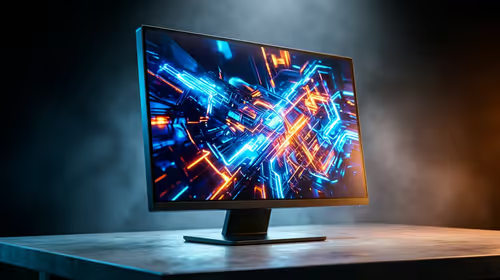
OLED monitors Context for SA PC Builders — Updated 2026
OLED monitors talk for Randburg buyers should be treated as market context, not a live claim. Compare demand, specs, warranty, platform fit, and total build value.
Read morePrebuilt Or Custom Gaming Pc on a R20,000 SA budget is a trade-off call, not a default answer. Compare parts balance, warranty support, build time, upgrade room, and total setup cost before choosing the better route for your SA buyers.
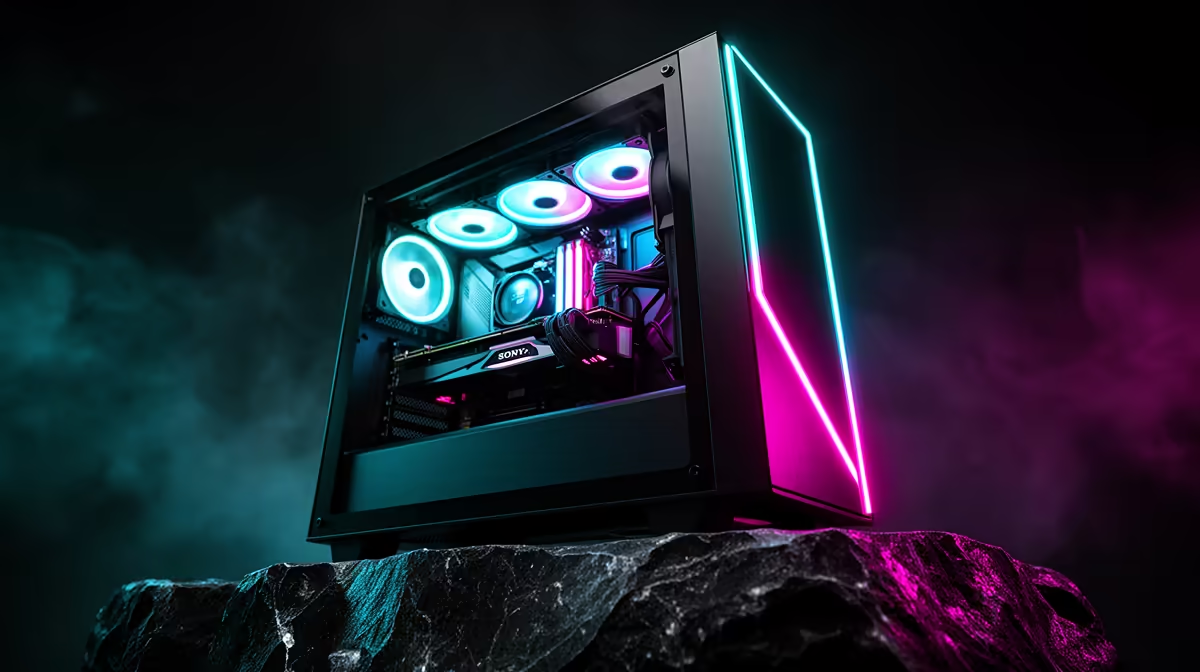
On R20,000, custom usually wins for gaming value if you want to choose the GPU, PSU, and case airflow; prebuilt wins when support speed matters more. Target Ryzen 5 7600 or Core i5-14400F, 16GB to 32GB DDR5, 1TB NVMe, and RTX 4060 or RX 7600 class graphics. That tier should aim at 1080p High 90 to 144 fps in esports and 60 fps in many story games.
A prebuilt is cleaner when the buyer wants one invoice, one support route, and less risk around BIOS setup, Windows install, and cable checks. It is also useful for parents buying a school-and-gaming machine because the PC arrives as a finished unit. The weak point is that you must check the exact GPU, PSU wattage, RAM channel count, and SSD size before paying.
Custom makes sense when the R20,000 must deliver the best gaming part mix. You can choose a better airflow case, a known 80 Plus PSU, and the GPU that matches the monitor. Avoid spending too much on RGB while leaving only 8GB RAM or a tiny SSD; 16GB RAM and 500GB to 1TB NVMe storage should be the floor.
For Cape Town, Joburg, Durban, and smaller towns, support logistics matter. If you are comfortable checking cables, drivers, and BIOS updates, custom gives more control. If the PC is for a first-time gamer, prebuilt reduces setup work and still leaves room for later RAM or SSD upgrades.
It can be, but only when the parts list includes every cable, case, PSU, and storage item. Missing small parts erase the saving quickly.
Avoid a gaming PC with only 8GB RAM, a no-name PSU, or no SSD. Those cuts hurt daily use more than they save.
Prebuilt is simpler because the complete PC has one support path. Custom gives part-level control but needs more care from the buyer.
Before choosing prebuilt or custom, write down the exact monitor resolution and refresh rate; that single detail decides the GPU tier.
OLED monitors talk for Randburg buyers should be treated as market context, not a live claim. Compare demand, specs, warranty, platform fit, and total build value.
Read more
Ryzen X3D chips stand out in SA gaming PCs because extra cache can help frame consistency in many games. Durban builders should still compare motherboard cost, cooling, BIOS support, and GPU balance before choosing a CPU.
Read more
Ryzen X3D chips dominate many SA gaming PC discussions because extra cache can lift performance in CPU-sensitive games. Kimberley gamers should compare GPU pairing, cooling, platform cost, and upgrade timing before buying.
Read more
ROG Ally X can beat LCD Steam Deck when Windows game access, battery, and handheld performance matter most. SA buyers in Mbombela should compare controls, storage, screen, weight, and how much setup friction they will accept.
Read more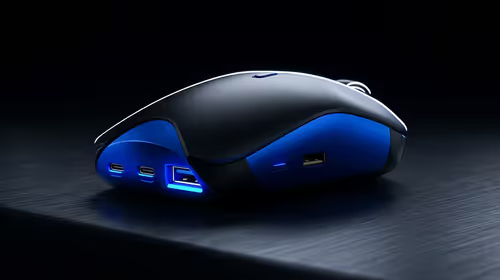
USB-C charging is becoming the standard because it cuts cable clutter and supports more modern peripherals. For SA buyers, it makes keyboards, mice, headsets, and controllers easier to charge across mixed setups.
Read more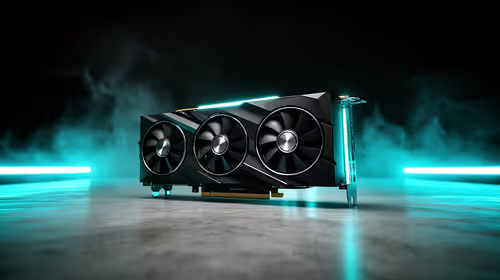
Will the RTX 5090 handle Dragon Ball Sparking should be shortlisted around the job it must do. South African buyers should compare GPU tier, VRAM, cooling, and PSU headroom, warranty path, and upgrade room before treating any pick as best.
Read more
NVIDIA lists 550W required system power for the RTX 5060 reference specification, based on a high-end test system. A quality 550W unit can be enough, but CPU draw, transient load, connectors and ageing decide real headroom.
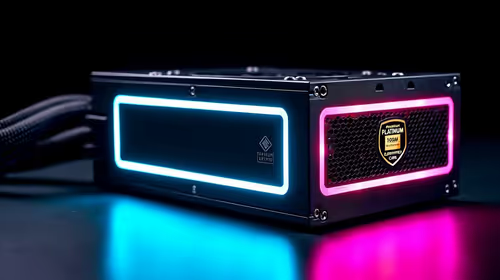
80+ Gold vs 80+ Platinum for couch co-op gaming is about PSU efficiency, heat, fan behaviour, quality, and wattage headroom, not direct FPS. SA buyers should compare the whole build.
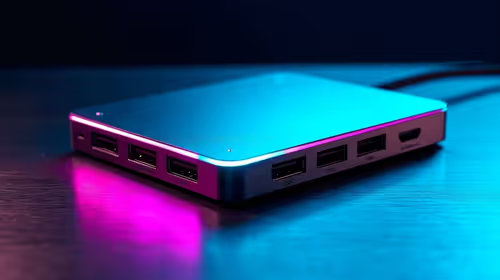
Upgrade your setup with the best USB-C hubs for creators. Discover why high-capacity card readers and dual 4K output are essential for professional South African content production. 🚀💻

B850 motherboard FPS drops needs a methodical troubleshooting pass. Review drivers, thermals, power settings, background apps, cables and game settings before replacing parts in an SA gaming setup.
NVIDIA lists 550W required system power for the RTX 5060 reference specification, based on a high-end test system. A quality 550W unit can be enough, but CPU draw, transient load, connectors and ageing decide real headroom.

OpenRGB's master branch now carries changes labelled for 1.0 final, including translation and platform work, but the official tags page still lists 1.0rc3.1 as the newest packaged release. Stable users should wait for the signed release channel.

A motherboard can remain useful for many years when power, cooling and connectors stay healthy. Replace it for confirmed faults, damaged power delivery or a blocked platform need, not simply because the calendar reaches a fixed age.
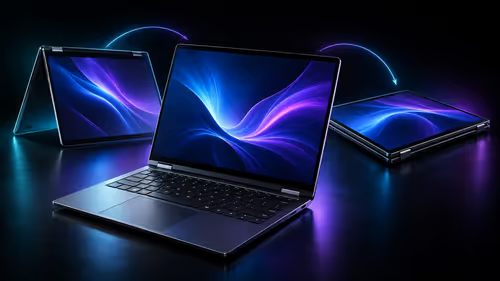
The VAIO T combines a 13.3-inch display with a multi-flip mechanism for laptop, tablet and outward-facing viewing modes. Orders begin in Japan on 18 September; South African availability is unconfirmed.
OLED monitors talk for Randburg buyers should be treated as market context, not a live claim. Compare demand, specs, warranty, platform fit, and total build value.
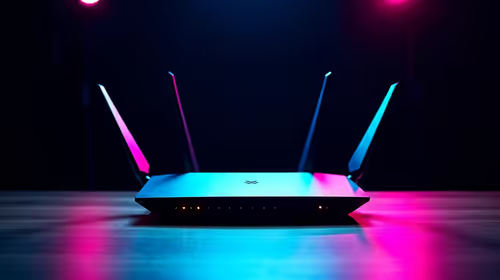
Wi-Fi 7 vs Wi-Fi 6e for aaa single-player gaming comes down to router support, latency goals, device compatibility, and coverage. SA buyers should match the choice to the real network setup.
Ryzen X3D chips stand out in SA gaming PCs because extra cache can help frame consistency in many games. Durban builders should still compare motherboard cost, cooling, BIOS support, and GPU balance before choosing a CPU.
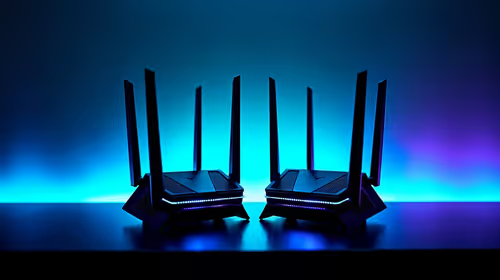
Wi-Fi 7 and Wi-Fi 6E affect AAA single-player gaming through downloads, updates, cloud saves, and remote features. The real world difference between wi fi 7 and wi fi depends on your router, fibre speed, and SA home layout.