Quick Answer
Infinity mirror ARGB refers to fan or pump head designs that use a partially reflective surface layered over addressable LEDs to create a deep, recursive light effect. Fan edge RGB describes LEDs positioned on the outer ring of a fan frame rather than on the blades or hub. Both are purely aesthetic features compatible with Aura Sync via the standard 3-pin 5V ARGB header, and neither affects fan airflow, static pressure, or cooling performance.
Infinity Mirror Design: How the Effect Works 🌟
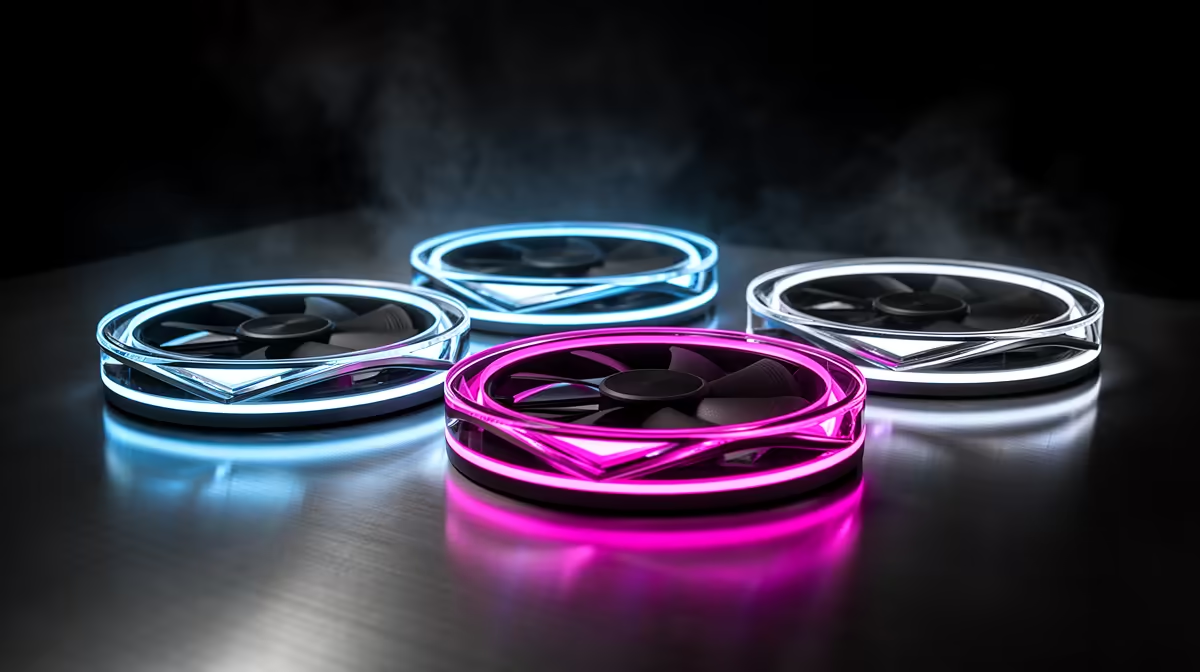
An infinity mirror uses two partially reflective surfaces facing each other with LEDs between them. Light from the ARGB LEDs reflects repeatedly between the two surfaces, each reflection appearing slightly smaller and more distant, creating the illusion of a tunnel receding into the component. In PC components, this is achieved using a clear acrylic or glass layer over a mirrored backing, with the ARGB LED strip positioned at the perimeter. The effect is most dramatic when viewed straight on in a dark room, making it best suited to builds with large side-panel windows and dark interior colour schemes. ASUS ROG pump heads and some fan hub designs use infinity mirror aesthetics as a premium visual feature on high-end AIOs.
Fan Edge RGB vs Blade and Hub RGB Placement 💡
Fan edge RGB places addressable LEDs around the outer frame ring of the fan.
Aura Sync Compatibility and Software Control 🔧
Aura Sync is ASUS's motherboard lighting control platform, and it communicates with ARGB devices through the standard 3-pin 5V ARGB header.
Infinity Mirror Cleaning Note ⚡
Infinity mirror surfaces attract fingerprints and dust that scatter the light effect and reduce reflection depth. Clean the acrylic surface with a lint-free microfibre cloth and isopropyl alcohol every few months, especially in SA homes with Highveld dust. Avoid abrasive cloths or household spray cleaners that can scratch the acrylic coating and permanently damage the reflective layering.
FAQ
Does an infinity mirror fan perform differently from a standard ARGB fan?
No, the infinity mirror effect is purely cosmetic. The fan's airflow, static pressure, noise level, and motor performance are determined by blade geometry and motor specification, which are independent of the LED and reflective layer design on the frame.
Can I control infinity mirror ARGB fans from non-ASUS motherboards?
Yes, using the standard 3-pin 5V ARGB header present on most modern motherboards from Gigabyte, MSI, and ASRock. The infinity mirror effect operates as long as the ARGB data signal drives the LEDs; the visual effect is physical and does not require any specific software to display, though per-LED effects require compatible software control.
Why do some fans show uneven brightness in the infinity mirror effect?
Uneven brightness typically indicates either individual LED failure (requiring fan replacement under warranty) or an incorrect LED count in the software profile. If the software expects more LEDs than are physically present in the chain, some positions receive no data signal and appear dark. Update your lighting software and rescan devices to correct profile mismatches.
Building a premium showcase PC with ARGB lighting?
Evetech stocks infinity mirror fans, edge RGB fan sets, and Aura Sync compatible controllers so you can design a lighting scheme that performs and looks the part.