Quick Answer
Beamforming microphones use multiple capsules to focus on your voice from a specific direction while suppressing noise arriving from other angles. For gaming headsets and mobile calls, this means cleaner voice pickup without needing to hold the mic directly at your mouth.
How Beamforming Mics Actually Work 🎙️
A traditional single-capsule mic captures sound from every direction, which is why keyboard clatter and fan hum bleed into your voice. Beamforming arrays two or more capsules a few millimetres apart and uses DSP to measure how sound arrives at each one. Sound from directly ahead arrives at both capsules simultaneously and reinforces; off-axis sound arrives at different moments and gets cancelled. High-end headsets like the Razer Barracuda Pro implement this with hybrid ANC. The result is roughly 20 to 30 dB of off-axis suppression, eliminating most mechanical keyboard and fan noise at typical distances.
Beamforming for Gaming vs Mobile Calls 🎮
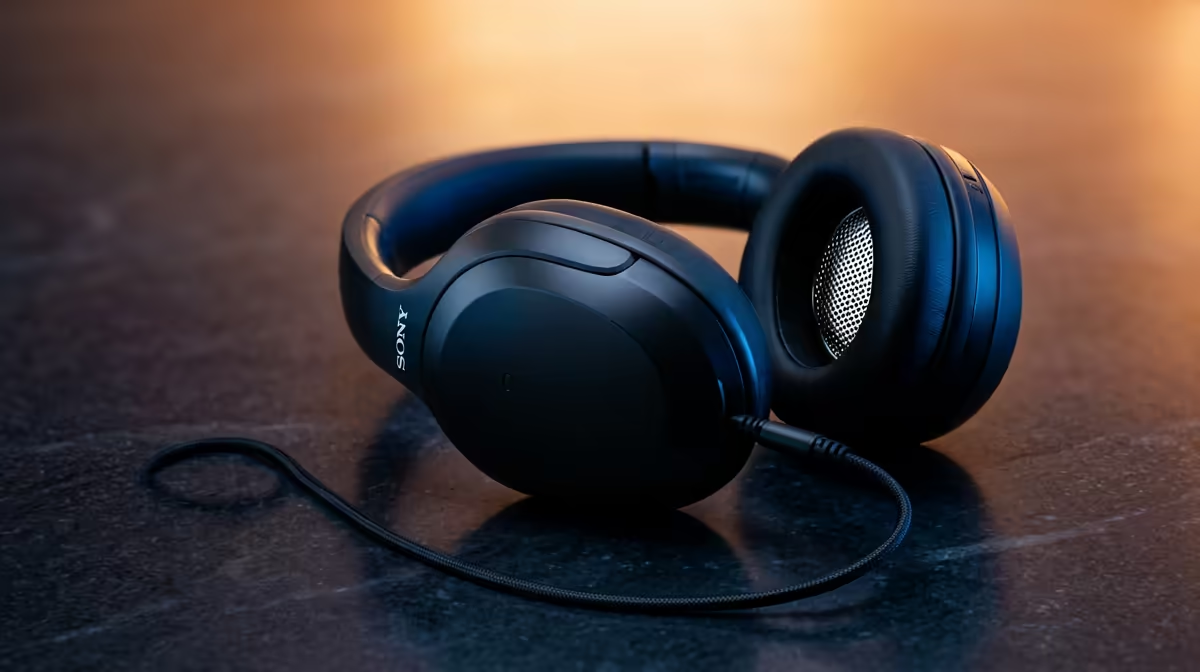
In a gaming context, beamforming is most useful during online squad play where clear comms matter. When you are on Discord or in-game voice chat, teammates hear less of your room and more of your words. The Razer Barracuda Pro, for example, pairs its beamforming array with AI voice enhancement and costs around R3,500 to R4,500 at Evetech, placing it in the premium wireless category. On mobile, beamforming is built into headsets that support simultaneous Bluetooth 5.2 and 2.4 GHz connections. You can take a WhatsApp call on your phone through the same headset you were using for PC gaming, and the beamforming array switches processing context automatically. Smartphones also benefit because hands-free speakerphone calls in noisier SA urban environments like Cape Town city traffic are far more intelligible.
What to Check Before You Buy 💰
Not every headset labelled noise-cancelling uses true beamforming. Some only apply software noise gates that cut the mic when you stop speaking, which is very different. Look for spec sheets that mention multi-capsule arrays, AI noise reduction, or hybrid ANC on the microphone side specifically. Beamforming is distinct from active noise cancellation on the ear cups, which only affects what you hear. Budget wireless headsets under R1,500 typically skip the multi-capsule array entirely. A properly implemented beamforming mic costs more to engineer, which is why the feature reliably appears in the R2,500 to R5,000 tier. If your headset will be used in a shared flat or student res with ambient noise, beamforming is worth prioritising over a higher speaker driver spec.
Test Your Mic Direction Before Sessions ⚡
Position the boom arm or built-in mic at a 45-degree angle toward your mouth, about 3 to 5 cm away. Beamforming is directional, so speaking directly into the array gives the DSP the strongest voice signal to work with. Use Discord's mic test feature before jumping into a competitive match to confirm background noise is suppressed.
FAQ
Does beamforming work without software drivers installed?
The capsule array and basic DSP processing run on the headset hardware itself, so some beamforming suppression happens even without drivers. However, AI enhancement layers and fine-tuning profiles typically require the manufacturer's app, such as Razer Synapse, to activate advanced modes.
Can beamforming mics pick up my voice when I move around?
Beamforming focuses on a cone of about 30 to 60 degrees in front of the array. Leaning far sideways or turning significantly drops voice quality. Headsets with swivel arms maintain consistent pickup better than flat built-in arrays.
Is there a noticeable quality difference on mobile calls versus PC?
On LTE with Vodacom or MTN you get wideband HD Voice, making the beamforming improvement clearly audible. WhatsApp and other VoIP calls preserve full quality and showcase beamforming best.
Want cleaner voice quality for gaming and calls? Browse the full wireless headset range at Evetech to find options with beamforming and AI mic enhancement across multiple price points.