


550W PSU Planning for RTX 5080 Super Builds in SA
550W for RTX 5080 Super needs a full-build check, not a simple yes. Review GPU guidance, CPU draw, transient load, connectors, PSU quality, and upgrade plans before deciding.
Read moreA 16-inch 3K OLED monitor has relevant panel features for competitive play, but suitability depends on the whole setup. The UColor O2 offers 120Hz and a 1ms response specification; source performance, connection behaviour and total latency still need testing.
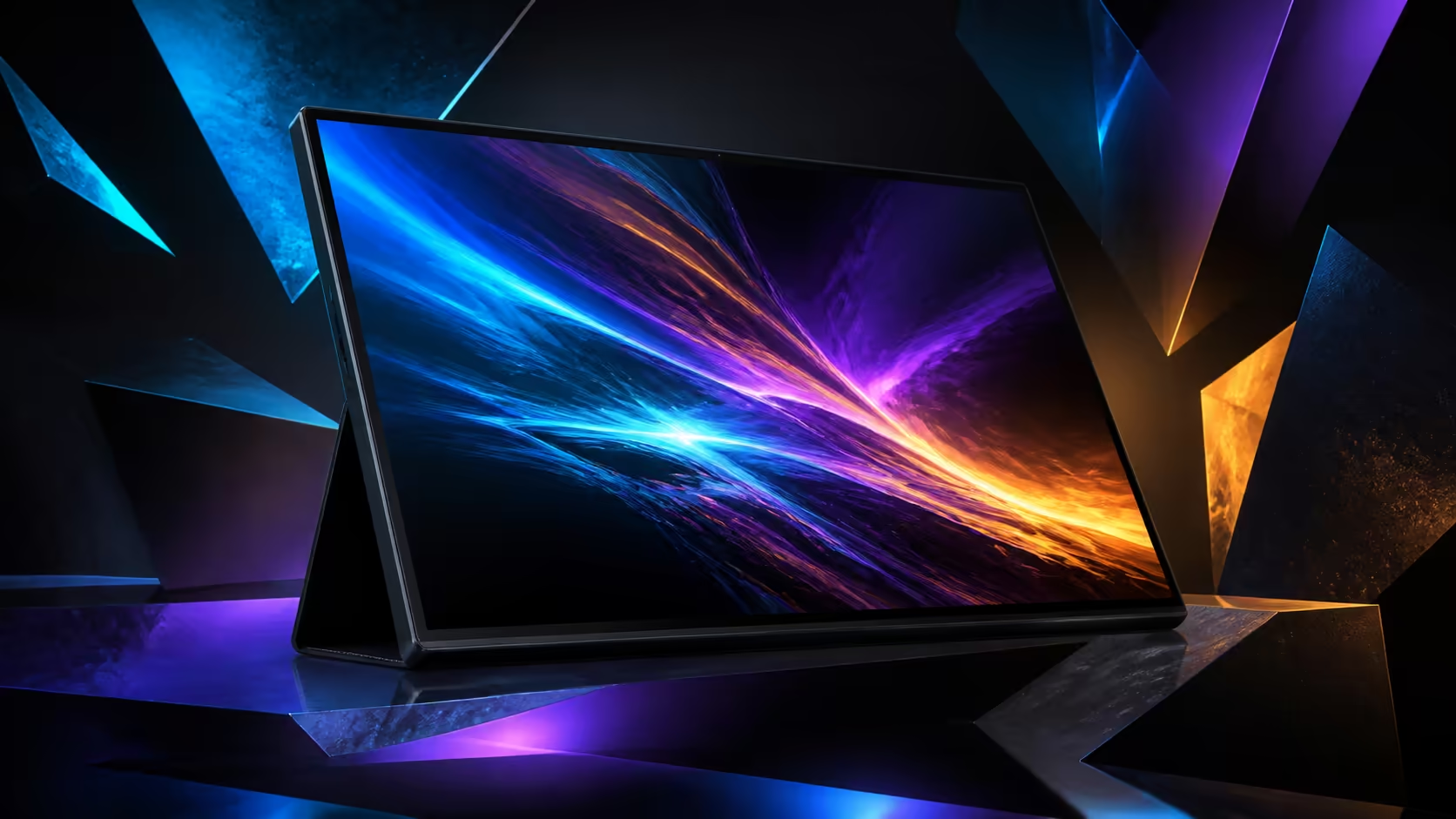
Competitive play exposes the whole gaming chain, so a fast panel label cannot answer the verdict alone. A 16-inch 3K OLED portable monitor for competitive gaming needs source, motion, control and connection tests. The UPERFECT UColor O2 provides the R7,199 case here.
The UColor O2 has the right panel-side foundation for competitive play: 120Hz, 1ms response, OLED pixels and broad 16-inch visibility.
The UColor O2 brings 120Hz OLED and a 1ms response specification to a 2880x1800 portable panel for R7,199. Those are useful test conditions, not proof of competitive results or total input latency. Evaluate the exact game, host, controller, frame delivery and cable before deciding whether its 16-inch format fits serious play.
Connect the source directly and choose 2880x1800. Launch the game, return to display information and verify that 120Hz remained selected. Record frame delivery through the repeatable match or practice scene. A refresh menu selection cannot create frames that the source does not render.
Find exact alternatives in the Evetech portable-monitor range after defining the same source conditions.
The 1ms specification concerns a panel-transition measure. End-to-end delay includes the controller, operating system, game engine, rendering, transport and display processing. Keep visible trailing and control response in different rows.
If latency measurement matters, use a suitable method rather than estimating from the response-time label.
Place the screen at the gaming distance and check target visibility, interface scaling and peripheral awareness. The 3K grid may offer detail, while the smaller physical area can change how quickly information is read. Player preference needs a full session rather than a brief showroom glance.
Keep OLED, HDR and colour observations separate from the control result.
Use the actual host port and cable, reconnect after transport and restore the saved mode without guesswork. Pack the 6.5mm display in a protective compartment; no durability or weight outcome should be inferred.
Compare permanent high-refresh screens through Evetech's PC-monitor category when mobility is unnecessary.
Hide the active refresh label and ask the player to complete the same training sequence at two modes. Record target tracking, missed inputs and comfort without announcing which run uses 120Hz. This reduces expectation bias and keeps the competitive judgement tied to performance the player can actually perceive.
Repeat on another day. One strong run can reflect fatigue, familiarity or random variation rather than the display change.
Write the stable resolution, refresh, cable and source settings that recover fastest after transport. Pack only the tested equipment and inspect the display before connection. If the preferred 3K 120Hz path fails, know which lower mode keeps play possible while diagnosis continues.
The fallback is not proof that every venue or console will work. It is a rehearsed state for the exact equipment the player owns.
After a full practice block, record whether small interface elements remain readable and whether the player keeps leaning toward the 16-inch screen. Repeat at the stable resolution and scale the owner plans to use. Fast motion has limited value if critical information becomes tiring to inspect.
Include room reflections in the note. Tournament or travel locations may alter visibility even when 120Hz and response settings remain identical.
State the game, host, controller, cable and display mode that passed. If another console or laptop has not been tested, leave it outside the conclusion. Competitive suitability should be narrow enough that another player can reproduce the conditions.
This wording does not weaken the result; it prevents a personal test from being stretched into a universal performance promise.
Its native 2880x1800 resolution can be demanding, so competitive suitability depends on the laptop or console sustaining the chosen frame rate and mode. Total latency is not defined by response time alone. Use the intended connection, controller and game to measure the complete path. The panel reduces one source of transition delay, but competition demands evidence from the entire setup.
No. It describes panel response, not the controller-to-image journey across the complete setup.
Not necessarily. Test frame delivery, scaling and target visibility at the intended settings and viewing distance.
It can present updates more often than 60Hz when the source supplies useful frames, but the whole system still matters.
No. Judge dark-scene visibility, motion, control response and comfort through repeatable play.
Ready to test competitive play as a complete signal chain? Compare Evetech gaming monitors with your game, host, controller and viewing distance fixed.
No. It describes panel response, not the controller-to-image journey across the complete setup.
Not necessarily. Test frame delivery, scaling and target visibility at the intended settings and viewing distance.
It can present updates more often than 60Hz when the source supplies useful frames, but the whole system still matters.
No. Judge dark-scene visibility, motion, control response and comfort through repeatable play.
550W for RTX 5080 Super needs a full-build check, not a simple yes. Review GPU guidance, CPU draw, transient load, connectors, PSU quality, and upgrade plans before deciding.
Read more
8000Hz polling is overrated for most SA gamers because gains can be tiny next to battery drain and monitor limits. Mbombela players should weigh mouse feel, game support, and system stability before chasing the number.
Read more
Magnetic switches are taking over SA gaming keyboards because actuation can be tuned. For Sandton gamers, rapid trigger, reset control, and profile depth can help, but layout, key feel, and software quality still matter.
Read more
Polokwane oled monitor value questions need cautious SA context because pricing can move with availability, exchange rates, specs, and warranty support. Treat the trend as a planning signal, not a fixed price promise.
Read more
Arc B580 budget builds for Midrand gamers can shift with exchange rates, supply, specs, and model tier. Treat the title as a buying prompt, then compare SA warranty, timing, and build priorities.
Read more
ROG Ally X may beat the LCD Steam Deck for SA gamers who value stronger handheld performance, more memory, and Windows flexibility. Compare battery life, controls, game libraries, and Polokwane support needs before deciding.
Read more
Minisforum's M2 Pro pairs Core Ultra X7, Arc B390 graphics and 32GB onboard memory in 1.8 litres. SA buyers should weigh its fixed memory and $1,439 launch offer against local mini PCs.

Lenovo says Legion Go failures linked to BIOS N3CN42WW are not user error. Affected SA owners should stop retrying the update, preserve proof and open a support case.

Smart monitors can add apps and convenience, but they also add privacy settings and unwanted-software risk. SA buyers should audit the operating system before paying for extras.

A fake 113GB GTA VI ISO reportedly used empty padding around a small malware payload. SA gamers should delete unofficial builds, keep Windows security active and wait for official channels.
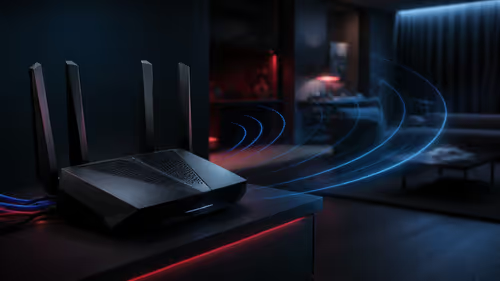
ASUS calls the ROG GT-BN98 the first Wi-Fi 8 gaming router. SA buyers should fix coverage and client limits before paying for a future wireless standard.
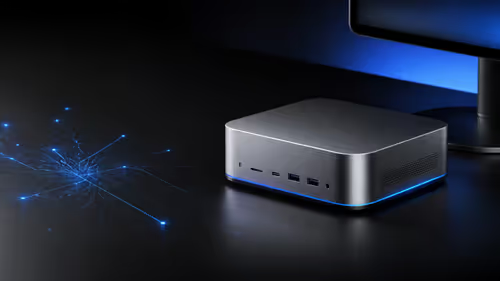
Apple's M6 Mac mini adds faster AI, graphics and networking in the same compact format. SA buyers should wait for a rand listing before comparing value.
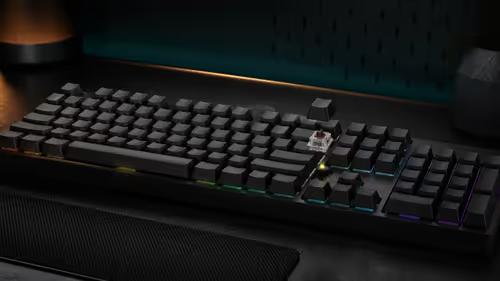
The Vulcan II XP adds hot-swappable switches, sound damping and gaming controls to a full-size wired board. SA buyers should compare feel before features.

Microsoft says Windows on Arm now has over 7,000 verified apps and games. SA buyers should still check each driver, game and work tool before switching.

Xbox Insiders can test disc-to-digital from 31 August 2026. Supported Xbox One and Series X discs gain a digital entitlement, but older discs, regions and title coverage still need exact checks.
ViewSonic's XG2738 pairs QHD QD-OLED with 240Hz and automatic panel care. SA buyers should compare warranty, brightness, ports and burn-in protection against today's R9,999-plus OLED shelf.

NVIDIA's final Windows 10 Game Ready driver is due in October 2026. SA gamers can keep using their GPU, but new game optimisations move on while critical security fixes continue quarterly.

JBL's new Quantum 520, 520X and 120 headsets cover wireless, Xbox-certified and wired use. SA buyers should compare connection, comfort and microphone needs before paying for a new badge.