


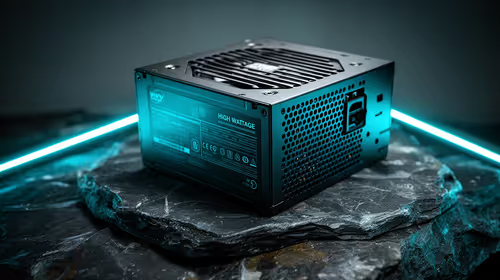
550W PSU Planning for RTX 5080 Super Builds in SA
550W for RTX 5080 Super needs a full-build check, not a simple yes. Review GPU guidance, CPU draw, transient load, connectors, PSU quality, and upgrade plans before deciding.
Read moreA 360mm AIO is necessary only when fit, thermal requirements and acceptable noise justify that format. The R65,999 package uses ASUS ROG RYUO IV SLC 360; measure cooling and acoustic results after installation.

Radiator size is only one part of a cooling decision. Whether a 360mm AIO is necessary for a high-end AM5 CPU depends on physical fit, measured heat behaviour and the noise level the builder accepts.
A 360mm liquid cooler is necessary only when the build can mount it and measured needs justify that format. For R65,999, ASUS ROG uses its RYUO IV SLC 360 beside the 9950X3D2. Check temperature, sound and fit on the complete PC.
Start with the case's official mounting information and inspect the intended location. Account for the radiator, fans, tubes, motherboard area and nearby memory rather than checking a nominal size alone. Component clearances can change with orientation.
The cooler model identifies a 360mm format, but target-case dimensions still decide whether the assembly fits. A dry layout plan before installation is safer than discovering an obstruction after other parts are in place.
Evetech's AMD barebone-kit category can frame cooling as part of the whole upgrade group.
Use a repeatable workload that represents the PC's intended use. Record starting conditions, sustained temperatures, clock behaviour and the time required to settle. A short burst and a long render can expose different cooling demands.
The included processor is Ryzen 9 9950X3D2. Its CPU resources do not define a guaranteed heat result, because case airflow, settings and ambient conditions remain part of the observed outcome.
A larger radiator does not establish a particular sound level. Fan control, pump behaviour, airflow resistance, placement and room noise all contribute. Compare at an equivalent workload and listening position instead of relying on an isolated impression.
Decide what acceptable means before testing: perhaps unobtrusive during editing, or controlled during a long CPU task. This turns a vague desire for quiet operation into an acceptance condition the finished build can meet or fail.
Browse Evetech's Ryzen 9 upgrade-kit range once those cooling priorities are written down.
The RYUO cooler arrives beside an X870E Extreme board and 96GB DDR5. The enclosure and airflow plan still need individual review.
At R65,999, the decision concerns a complete premium platform. If the existing case cannot accept the cooler, price the necessary change or compare another route. Necessity comes from the build requirements, not the CPU tier label.
Prepare a cooling worksheet before assembly. Sketch the proposed radiator position, airflow direction and tube path, then mark the graphics card, memory and board areas that could interfere. Beside the drawing, list separate limits for sustained processor temperature, clock behaviour and acceptable sound during a chosen task. A single pass/fail label is too vague because one condition can improve while another worsens. After the first test, change only the control linked to the observed problem and repeat the same workload. The worksheet turns "necessary" into a set of physical and measured requirements. Include a maintenance route showing how filters, fans and radiator surfaces will be reached. A technically fitting installation can still be a poor long-term choice if ordinary cleaning requires dismantling the system. Service access therefore belongs beside thermal and acoustic acceptance.
After the enclosure is closed, repeat the same cooling workload used during open-case commissioning. The difference identifies whether panel placement and final cable routing changed airflow enough to require another layout review.
It makes sense when the enclosure accepts it and controlled tests show that the format suits the intended thermal and acoustic target.
Cooling is handled by the RYUO IV SLC 360 model from ASUS ROG.
No. Processor choice informs the test, but case airflow, settings, workload and acceptable noise shape the cooling requirement.
Confirm radiator and fan clearance, mounting location, tube route and conflicts with the motherboard, memory or other hardware.
Measure the completed build under a repeatable workload in its normal environment before assigning any acoustic result.
Keep ambient conditions, workload duration, settings and monitoring method consistent, then compare several sustained runs.
Ready to decide whether 360mm cooling fits the plan? Compare Evetech's Ryzen 9 kits after mapping the enclosure and defining a repeatable temperature and noise acceptance test.
It makes sense when the enclosure accepts it and controlled tests show that the format suits the intended thermal and acoustic target.
Cooling is handled by the RYUO IV SLC 360 model from ASUS ROG.
No. Processor choice informs the test, but case airflow, settings, workload and acceptable noise shape the cooling requirement.
Confirm radiator and fan clearance, mounting location, tube route and conflicts with the motherboard, memory or other hardware.
Measure the completed build under a repeatable workload in its normal environment before assigning any acoustic result.
Keep ambient conditions, workload duration, settings and monitoring method consistent, then compare several sustained runs.
550W for RTX 5080 Super needs a full-build check, not a simple yes. Review GPU guidance, CPU draw, transient load, connectors, PSU quality, and upgrade plans before deciding.
Read more
8000Hz polling is overrated for most SA gamers because gains can be tiny next to battery drain and monitor limits. Mbombela players should weigh mouse feel, game support, and system stability before chasing the number.
Read more
Magnetic switches are taking over SA gaming keyboards because actuation can be tuned. For Sandton gamers, rapid trigger, reset control, and profile depth can help, but layout, key feel, and software quality still matter.
Read more
Polokwane oled monitor value questions need cautious SA context because pricing can move with availability, exchange rates, specs, and warranty support. Treat the trend as a planning signal, not a fixed price promise.
Read more
Arc B580 budget builds for Midrand gamers can shift with exchange rates, supply, specs, and model tier. Treat the title as a buying prompt, then compare SA warranty, timing, and build priorities.
Read more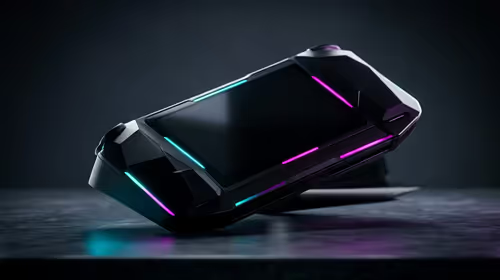
ROG Ally X may beat the LCD Steam Deck for SA gamers who value stronger handheld performance, more memory, and Windows flexibility. Compare battery life, controls, game libraries, and Polokwane support needs before deciding.
Read more
Minisforum's M2 Pro pairs Core Ultra X7, Arc B390 graphics and 32GB onboard memory in 1.8 litres. SA buyers should weigh its fixed memory and $1,439 launch offer against local mini PCs.

Lenovo says Legion Go failures linked to BIOS N3CN42WW are not user error. Affected SA owners should stop retrying the update, preserve proof and open a support case.

Smart monitors can add apps and convenience, but they also add privacy settings and unwanted-software risk. SA buyers should audit the operating system before paying for extras.

A fake 113GB GTA VI ISO reportedly used empty padding around a small malware payload. SA gamers should delete unofficial builds, keep Windows security active and wait for official channels.
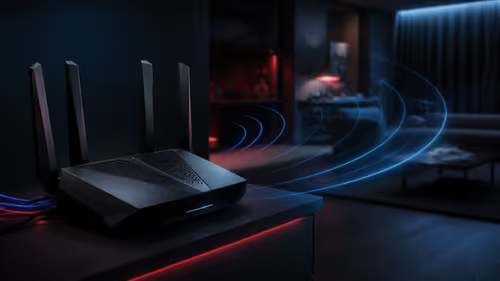
ASUS calls the ROG GT-BN98 the first Wi-Fi 8 gaming router. SA buyers should fix coverage and client limits before paying for a future wireless standard.
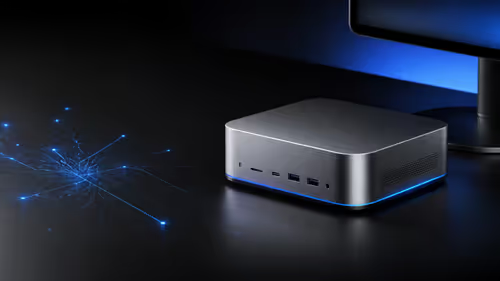
Apple's M6 Mac mini adds faster AI, graphics and networking in the same compact format. SA buyers should wait for a rand listing before comparing value.
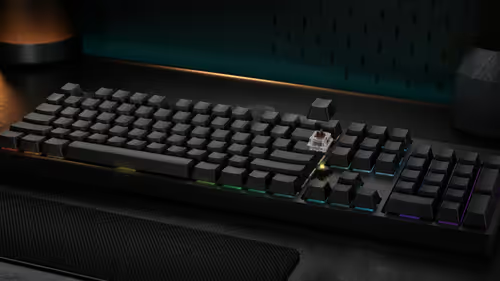
The Vulcan II XP adds hot-swappable switches, sound damping and gaming controls to a full-size wired board. SA buyers should compare feel before features.

Microsoft says Windows on Arm now has over 7,000 verified apps and games. SA buyers should still check each driver, game and work tool before switching.

Xbox Insiders can test disc-to-digital from 31 August 2026. Supported Xbox One and Series X discs gain a digital entitlement, but older discs, regions and title coverage still need exact checks.

ViewSonic's XG2738 pairs QHD QD-OLED with 240Hz and automatic panel care. SA buyers should compare warranty, brightness, ports and burn-in protection against today's R9,999-plus OLED shelf.

NVIDIA's final Windows 10 Game Ready driver is due in October 2026. SA gamers can keep using their GPU, but new game optimisations move on while critical security fixes continue quarterly.

JBL's new Quantum 520, 520X and 120 headsets cover wireless, Xbox-certified and wired use. SA buyers should compare connection, comfort and microphone needs before paying for a new badge.