


550W PSU Planning for RTX 5080 Super Builds in SA
550W for RTX 5080 Super needs a full-build check, not a simple yes. Review GPU guidance, CPU draw, transient load, connectors, PSU quality, and upgrade plans before deciding.
Read moreA laptop BIOS update is worth doing when it fixes a documented stability or compatibility issue, but a power cut mid-flash carries real risk, so it is never routine maintenance. Evetech recommends checking the manufacturer's changelog before updating any laptop.
A laptop BIOS update can fix a boot problem, memory compatibility issue, security flaw or fan-control bug. It also rewrites firmware needed before Windows starts. Update for a documented reason, use the exact file for the product number and protect the machine from interruption.
Read the manufacturer's release notes and confirm the update addresses your issue or contains a security fix that applies. Back up important files and your encryption recovery key. Connect the correct mains adapter, charge the battery above the maker's minimum and close applications. Use the supported update tool and leave the laptop untouched until it restarts.
Evetech's laptop best-seller page helps distinguish similar model families. The gaming laptop specials provide exact product details to compare before downloading firmware from the manufacturer's support site.
Match the full model, board revision and service tag where the maker uses one. A familiar marketing name can cover several platforms. Let the official detection utility identify the machine when available.
Read every release note between your installed version and the target. Look for prerequisites, staged updates and whether rollback is blocked. A BIOS that fixes an issue you do not have may still carry security changes, but it is not a casual performance tweak.
Do not install firmware from a file-sharing site or another regional model page. Use the laptop manufacturer's official source.
Confirm that you can retrieve the BitLocker or device-encryption recovery key from another device. Firmware changes can trigger a recovery prompt. Back up work and record custom BIOS settings.
Disconnect unnecessary docks, storage and controllers. Leave the approved charger connected and make sure the battery meets the update tool's requirement. Do not begin during unstable mains conditions.
If the maker offers a recovery method, read it before starting. Downloading it after a failed flash is too late when the machine will not boot.
The screen can go dark, fans can change speed and the laptop can restart several times. Do not close the lid, press Power or unplug it. A progress pause is not permission to interrupt.
Use the Windows utility, BIOS flash menu or bootable method documented for that exact model. Disable third-party tuning tools before a Windows-based update.
After the final restart, enter BIOS and load defaults only when the release instructions call for it. Restore storage, virtualisation or boot settings with care.
Confirm the new BIOS version in firmware or Windows System Information. Test charging, sleep, keyboard controls, fans and the issue named in the release notes.
A firmware update can reset memory, GPU or charge-limit settings. Reapply only those you recorded and still need. Run a known game scene before judging performance.
Read the release notes and support guidance. Apply relevant stability and security fixes through the official process, not as blind routine.
It can fix power, memory or compatibility behaviour, but a frame-rate gain is not guaranteed unless the release documents one.
They provide two layers of power continuity during a firmware rewrite. Follow the maker's minimum charge rule.
Match the exact product number, read the BIOS release notes and protect the official flash with mains power, battery charge and a saved recovery key.
Read the release notes and support guidance. Apply relevant stability and security fixes through the official process, not as blind routine.
It can fix power, memory or compatibility behaviour, but a frame-rate gain is not guaranteed unless the release documents one.
They provide two layers of power continuity during a firmware rewrite. Follow the maker's minimum charge rule. {{PRODUCTS: { facets: { query: "laptop" }, limit: 12, title: "Gaming Laptops", style: "4" } }}
550W for RTX 5080 Super needs a full-build check, not a simple yes. Review GPU guidance, CPU draw, transient load, connectors, PSU quality, and upgrade plans before deciding.
Read more
8000Hz polling is overrated for most SA gamers because gains can be tiny next to battery drain and monitor limits. Mbombela players should weigh mouse feel, game support, and system stability before chasing the number.
Read more
Magnetic switches are taking over SA gaming keyboards because actuation can be tuned. For Sandton gamers, rapid trigger, reset control, and profile depth can help, but layout, key feel, and software quality still matter.
Read more
Polokwane oled monitor value questions need cautious SA context because pricing can move with availability, exchange rates, specs, and warranty support. Treat the trend as a planning signal, not a fixed price promise.
Read more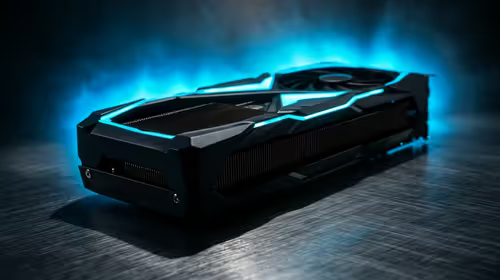
Arc B580 budget builds for Midrand gamers can shift with exchange rates, supply, specs, and model tier. Treat the title as a buying prompt, then compare SA warranty, timing, and build priorities.
Read more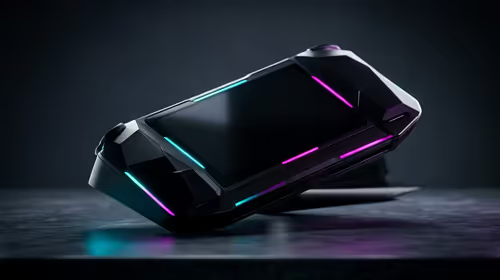
ROG Ally X may beat the LCD Steam Deck for SA gamers who value stronger handheld performance, more memory, and Windows flexibility. Compare battery life, controls, game libraries, and Polokwane support needs before deciding.
Read more
Minisforum's M2 Pro pairs Core Ultra X7, Arc B390 graphics and 32GB onboard memory in 1.8 litres. SA buyers should weigh its fixed memory and $1,439 launch offer against local mini PCs.

Lenovo says Legion Go failures linked to BIOS N3CN42WW are not user error. Affected SA owners should stop retrying the update, preserve proof and open a support case.

Smart monitors can add apps and convenience, but they also add privacy settings and unwanted-software risk. SA buyers should audit the operating system before paying for extras.

A fake 113GB GTA VI ISO reportedly used empty padding around a small malware payload. SA gamers should delete unofficial builds, keep Windows security active and wait for official channels.

ASUS calls the ROG GT-BN98 the first Wi-Fi 8 gaming router. SA buyers should fix coverage and client limits before paying for a future wireless standard.

Apple's M6 Mac mini adds faster AI, graphics and networking in the same compact format. SA buyers should wait for a rand listing before comparing value.

The Vulcan II XP adds hot-swappable switches, sound damping and gaming controls to a full-size wired board. SA buyers should compare feel before features.

Microsoft says Windows on Arm now has over 7,000 verified apps and games. SA buyers should still check each driver, game and work tool before switching.

Xbox Insiders can test disc-to-digital from 31 August 2026. Supported Xbox One and Series X discs gain a digital entitlement, but older discs, regions and title coverage still need exact checks.
ViewSonic's XG2738 pairs QHD QD-OLED with 240Hz and automatic panel care. SA buyers should compare warranty, brightness, ports and burn-in protection against today's R9,999-plus OLED shelf.

NVIDIA's final Windows 10 Game Ready driver is due in October 2026. SA gamers can keep using their GPU, but new game optimisations move on while critical security fixes continue quarterly.

JBL's new Quantum 520, 520X and 120 headsets cover wireless, Xbox-certified and wired use. SA buyers should compare connection, comfort and microphone needs before paying for a new badge.