A few centimetres of PCB is the entire argument between these two form factors, yet it shapes case choice, cooling and cost for the rest of the build. Before settling on a b860m motherboard, it helps to know exactly what those centimetres cost you and what they do not.
Quick Answer
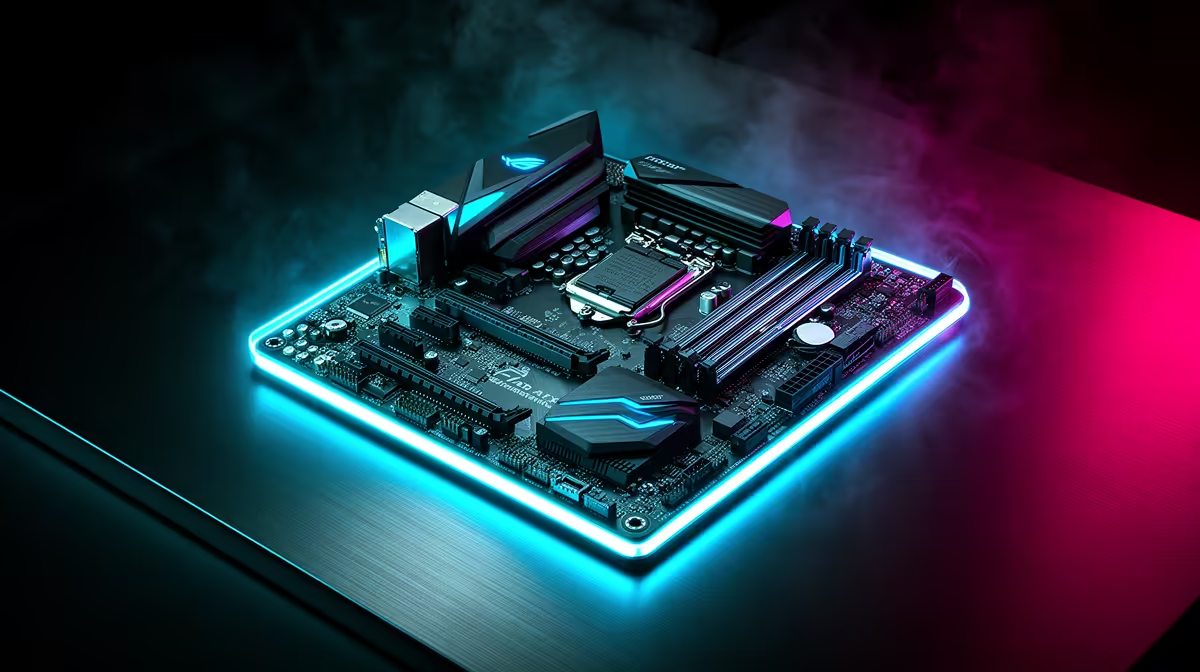
Micro-ATX boards drop from seven expansion slots to typically four, but keep the full-size PCIe x16 graphics slot and most core features intact. The ASUS B860M MAX Gaming AX proves this at R4,499, fitting PCIe 5.0 graphics support and triple M.2 storage into the smaller Micro-ATX footprint.
What You Give Up Moving to Micro-ATX 🔌
The main sacrifice is expansion slot count. A full ATX board typically offers more PCIe and add-in card slots for things like capture cards, extra networking cards or multiple graphics cards, none of which the average gaming build actually uses. Micro-ATX boards also tend to have slightly less room around the socket for oversized coolers, though this varies by model.
What Rarely Changes
The primary PCIe x16 slot for your graphics card, the number of memory slots in most cases, and core chipset features are usually preserved on a well-specced Micro-ATX board, since these do not require the extra board area that a full ATX layout provides.
What You Keep With a Well-Built Board 🎮
A Micro-ATX board is not automatically a stripped-down one. The ASUS B860M MAX Gaming AX carries a PCIe 5.0 x16 graphics slot, triple PCIe 5.0 M.2 storage, 2.5Gb Ethernet and 20Gbps USB-C, all packed into the compact board. Little of substance is lost for a typical single-GPU gaming setup.
Cooling in a Smaller Case 🌀
Micro-ATX builds usually pair with more compact cases, which can mean tighter clearances for tall air coolers or large radiators. This is a case and airflow consideration more than a motherboard limitation, and plenty of Micro-ATX builds run high-end air or liquid coolers without issue when the case is chosen with that in mind.
Build Size and Overall Footprint 📐
Choosing Micro-ATX over ATX mainly changes the size of case you need and, often, the price of that case. A smaller case also tends to mean shorter cable runs and an easier first build, since there is less internal volume to route through. This board, part of the current Intel B860 generation, shows that Micro-ATX no longer forces a compromise on chipset features. If you are still weighing up form factors, the wider Intel motherboard selection is worth a browse, since some full ATX boards on the same chipset add little beyond extra slots you may never populate.
Frequently Asked Questions
Does Micro-ATX limit graphics card size?
No. Micro-ATX boards use the same full-size PCIe x16 slot as ATX boards, so graphics card compatibility is unaffected by the form factor.
Will I lose memory slots on a Micro-ATX board?
Most Micro-ATX boards, including this one, still offer the standard four memory slots, though it varies by specific model.
Is Micro-ATX cheaper than ATX generally?
Often, yes, since the smaller PCB and case requirements typically reduce cost, though features vary widely between boards regardless of size.
Can a Micro-ATX board handle a high-end CPU cooler?
Usually, as long as the case has enough clearance. The motherboard's socket area is rarely the limiting factor for cooler compatibility.
Is Micro-ATX a downgrade for gaming builds?
Not meaningfully for most single-GPU gaming setups, since the core features that affect gaming performance are typically preserved.
Does form factor affect motherboard price directly?
Not on its own. Price is driven mostly by chipset tier and included features, so a well-specced Micro-ATX board can cost the same as a stripped-down ATX one.
Ready to decide between compact and full-size?
The ASUS B860M MAX Gaming AX waits among our Intel B860 motherboard category, geared to prove a Micro-ATX layout can still handle full expansion.