


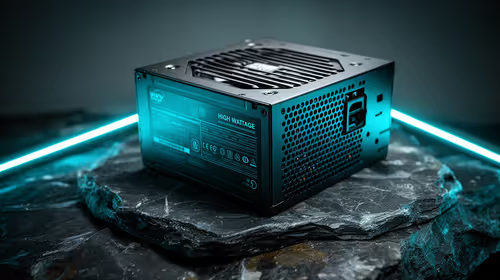
550W PSU Planning for RTX 5080 Super Builds in SA
550W for RTX 5080 Super needs a full-build check, not a simple yes. Review GPU guidance, CPU draw, transient load, connectors, PSU quality, and upgrade plans before deciding.
Read moreWhether Eskom or your municipality supplies your area changes who you call and how fast your power supply comes back after a fault. Municipal networks often restore local faults within hours, while Eskom-fed areas can wait longer during regional outages.
The logo on your bill changes the fault-reporting route more reliably than it predicts how long every outage will last. Municipal vs Eskom power supply should be compared through your area's current network, notices and escalation contacts.
Whether Eskom or a municipality supplies you changes the fault-reporting route, account reference, outage communication, and which network operator investigates. It does not create a dependable rule that one restores local or regional faults faster. Cause, access, damage, spares, weather, safety, and network topology shape restoration time.
The PC still needs model-level input and protection evidence from exact units in the Corsair PSU catalogue. The best-selling PSU page provides another exact-model comparison. A retailer cannot predict utility restoration or speak for either provider.
Check the electricity bill, prepaid meter documentation, municipal account, landlord, body corporate, or official provider tools. Keep the correct fault number and account or meter reference somewhere accessible without the internet.
A municipality can distribute electricity purchased from Eskom while owning the local fault response. Some properties use a private sub-meter or estate network. Report to the entity responsible for your connection, not the logo remembered from a news report.
Use official outage channels and obtain a reference number. Avoid posting account, meter, address, or contact details publicly.
Size backup power for the work, network, lighting, security, and safe shutdown you need. Use measured watts, required runtime, battery condition, and supported output.
Keep an alternate communication and work plan for an extended event. A quoted estimate can change as crews find damage. Do not run a battery to empty because a social post predicted restoration within an hour.
If voltage returns unstable, lights vary sharply, or equipment smells hot, disconnect sensitive loads only when safe and report the supply fault. Restoration does not prove power quality is normal.
Save official fault notices, reference numbers, start and restoration times, UPS events, and any damage reports. This helps a provider investigation or insurance claim without turning a social-media estimate into evidence.
Write down whether only your property, the street, or a wider area appeared affected. Do not inspect substations, street cabinets, overhead lines, or fallen conductors. Report damaged network equipment and keep well away.
After repeated events, ask a registered electrician to assess the property installation and backup connection. The provider handles its network; the electrician handles the customer installation boundary as applicable.
Review backup batteries after long discharge. Recharge according to the manual, record runtime loss, and replace unsafe or exhausted units through the supported route.
No reliable universal comparison applies. Fault type, network, crews, access, parts, weather, and safety determine each event.
Use the distributor shown on your bill or meter records, or ask the landlord or body corporate for the responsible network. Keep the official reference number.
Wait for the supply and network to stabilise, check for abnormal voltage symptoms, then restore equipment upstream to downstream. Use the UPS and device manuals.
Record the responsible electricity operator and fault channels now, then size backup runtime without assuming either provider will restore a future fault on schedule.
No reliable universal comparison applies. Fault type, network, crews, access, parts, weather, and safety determine each event.
Use the distributor shown on your bill or meter records, or ask the landlord or body corporate for the responsible network. Keep the official reference number.
Wait for the supply and network to stabilise, check for abnormal voltage symptoms, then restore equipment upstream to downstream. Use the UPS and device manuals.
550W for RTX 5080 Super needs a full-build check, not a simple yes. Review GPU guidance, CPU draw, transient load, connectors, PSU quality, and upgrade plans before deciding.
Read more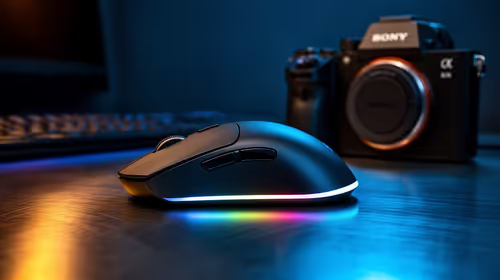
8000Hz polling is overrated for most SA gamers because gains can be tiny next to battery drain and monitor limits. Mbombela players should weigh mouse feel, game support, and system stability before chasing the number.
Read more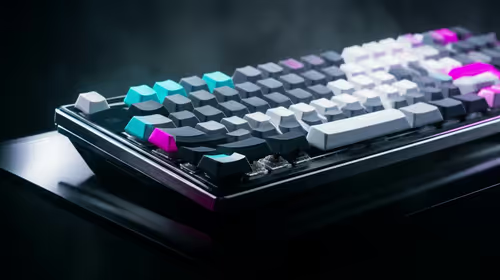
Magnetic switches are taking over SA gaming keyboards because actuation can be tuned. For Sandton gamers, rapid trigger, reset control, and profile depth can help, but layout, key feel, and software quality still matter.
Read more
Polokwane oled monitor value questions need cautious SA context because pricing can move with availability, exchange rates, specs, and warranty support. Treat the trend as a planning signal, not a fixed price promise.
Read more
Arc B580 budget builds for Midrand gamers can shift with exchange rates, supply, specs, and model tier. Treat the title as a buying prompt, then compare SA warranty, timing, and build priorities.
Read more
ROG Ally X may beat the LCD Steam Deck for SA gamers who value stronger handheld performance, more memory, and Windows flexibility. Compare battery life, controls, game libraries, and Polokwane support needs before deciding.
Read more
Minisforum's M2 Pro pairs Core Ultra X7, Arc B390 graphics and 32GB onboard memory in 1.8 litres. SA buyers should weigh its fixed memory and $1,439 launch offer against local mini PCs.

Lenovo says Legion Go failures linked to BIOS N3CN42WW are not user error. Affected SA owners should stop retrying the update, preserve proof and open a support case.

Smart monitors can add apps and convenience, but they also add privacy settings and unwanted-software risk. SA buyers should audit the operating system before paying for extras.

A fake 113GB GTA VI ISO reportedly used empty padding around a small malware payload. SA gamers should delete unofficial builds, keep Windows security active and wait for official channels.
ASUS calls the ROG GT-BN98 the first Wi-Fi 8 gaming router. SA buyers should fix coverage and client limits before paying for a future wireless standard.
Apple's M6 Mac mini adds faster AI, graphics and networking in the same compact format. SA buyers should wait for a rand listing before comparing value.
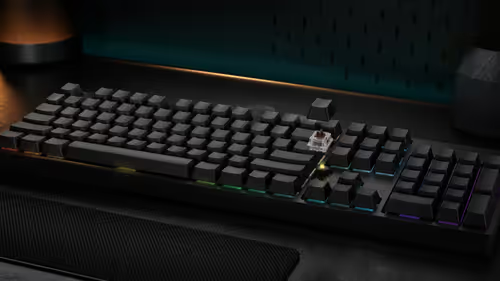
The Vulcan II XP adds hot-swappable switches, sound damping and gaming controls to a full-size wired board. SA buyers should compare feel before features.

Microsoft says Windows on Arm now has over 7,000 verified apps and games. SA buyers should still check each driver, game and work tool before switching.

Xbox Insiders can test disc-to-digital from 31 August 2026. Supported Xbox One and Series X discs gain a digital entitlement, but older discs, regions and title coverage still need exact checks.

ViewSonic's XG2738 pairs QHD QD-OLED with 240Hz and automatic panel care. SA buyers should compare warranty, brightness, ports and burn-in protection against today's R9,999-plus OLED shelf.

NVIDIA's final Windows 10 Game Ready driver is due in October 2026. SA gamers can keep using their GPU, but new game optimisations move on while critical security fixes continue quarterly.

JBL's new Quantum 520, 520X and 120 headsets cover wireless, Xbox-certified and wired use. SA buyers should compare connection, comfort and microphone needs before paying for a new badge.