


550W PSU Planning for RTX 5080 Super Builds in SA
550W for RTX 5080 Super needs a full-build check, not a simple yes. Review GPU guidance, CPU draw, transient load, connectors, PSU quality, and upgrade plans before deciding.
Read moreAn old router can bottleneck a fast fibre line through underpowered hardware, outdated firmware lacking modern traffic management, and weaker bufferbloat control. Evetech stocks current-generation routers that handle these limits so your fibre speed reaches your games.
Fast fibre still has to pass through the processor, radios and firmware in your router. An old router adding lag often reveals itself under several active devices or heavy traffic, where idle tests hide the weakness.
An old router can add lag when its processor cannot handle the line, Wi-Fi is crowded, firmware is unsupported or queues grow under load. Age alone is not the diagnosis. Test Ethernet with the house quiet, then repeat during an upload. Check port speed, CPU-heavy features and firmware status. Replace the unit when a measured first-hop, throughput, bufferbloat or coverage limit disappears with another supported router.
Connect one computer to the main router. Ping the router and an approved external destination. The first hop should stay low and steady.
Run a wired speed test and compare it with the service. A router with 100Mbps ports cannot deliver a faster package through that port.
Try another known cable and LAN port. A damaged lead can negotiate at a lower speed or lose packets.
Start a controlled upload and download while watching ping. A large rise shows queueing. Turn on the router's supported QoS or smart queue control and retest.
Some old processors lose throughput when QoS, VPN, parental control or traffic analysis is enabled. Test one feature at a time.
Check the manufacturer firmware page. A router without current security support deserves replacement even when raw ping looks fine.
Test beside the access point and in the gaming room. Weak 5GHz coverage, crowded 2.4GHz and old client standards can create wireless lag while Ethernet remains clean.
Move the router into the open and choose a clean supported channel. Use wired backhaul for a fixed desk where possible.
Browse routers and network hardware for current ports, standards and queue controls. Choose a known-good test lead from popular accessories after measuring the run to your desk.
Confirm how the ISP device connects to the router. A 1Gbps service needs matching WAN and LAN ports throughout the path, while faster packages can need 2.5Gbps or greater ports to reach one client. Auto-negotiation should show the expected link speed.
If the ISP gateway also routes, your old router may create a second NAT layer. Map the cable path and use bridge or access-point modes only with current provider and manufacturer guidance. Keep a rollback note before changing the service device.
Run the original fault test after each correction. When a new cable restores full link speed, the router has not earned replacement. When supported firmware, clean cables and direct Ethernet still expose the same processor or port ceiling, you have a clear shopping requirement.
No. A stable supported unit can still serve a modest line. Measure the bottleneck.
The access line is healthy while wireless coverage, interference or the client link is weak.
Unsupported firmware, limited ports, repeatable first-hop loss, insufficient throughput or poor loaded latency are useful evidence.
Compare quiet Ethernet, loaded Ethernet and room Wi-Fi before choosing a router that fixes the limit you can reproduce.
No. A stable supported unit can still serve a modest line. Measure the bottleneck.
The access line is healthy while wireless coverage, interference or the client link is weak.
Unsupported firmware, limited ports, repeatable first-hop loss, insufficient throughput or poor loaded latency are useful evidence.
550W for RTX 5080 Super needs a full-build check, not a simple yes. Review GPU guidance, CPU draw, transient load, connectors, PSU quality, and upgrade plans before deciding.
Read more
8000Hz polling is overrated for most SA gamers because gains can be tiny next to battery drain and monitor limits. Mbombela players should weigh mouse feel, game support, and system stability before chasing the number.
Read more
Magnetic switches are taking over SA gaming keyboards because actuation can be tuned. For Sandton gamers, rapid trigger, reset control, and profile depth can help, but layout, key feel, and software quality still matter.
Read more
Polokwane oled monitor value questions need cautious SA context because pricing can move with availability, exchange rates, specs, and warranty support. Treat the trend as a planning signal, not a fixed price promise.
Read more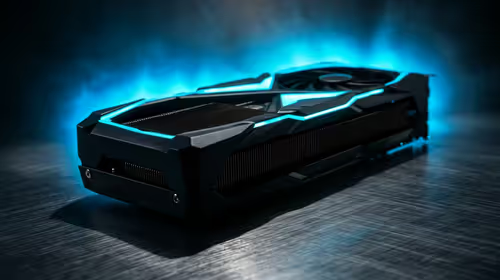
Arc B580 budget builds for Midrand gamers can shift with exchange rates, supply, specs, and model tier. Treat the title as a buying prompt, then compare SA warranty, timing, and build priorities.
Read more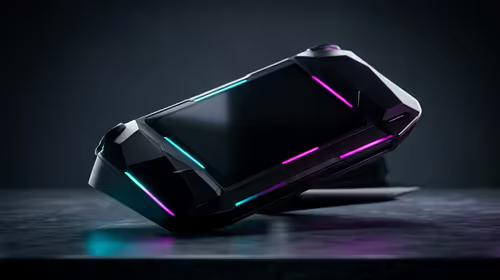
ROG Ally X may beat the LCD Steam Deck for SA gamers who value stronger handheld performance, more memory, and Windows flexibility. Compare battery life, controls, game libraries, and Polokwane support needs before deciding.
Read more
Minisforum's M2 Pro pairs Core Ultra X7, Arc B390 graphics and 32GB onboard memory in 1.8 litres. SA buyers should weigh its fixed memory and $1,439 launch offer against local mini PCs.

Lenovo says Legion Go failures linked to BIOS N3CN42WW are not user error. Affected SA owners should stop retrying the update, preserve proof and open a support case.

Smart monitors can add apps and convenience, but they also add privacy settings and unwanted-software risk. SA buyers should audit the operating system before paying for extras.

A fake 113GB GTA VI ISO reportedly used empty padding around a small malware payload. SA gamers should delete unofficial builds, keep Windows security active and wait for official channels.
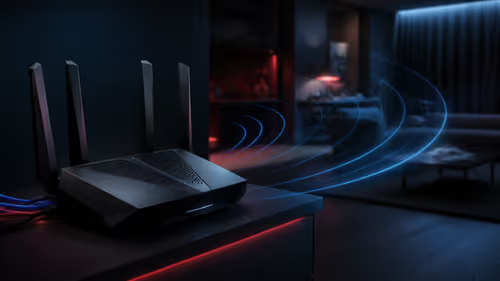
ASUS calls the ROG GT-BN98 the first Wi-Fi 8 gaming router. SA buyers should fix coverage and client limits before paying for a future wireless standard.
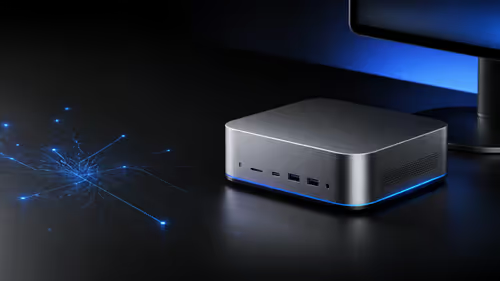
Apple's M6 Mac mini adds faster AI, graphics and networking in the same compact format. SA buyers should wait for a rand listing before comparing value.
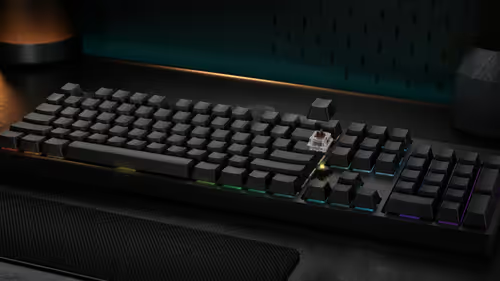
The Vulcan II XP adds hot-swappable switches, sound damping and gaming controls to a full-size wired board. SA buyers should compare feel before features.

Microsoft says Windows on Arm now has over 7,000 verified apps and games. SA buyers should still check each driver, game and work tool before switching.

Xbox Insiders can test disc-to-digital from 31 August 2026. Supported Xbox One and Series X discs gain a digital entitlement, but older discs, regions and title coverage still need exact checks.

ViewSonic's XG2738 pairs QHD QD-OLED with 240Hz and automatic panel care. SA buyers should compare warranty, brightness, ports and burn-in protection against today's R9,999-plus OLED shelf.

NVIDIA's final Windows 10 Game Ready driver is due in October 2026. SA gamers can keep using their GPU, but new game optimisations move on while critical security fixes continue quarterly.

JBL's new Quantum 520, 520X and 120 headsets cover wireless, Xbox-certified and wired use. SA buyers should compare connection, comfort and microphone needs before paying for a new badge.