


550W PSU Planning for RTX 5080 Super Builds in SA
550W for RTX 5080 Super needs a full-build check, not a simple yes. Review GPU guidance, CPU draw, transient load, connectors, PSU quality, and upgrade plans before deciding.
Read moreOLED pixel cleaning refreshes each subpixel's brightness to compensate for uneven diode wear, typically after four hours of on-time. Let the cycle finish rather than force a shutdown, and Evetech recommends this for every OLED monitor it sells.
OLED pixel-cleaning routines measure or compensate for changes in subpixel behaviour so the screen stays uniform as it ages. Many monitors schedule a short cycle after several hours of accumulated use, often when the display enters standby. The interval and name vary by model.
Leave the monitor connected to power and put it into standby after a long session. Let the automatic cycle finish. Run a manual panel refresh only when the maker's instructions or a persistent image issue calls for it, because the longer routine is not intended as an after-every-game habit.
Compare the wider monitor catalogue, current display best sellers and the dedicated OLED monitor range. Check each model's panel-care schedule and warranty rather than assuming a four-hour rule covers them all.
The monitor tracks panel use and applies compensation data to reduce visible non-uniformity as organic emitters age. A short cycle can complete in standby without a picture. A longer refresh may take much more time and use a separate menu command.
This process does not make every subpixel new or erase permanent wear. It can clear temporary retention and balance small response differences. Content habits, brightness, heat and total hours still affect the panel.
After gaming, switch the monitor off with its normal power control or let it enter standby. Do not cut mains power at a plug strip the moment the screen goes dark. An indicator light or on-screen message may show that maintenance is running.
Do not turn the display back on halfway through unless you need it. If the cycle is interrupted, the monitor may reschedule it. Follow the manual when the indicator behaviour is unclear.
Some displays prompt after accumulated hours. Accept at a convenient break instead of postponing it for days. A four-hour figure is common on selected OLEDs, not a universal standard.
A long manual refresh is a diagnostic and maintenance tool for persistent retention or a maker-directed schedule. Running it every day can add unnecessary compensation work and may change panel ageing.
Before using it, allow temporary retention to clear through normal mixed content and an automatic cycle. Photograph the issue on a neutral grey pattern, note total hours and read the exact manual. Contact support when uniformity remains poor.
Keep screen-shift, logo-dimming and static-content detection at their documented defaults during the test. Those protections work alongside compensation and can make one region look different while active. Reset unusual service or gaming options before judging uniformity.
No. Let the monitor's automatic schedule handle routine cycles and follow its exact manual.
It may reduce temporary retention and compensate for uneven response, but it cannot promise reversal of permanent wear.
Keep it powered in standby long enough to complete scheduled maintenance, according to the maker's guidance.
Let the OLED complete its automatic standby cycle, reserve manual refresh for documented cases and keep the exact model's panel-care schedule close.
No. Let the monitor's automatic schedule handle routine cycles and follow its exact manual.
It may reduce temporary retention and compensate for uneven response, but it cannot promise reversal of permanent wear.
Keep it powered in standby long enough to complete scheduled maintenance, according to the maker's guidance. {{PRODUCTS: { facets: { query: "OLED monitor with panel care" }, limit: 12, title: "Compare OLED Panel-Care Features", style: "4" } }}
550W for RTX 5080 Super needs a full-build check, not a simple yes. Review GPU guidance, CPU draw, transient load, connectors, PSU quality, and upgrade plans before deciding.
Read more
8000Hz polling is overrated for most SA gamers because gains can be tiny next to battery drain and monitor limits. Mbombela players should weigh mouse feel, game support, and system stability before chasing the number.
Read more
Magnetic switches are taking over SA gaming keyboards because actuation can be tuned. For Sandton gamers, rapid trigger, reset control, and profile depth can help, but layout, key feel, and software quality still matter.
Read more
Polokwane oled monitor value questions need cautious SA context because pricing can move with availability, exchange rates, specs, and warranty support. Treat the trend as a planning signal, not a fixed price promise.
Read more
Arc B580 budget builds for Midrand gamers can shift with exchange rates, supply, specs, and model tier. Treat the title as a buying prompt, then compare SA warranty, timing, and build priorities.
Read more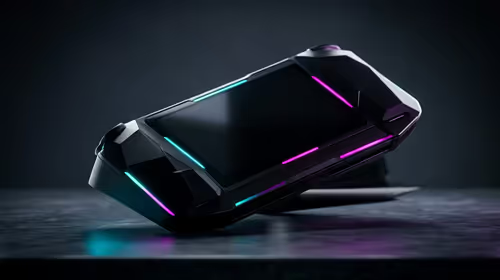
ROG Ally X may beat the LCD Steam Deck for SA gamers who value stronger handheld performance, more memory, and Windows flexibility. Compare battery life, controls, game libraries, and Polokwane support needs before deciding.
Read more
Minisforum's M2 Pro pairs Core Ultra X7, Arc B390 graphics and 32GB onboard memory in 1.8 litres. SA buyers should weigh its fixed memory and $1,439 launch offer against local mini PCs.

Lenovo says Legion Go failures linked to BIOS N3CN42WW are not user error. Affected SA owners should stop retrying the update, preserve proof and open a support case.

Smart monitors can add apps and convenience, but they also add privacy settings and unwanted-software risk. SA buyers should audit the operating system before paying for extras.

A fake 113GB GTA VI ISO reportedly used empty padding around a small malware payload. SA gamers should delete unofficial builds, keep Windows security active and wait for official channels.

ASUS calls the ROG GT-BN98 the first Wi-Fi 8 gaming router. SA buyers should fix coverage and client limits before paying for a future wireless standard.

Apple's M6 Mac mini adds faster AI, graphics and networking in the same compact format. SA buyers should wait for a rand listing before comparing value.

The Vulcan II XP adds hot-swappable switches, sound damping and gaming controls to a full-size wired board. SA buyers should compare feel before features.

Microsoft says Windows on Arm now has over 7,000 verified apps and games. SA buyers should still check each driver, game and work tool before switching.

Xbox Insiders can test disc-to-digital from 31 August 2026. Supported Xbox One and Series X discs gain a digital entitlement, but older discs, regions and title coverage still need exact checks.

ViewSonic's XG2738 pairs QHD QD-OLED with 240Hz and automatic panel care. SA buyers should compare warranty, brightness, ports and burn-in protection against today's R9,999-plus OLED shelf.

NVIDIA's final Windows 10 Game Ready driver is due in October 2026. SA gamers can keep using their GPU, but new game optimisations move on while critical security fixes continue quarterly.

JBL's new Quantum 520, 520X and 120 headsets cover wireless, Xbox-certified and wired use. SA buyers should compare connection, comfort and microphone needs before paying for a new badge.