


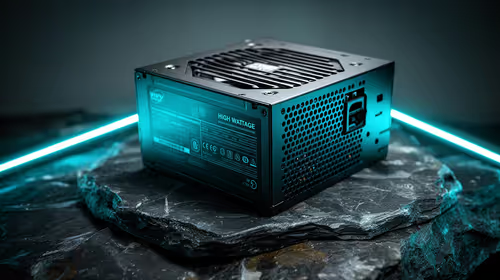
550W PSU Planning for RTX 5080 Super Builds in SA
550W for RTX 5080 Super needs a full-build check, not a simple yes. Review GPU guidance, CPU draw, transient load, connectors, PSU quality, and upgrade plans before deciding.
Read moreOptimise an Ampere workstation workflow by matching GPU resources to supported application tasks and project demands. The RTX A1000 costs R12,099; its 2304 CUDA cores work alongside a 128-bit memory interface and 8GB GDDR6 capacity.

Optimisation is most useful when it removes a measured delay, not when it changes every setting because the GPU belongs to a particular generation. An NVIDIA Ampere workstation GPU gives a hardware foundation; the workflow still determines which resources matter. Define the slow stage, establish a baseline and protect the output requirement before tuning.
This Ampere implementation delivers up to 6.74 TFLOPS FP32, 13.2 TFLOPS ray tracing and 53.8 TFLOPS Tensor performance in a 50W professional card.
Optimise an Ampere workstation by confirming software support, timing one repeatable task and altering a single constraint. The RTX A1000 is R12,099 and contains 2304 CUDA cores. It couples 8GB GDDR6 to a 128-bit interface, but the architecture cannot promise gains in every professional program.
Pick one operation that affects delivery: viewport navigation, a render pass, an effect preview or an export. Use the same file, output settings and application version for every run. Record completion time and any memory warning, then save a copy of the original configuration.
A baseline prevents subjective tuning. If the revised setup feels different but the task takes the same time, the change did not solve the measured problem. It may also reveal that CPU, storage or system memory is responsible, saving an unnecessary graphics-card replacement.
GPU memory and compute capacity answer different needs. Reduce temporary project complexity only if memory pressure is involved. Select a supported CUDA device only when the application can use that path. Keep quality settings aligned with the final deliverable rather than dropping them blindly.
The RTX A1000 is built on Ampere; compute is represented by 2304 CUDA cores, and 8GB GDDR6 sits behind a 128-bit interface. The specific PNY workstation card costs R12,099, giving the optimisation review a concrete configuration instead of an abstract architecture label.
Create a short test sequence. First run the untouched project. Next adjust one device or project setting. Then repeat after restarting the application if the change requires it. This makes regression obvious and lets another team member reproduce the result.
Do not infer improvement from utilisation alone. A high reading can mean the GPU is busy, but it does not state whether the work is efficient or whether another stage is waiting. Completion time, stability and output correctness remain the practical measures.
Use Evetech's professional graphics-card selection when the test shows that the GPU is the limiting component. Compare memory capacity and compute resources against the exact project, then preserve room in the budget for any CPU, RAM or storage constraint uncovered during diagnosis.
Some pipelines now include AI-assisted operations. The AI PC range helps those buyers compare whole systems, but each tool still needs its own support check. Ampere architecture, by itself, cannot confirm that a named model or feature will run as expected.
Once a change produces a repeatable benefit, save the application settings and name the project used to verify them. Record the date and software version as well. This creates a stable profile that can be restored after an update or compared with another workstation.
Do not copy the profile blindly to unrelated projects. Its purpose is to preserve one tested path and reveal when a later change alters behaviour. If a new file needs different memory or quality settings, create a second profile with its own baseline rather than overwriting the first.
Ampere's value here is visible in the complete A1000 rather than the architecture name alone. It combines those processing resources with 8GB GDDR6 moving through a 128-bit interface at 192GB/sec. The single-slot low-profile board can then fit a compact workstation and drive as many as four 5K displays through Mini DisplayPort 1.4a, giving optimisation work a precise hardware baseline.
Save that baseline beside the application version used for the test.
Begin with one slow, repeatable task and an unchanged project. A measured baseline provides a reference for every later adjustment.
No. Altering one condition at a time reveals which action helped and keeps the workflow easy to restore if the result gets worse.
It is the A1000's graphics-memory capacity. Compare active project demand with that limit rather than assuming the number is sufficient for every file.
Architecture identifies the GPU generation, not an application result. Relevant support and a repeatable workload test are needed to measure improvement.
Ready to replace guesswork with a controlled GPU test? Explore Evetech's workstation graphics choices after documenting the task, settings and project that your current setup struggles to complete.
Begin with one slow, repeatable task and an unchanged project. A measured baseline provides a reference for every later adjustment.
No. Altering one condition at a time reveals which action helped and keeps the workflow easy to restore if the result gets worse.
It is the A1000's graphics-memory capacity. Compare active project demand with that limit rather than assuming the number is sufficient for every file.
Architecture identifies the GPU generation, not an application result. Relevant support and a repeatable workload test are needed to measure improvement.
550W for RTX 5080 Super needs a full-build check, not a simple yes. Review GPU guidance, CPU draw, transient load, connectors, PSU quality, and upgrade plans before deciding.
Read more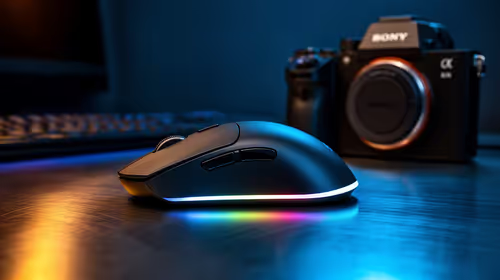
8000Hz polling is overrated for most SA gamers because gains can be tiny next to battery drain and monitor limits. Mbombela players should weigh mouse feel, game support, and system stability before chasing the number.
Read more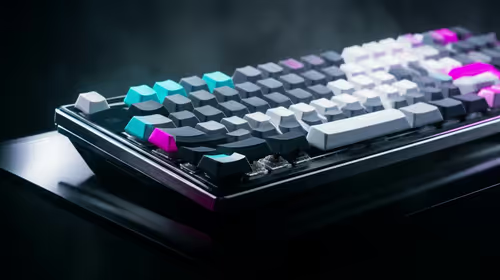
Magnetic switches are taking over SA gaming keyboards because actuation can be tuned. For Sandton gamers, rapid trigger, reset control, and profile depth can help, but layout, key feel, and software quality still matter.
Read more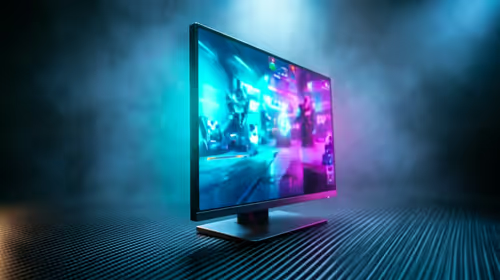
Polokwane oled monitor value questions need cautious SA context because pricing can move with availability, exchange rates, specs, and warranty support. Treat the trend as a planning signal, not a fixed price promise.
Read more
Arc B580 budget builds for Midrand gamers can shift with exchange rates, supply, specs, and model tier. Treat the title as a buying prompt, then compare SA warranty, timing, and build priorities.
Read more
ROG Ally X may beat the LCD Steam Deck for SA gamers who value stronger handheld performance, more memory, and Windows flexibility. Compare battery life, controls, game libraries, and Polokwane support needs before deciding.
Read more
Minisforum's M2 Pro pairs Core Ultra X7, Arc B390 graphics and 32GB onboard memory in 1.8 litres. SA buyers should weigh its fixed memory and $1,439 launch offer against local mini PCs.

Lenovo says Legion Go failures linked to BIOS N3CN42WW are not user error. Affected SA owners should stop retrying the update, preserve proof and open a support case.

Smart monitors can add apps and convenience, but they also add privacy settings and unwanted-software risk. SA buyers should audit the operating system before paying for extras.

A fake 113GB GTA VI ISO reportedly used empty padding around a small malware payload. SA gamers should delete unofficial builds, keep Windows security active and wait for official channels.
ASUS calls the ROG GT-BN98 the first Wi-Fi 8 gaming router. SA buyers should fix coverage and client limits before paying for a future wireless standard.
Apple's M6 Mac mini adds faster AI, graphics and networking in the same compact format. SA buyers should wait for a rand listing before comparing value.
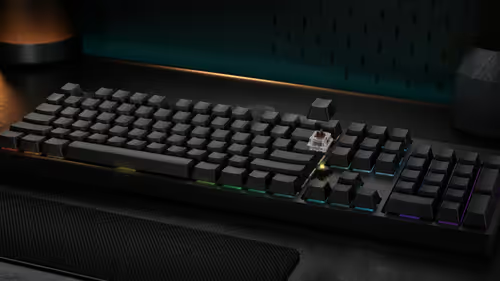
The Vulcan II XP adds hot-swappable switches, sound damping and gaming controls to a full-size wired board. SA buyers should compare feel before features.

Microsoft says Windows on Arm now has over 7,000 verified apps and games. SA buyers should still check each driver, game and work tool before switching.

Xbox Insiders can test disc-to-digital from 31 August 2026. Supported Xbox One and Series X discs gain a digital entitlement, but older discs, regions and title coverage still need exact checks.
ViewSonic's XG2738 pairs QHD QD-OLED with 240Hz and automatic panel care. SA buyers should compare warranty, brightness, ports and burn-in protection against today's R9,999-plus OLED shelf.

NVIDIA's final Windows 10 Game Ready driver is due in October 2026. SA gamers can keep using their GPU, but new game optimisations move on while critical security fixes continue quarterly.

JBL's new Quantum 520, 520X and 120 headsets cover wireless, Xbox-certified and wired use. SA buyers should compare connection, comfort and microphone needs before paying for a new badge.