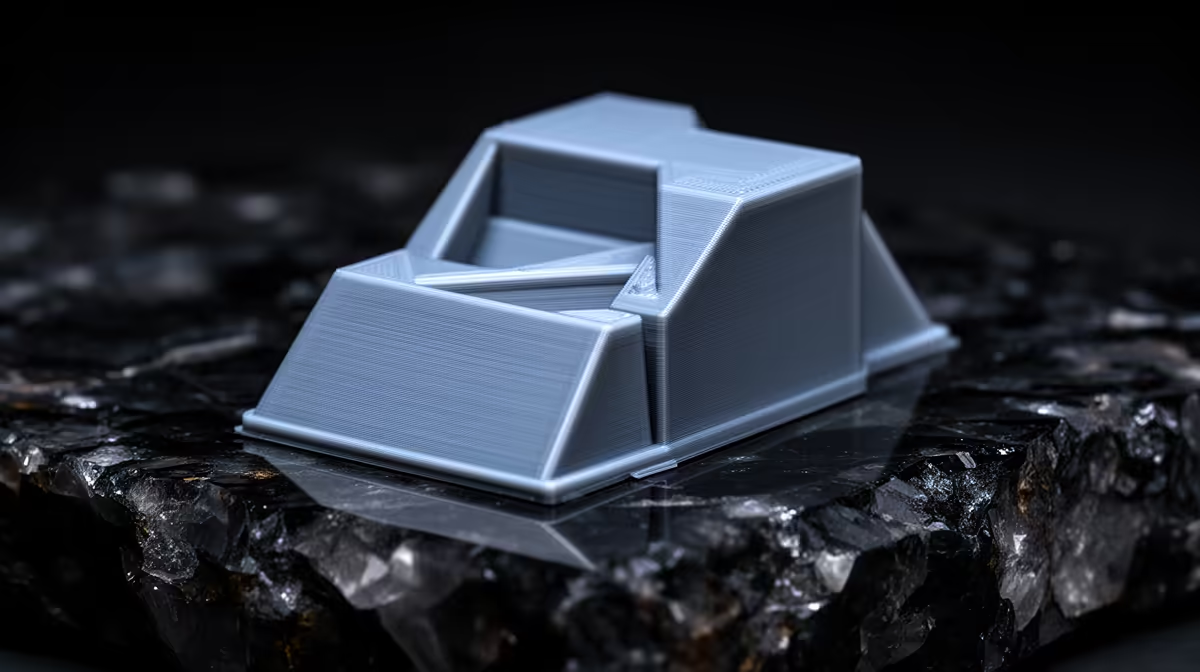
PETG rewards you with tough, slightly flexible prints, then punishes you with three signature failures: hairy stringing between parts, bed adhesion so fierce it gouges your plate, and ugly blobs deposited mid-travel. All three trace back to the same root cause, which is that PETG stays tacky and flows for longer than PLA. Tune for that behaviour and the filament behaves beautifully.
Quick Answer
Fix PETG stringing with stronger, slower retraction and a temperature drop of about 5 to 10 degrees; cure over-adhesion by lowering the bed by 10 to 15 degrees and adding a thin release layer like glue stick; stop blobbing by tightening temperature control and enabling coasting or wipe so the nozzle stops oozing on travel moves.
Fixing PETG stringing
Stringing happens because molten PETG keeps flowing after the nozzle should have stopped. Start by raising retraction distance in small steps and slowing the retraction speed so you do not grind the filament. Then nudge the hotend temperature down a few degrees at a time and reprint a small two-tower test; the strings should thin out with each pass.
Dry filament matters more with PETG than almost anything else. Moisture trapped in the spool turns to steam at the nozzle and shows up as fine wisps no retraction setting can cure, so a few hours in a filament dryer often clears stringing on its own.
A capable machine makes this tuning far easier, and the 3D printers carried at Evetech include models with the firm extrusion and stable hotends that PETG likes.
Curing bed over-adhesion
PETG bonds so well to smooth PEI and glass that it can rip chunks out of the surface when you remove a part. Counterintuitively, you usually fix this by reducing bed contact, not increasing it. Drop the bed temperature, raise the first-layer Z height very slightly, and add a release barrier such as a thin glue-stick film or a sheet of painter's tape.
A textured plate also helps, because it gives PETG a mechanical grip without the vacuum-tight weld a glassy surface creates. The goal is a part that holds during printing and pops free cleanly once cool.
Stopping blobbing and zits
Blobs and zits appear where the nozzle pauses, changes direction, or starts a new perimeter and leaves a little extra material behind. Tighten temperature so flow stays consistent, enable coasting and wiping so pressure bleeds off before a travel move, and make sure your retraction is doing its job from the stringing step.
Keeping a clean nozzle and the right small tools on hand turns this from a recurring headache into a quick fix. A lot of those handy extras sit in the printer accessory best-sellers, from cleaning kits to spare nozzles.
Frequently Asked Questions
Why is PETG so much stringier than PLA?
PETG stays molten and tacky across a wider window and is more sensitive to moisture, so it tends to ooze and form fine strands where PLA would snap clean. Drier filament and tuned retraction close most of the gap.
My PETG sticks too well and damages the bed. What do I do?
Lower the bed temperature, add a release layer such as glue stick or tape, and raise the first layer slightly. The aim is reliable adhesion during the print without a permanent weld that tears the surface on removal.
Does drying PETG really make a difference?
Yes, a large one. Wet PETG produces steam at the nozzle that shows up as wisps, popping and inconsistent flow. A few hours in a filament dryer often improves stringing and surface quality before you change any slicer setting.
What temperature should I print PETG at?
Most PETG prints well somewhere in the 230 to 250 degree range, but the right figure depends on your specific filament and hotend. Run a temperature tower and pick the lowest temperature that still gives clean layer bonding.
Can a textured plate help with PETG?
It can. A textured PEI sheet grips PETG mechanically without the airtight bond a smooth plate creates, so parts hold while printing and release more easily once cool.
Ready to make PETG behave? Pair a well-tuned printer from the Evetech 3D printer range with fresh, dry filament and work through stringing, adhesion and blobbing one setting at a time.