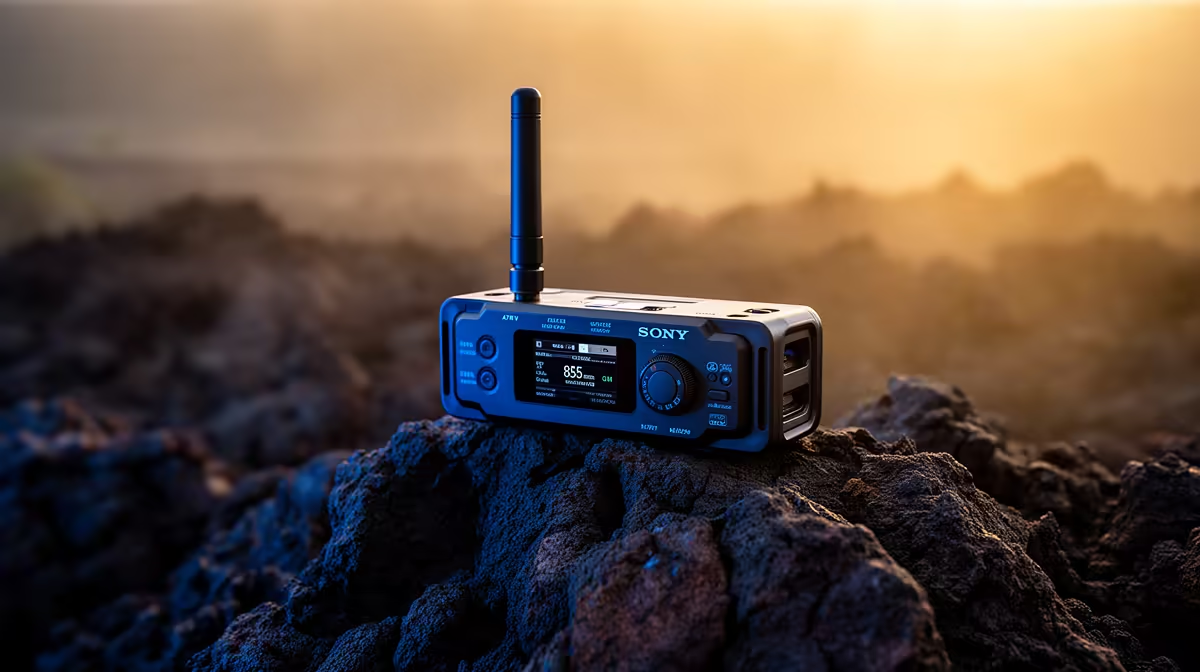
The moment the director calls action at an outdoor shoot, your wireless audio system faces a set of challenges no studio recording ever encounters. Bodies move, buildings obstruct, and the radio spectrum in any populated South African location is cluttered with Wi-Fi, cellular signals, and competing wireless systems. Reliable wireless audio transmission at an outdoor shoot comes down to three decisions made before the shoot starts: the right frequency band, a receiver with proper antenna diversity, and a channel scan that confirms a clean path before recording begins.
Quick Answer
Outdoor wireless audio reliability depends on a clean 2.4GHz or UHF frequency band, clear line of sight within about 100 metres, and a diversity receiver with two antennas. Scan for interference before the shoot. Near events or crowded locations, UHF tends to dodge the congestion that clogs the open 2.4GHz band.
🌐 Choosing the Right Frequency Band
Most affordable wireless microphone systems operate in the 2.4GHz band. It is licence-free in South Africa, works without frequency coordination, and connects quickly, making it the default for run-and-gun setups. The limitation outdoors is that 2.4GHz is the same band as almost every Wi-Fi router, smartphone hotspot, and Bluetooth device in the vicinity.
At a location dense with phones, a public park near a fibre-connected neighbourhood, or an event with broadcast infrastructure, the 2.4GHz band is heavily contested. UHF systems occupy a portion of the spectrum that sees far less casual congestion, handles body interference more gracefully, and propagates more reliably at typical shooting distances. For professional outdoor productions where audio dropout is not acceptable, UHF is the practical choice.
Digital 2.4GHz systems with frequency-hopping spread spectrum technology sit between these two options. They continuously shift transmit frequency to avoid occupied channels, improving reliability in crowded environments without the cost of full UHF gear.
📡 Line of Sight and the 100-Metre Limit
Outdoor range figures assume unobstructed line of sight. In practice, several factors cut into that number. The human body blocks radio signals, and a presenter's torso can move between transmitter and receiver as they turn. A true diversity receiver with two antennas addresses this directly by switching continuously to whichever antenna has the stronger signal.
Physical obstructions reduce effective range faster than specification sheets suggest. A 100-metre rated system may deliver reliable audio at 60 metres through a busy crowd. Shooting within 50 to 60 metres at South African outdoor locations gives a reliable safety margin.
Coastal humidity along the eastern seaboard and around Cape Town slightly reduces effective range by increasing signal absorption. Keeping transmitters dry and shortening working distance modestly in humid conditions maintains transmission quality.
🔧 Pre-Shoot Frequency Scanning
A channel scan takes a few minutes and is the single most effective step before pressing record. Most quality wireless systems include a scan function in the receiver menu that shows which frequencies are occupied and which are clear. Arriving 20 minutes early to scan gives real information about what is actually in the spectrum that day.
For shoots using multiple wireless microphone systems, assign each system to a separate frequency confirmed clear by the scan. Systems sharing a frequency or on adjacent channels cause intermodulation, a form of self-created interference that produces tones and crackle independently of the surrounding spectrum.
⚡ Battery Management on a Full Outdoor Day
A wireless transmitter losing power mid-shoot cannot be fixed in post. Most quality transmitters deliver six to eight hours on a charge, but outdoor conditions push the lower edge of that range. Carry at least two spare batteries per device and start every shooting day with a full charge. Check receiver battery indicators before the most critical sections of the shoot rather than waiting for a low-battery warning, since the gap between warning and failure is narrower than most indicators suggest.
Frequently Asked Questions
How far can outdoor wireless microphones reliably transmit?
Around 100 metres under ideal line-of-sight conditions. Obstructions, crowds, and coastal humidity all reduce that in practice. Shooting within 50 to 60 metres at South African outdoor locations provides a reliable safety margin.
Which frequency band resists interference better at outdoor events?
UHF generally outperforms 2.4GHz near events and locations dense with smartphones. The 2.4GHz band is heavily contested in populated outdoor spaces, while UHF occupies a less congested portion of the spectrum.
How do I prevent audio dropouts when the presenter is moving?
Use a true diversity receiver with two antennas. The receiver monitors both antennas and switches to the stronger one in real time, directly addressing the body-obstruction problem as the presenter turns.
Will using multiple wireless microphones at the same shoot cause interference?
Only if they share a frequency or sit on adjacent channels. Run a spectrum scan before the shoot and assign each system to a confirmed clear channel with adequate separation from neighbouring units.
Ready to keep your outdoor audio rock-steady from first take to last? Browse the wireless microphone range for South African video productions and find a system rated for the range and environment your shoots actually demand.