Quick Answer
For Zenless Zone Zero, the Ryzen 5 9600X and RTX 5080 are a comfortable, well-matched pair at 1440p. Zenless Zone Zero is a stylish action gacha capped at 60 fps that runs comfortably on modest hardware, so the RTX 5080 (16GB) cruises and the Ryzen 5 9600X is never the weak link. Expect a smooth, well above 60 fps experience with headroom to spare.
Zenless Zone Zero at 1440p: how the RTX 5080 behaves
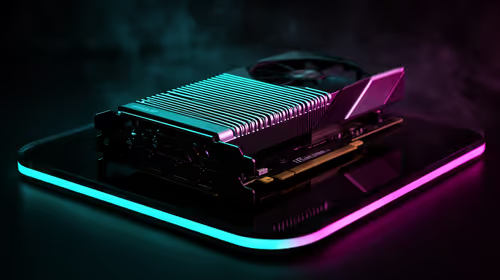
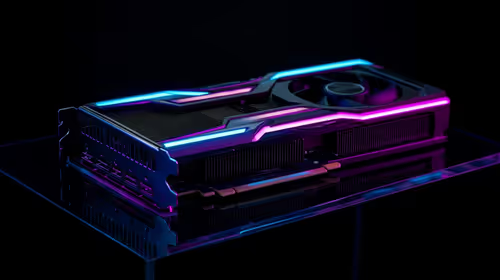
The RTX 5080 is a enthusiast card and a 4K-capable card that treats 1440p as a high-refresh playground. At 1440p it is rarely the limiting part, so the cpu does more of the talking. In Zenless Zone Zero you can expect roughly 150-220 fps at 1440p with sensible high settings, depending on whether you lean on DLSS or FSR upscaling. Because Zenless Zone Zero is a stylish action gacha capped at 60 fps that runs comfortably on modest hardware, the headroom you actually feel comes down to how hard the engine pushes each frame. At Evetech the RTX 5080 currently sits around R28,000, which sets the budget anchor for a balanced build.
Does the Ryzen 5 9600X hold the RTX 5080 back?
The Ryzen 5 9600X brings 6 cores and 12 threads of Zen 5 silicon with fast Zen 5 cores with strong per-core performance, and at around R6,500 it is a sensible partner for this class of GPU. The honest answer for Zenless Zone Zero is no real bottleneck. A 6-core chip is most exposed in simulation-heavy or effect-dense scenes; in lighter moments it sits well within its limits and lets the RTX 5080 run free. If you mostly chase smooth 1% lows rather than peak averages, keep an eye on background apps and fast DDR5 memory before blaming the CPU.
Getting the best out of this pairing in SA
For South African buyers, the practical wins are mundane but real: run 6000MT/s DDR5 in dual channel, keep the latest GPU driver installed, and turn on DLSS 4 or FSR 4 quality mode to lift frame rates without obvious image loss. Cap your frame rate a few frames under your monitor's refresh ceiling (a 165Hz panel pairs nicely here) so the Ryzen 5 9600X is not chasing pointless extra frames. With those basics sorted, this balanced setup handles Zenless Zone Zero confidently at 1440p.
FAQ
Is the Ryzen 5 9600X enough for the RTX 5080 in Zenless Zone Zero?
Yes for the vast majority of play. The result is no real bottleneck, so you get a balanced 1440p experience. The RTX 5080 (16GB) stays the part that decides your settings in most scenes.
What frame rate can I expect at 1440p?
Plan for roughly 150-220 fps at high settings in Zenless Zone Zero, shifting with upscaling and ray tracing. A 144Hz or 165Hz monitor is a good match for that range. Enabling DLSS or FSR quality mode adds a comfortable buffer.
Should I upgrade the CPU or the GPU first?
With this pairing already aligned, neither needs an urgent swap for Zenless Zone Zero. If you later move to 4K, the RTX 5080 works harder and the Ryzen 5 9600X matters less. If you chase 240Hz esports frame rates, a faster CPU helps more than a bigger GPU.
Quick check
Before you buy, confirm your power supply suits the RTX 5080 and that your case has clearance and airflow for it. Pair the Ryzen 5 9600X with 32GB of 6000MT s DDR5 and a 1440p high-refresh monitor for the most balanced result in Zenless Zone Zero.