


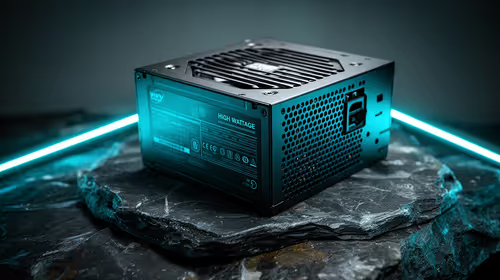
550W PSU Planning for RTX 5080 Super Builds in SA
550W for RTX 5080 Super needs a full-build check, not a simple yes. Review GPU guidance, CPU draw, transient load, connectors, PSU quality, and upgrade plans before deciding.
Read moreFibre delivers the steadier, lower-latency connection cloud gaming needs, while 5G can match its speed on paper but suffers more from congestion and inconsistent signal in South Africa. For any serious cloud gaming session, a stable fibre line remains the safer bet.

A huge download number cannot smooth every cloud-gaming frame. The real fibre vs 5G for cloud gaming test is stability: latency, jitter and congestion across the hours when you want to play.
South African fibre is often the calmer cloud-gaming link because latency and capacity stay steadier through a fixed line. A good 5G connection can also stream well, especially near a lightly loaded site with strong signal. Peak download speed does not choose the winner. Measure latency, jitter and packet loss at the exact gaming spot during the hours you play. Connect the console, PC or TV by Ethernet where possible, even when the home's upstream connection is 5G.
Cloud gaming sends compressed video down and control input up. It needs enough throughput, then it needs packets to arrive at an even rhythm. Jitter creates uneven response. Packet loss causes visual break-up or pauses. Latency makes your action feel late.
A 500Mbps result with unstable latency can feel worse than a clean 50Mbps line. Test to the service region when the app offers its own network check. A generic nearby speed-test server may hide the route your game uses.
Fibre avoids radio signal between your home and provider. That often gives consistent latency and resists weather or cell congestion. The provider's backhaul, peering and fault state still matter. A weak Wi-Fi router can ruin an excellent fibre line in the last ten metres.
Run Ethernet from router to the streaming screen. If that is impossible, place a modern access point in the same room and use a clean band. Do not bury it behind the television.
5G can deliver ample throughput and low delay with strong signal. Performance changes as the cell loads, your router shifts bands or indoor signal fades. Test at 20:00, not only on a quiet weekday morning.
Position the 5G router from measured signal information rather than where the plug looks neat. Then connect the gaming device to that router by cable. This removes local Wi-Fi from the path while keeping 5G as the access link.
Play a cloud game for fifteen minutes while the network is quiet. Then ask another person to start a 4K stream and upload a file. Watch for input delay and image break-up. This recreates the home you have, not a laboratory line.
Router traffic management can protect the gaming stream from one large download. It cannot repair high latency between your provider and the cloud service. Test another service or route before blaming the controller.
If 5G changes sharply by time of day, repeat the test over several evenings. If fibre is available, ask neighbours on the same provider about local fault handling and peak-time behaviour rather than choosing from an advertised maximum.
Compare gaming controllers and popular peripheral options after the network test, because a controller cannot repair unstable streaming.
No. Peak speed varies by plan and location. Fibre often wins on consistency, which matters more to cloud controls.
Yes. It removes the in-home wireless hop between the router and gaming device.
Watch round-trip latency, jitter, packet loss and behaviour during the hour you normally play.
Test fibre or 5G at your gaming position first, then choose the controller and screen for a stream that already feels stable.
No. Peak speed varies by plan and location. Fibre often wins on consistency, which matters more to cloud controls.
Yes. It removes the in-home wireless hop between the router and gaming device.
Watch round-trip latency, jitter, packet loss and behaviour during the hour you normally play.
550W for RTX 5080 Super needs a full-build check, not a simple yes. Review GPU guidance, CPU draw, transient load, connectors, PSU quality, and upgrade plans before deciding.
Read more
8000Hz polling is overrated for most SA gamers because gains can be tiny next to battery drain and monitor limits. Mbombela players should weigh mouse feel, game support, and system stability before chasing the number.
Read more
Magnetic switches are taking over SA gaming keyboards because actuation can be tuned. For Sandton gamers, rapid trigger, reset control, and profile depth can help, but layout, key feel, and software quality still matter.
Read more
Polokwane oled monitor value questions need cautious SA context because pricing can move with availability, exchange rates, specs, and warranty support. Treat the trend as a planning signal, not a fixed price promise.
Read more
Arc B580 budget builds for Midrand gamers can shift with exchange rates, supply, specs, and model tier. Treat the title as a buying prompt, then compare SA warranty, timing, and build priorities.
Read more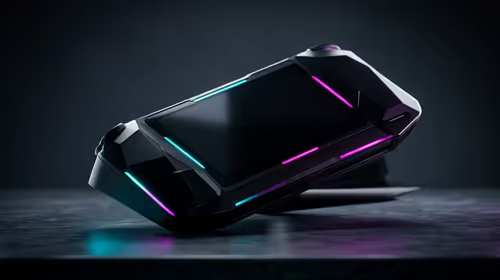
ROG Ally X may beat the LCD Steam Deck for SA gamers who value stronger handheld performance, more memory, and Windows flexibility. Compare battery life, controls, game libraries, and Polokwane support needs before deciding.
Read more
Minisforum's M2 Pro pairs Core Ultra X7, Arc B390 graphics and 32GB onboard memory in 1.8 litres. SA buyers should weigh its fixed memory and $1,439 launch offer against local mini PCs.

Lenovo says Legion Go failures linked to BIOS N3CN42WW are not user error. Affected SA owners should stop retrying the update, preserve proof and open a support case.

Smart monitors can add apps and convenience, but they also add privacy settings and unwanted-software risk. SA buyers should audit the operating system before paying for extras.

A fake 113GB GTA VI ISO reportedly used empty padding around a small malware payload. SA gamers should delete unofficial builds, keep Windows security active and wait for official channels.
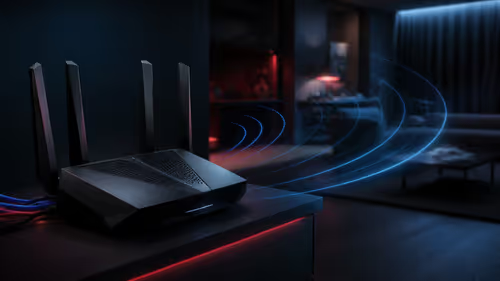
ASUS calls the ROG GT-BN98 the first Wi-Fi 8 gaming router. SA buyers should fix coverage and client limits before paying for a future wireless standard.
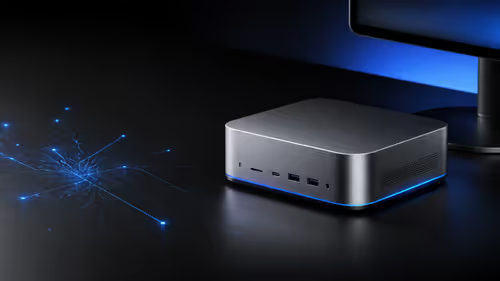
Apple's M6 Mac mini adds faster AI, graphics and networking in the same compact format. SA buyers should wait for a rand listing before comparing value.
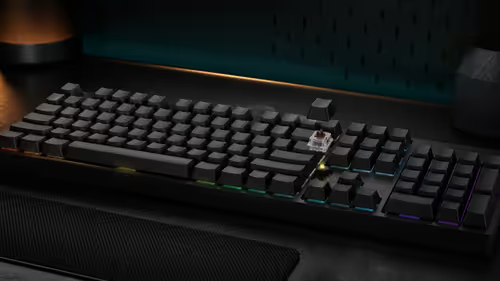
The Vulcan II XP adds hot-swappable switches, sound damping and gaming controls to a full-size wired board. SA buyers should compare feel before features.

Microsoft says Windows on Arm now has over 7,000 verified apps and games. SA buyers should still check each driver, game and work tool before switching.

Xbox Insiders can test disc-to-digital from 31 August 2026. Supported Xbox One and Series X discs gain a digital entitlement, but older discs, regions and title coverage still need exact checks.
ViewSonic's XG2738 pairs QHD QD-OLED with 240Hz and automatic panel care. SA buyers should compare warranty, brightness, ports and burn-in protection against today's R9,999-plus OLED shelf.

NVIDIA's final Windows 10 Game Ready driver is due in October 2026. SA gamers can keep using their GPU, but new game optimisations move on while critical security fixes continue quarterly.

JBL's new Quantum 520, 520X and 120 headsets cover wireless, Xbox-certified and wired use. SA buyers should compare connection, comfort and microphone needs before paying for a new badge.