


550W PSU Planning for RTX 5080 Super Builds in SA
550W for RTX 5080 Super needs a full-build check, not a simple yes. Review GPU guidance, CPU draw, transient load, connectors, PSU quality, and upgrade plans before deciding.
Read moreThe primary NVMe ssd slot on most motherboards connects directly to the CPU's PCIe lanes, while a second slot often routes through the chipset, sharing bandwidth elsewhere. Evetech recommends checking the manual for lane sharing before expecting identical speed.
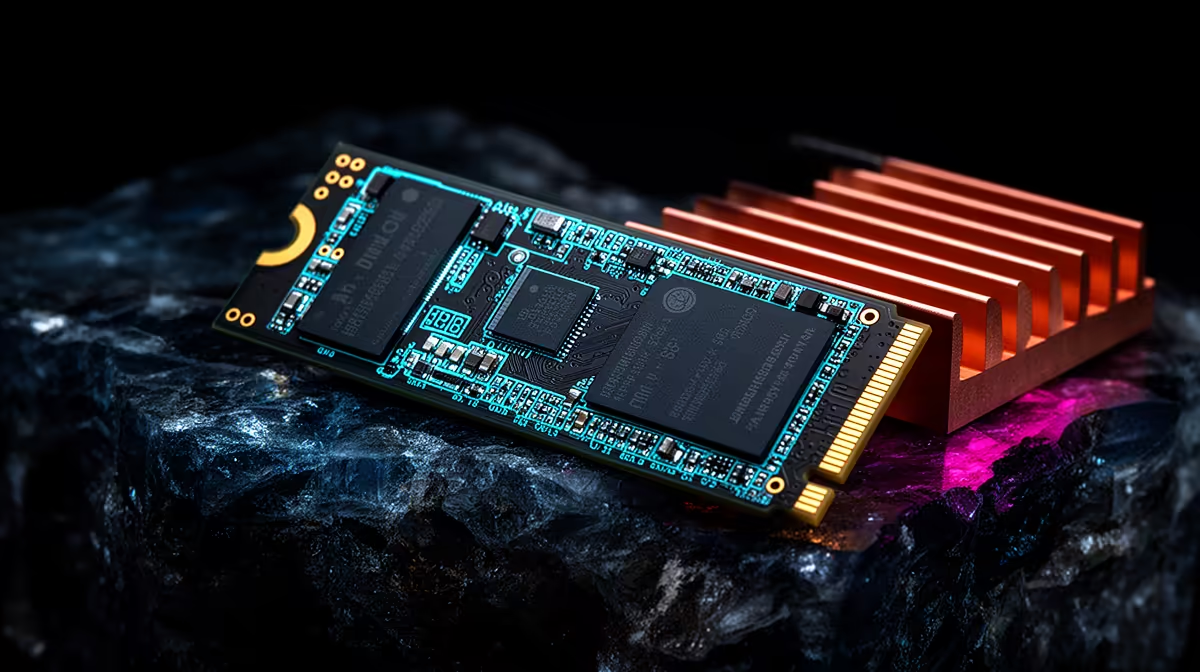
Two M.2 slots on one board can take identical drives and connect through different paths. A slower second NVMe slot often reflects chipset lanes, shared bandwidth or negotiated link speed documented in the motherboard manual.
The second M.2 slot is slower only when its documented PCIe generation, lane count or shared path limits the SSD. Many primary slots connect to CPU lanes, while extra slots may connect through the chipset or another CPU lane block. A chipset-connected Gen4 x4 slot can still reach strong sequential speed. Read the motherboard lane table because installing one drive can disable a SATA port, reduce another slot or share upstream bandwidth.
M2_1 often names the top socket near the CPU, but makers use different labels. The manual lists supported drive types, PCIe generation, lane width and CPU requirements for every socket.
Some slots accept PCIe NVMe only. Others also support SATA M.2 drives. A SATA M.2 SSD placed in an NVMe-only socket will not appear even though the card fits.
CPU generation can matter. A board may advertise a Gen5 slot that drops to Gen4 or becomes unavailable with a processor that exposes fewer lanes.
A chipset-connected SSD sends data through the chipset's link to the CPU. USB, networking, SATA and expansion devices may share that route. One game drive rarely saturates all of it for long.
Large simultaneous transfers between several chipset devices can expose the limit. Measure the workload you have: moving video between two fast SSDs, capturing to storage and using multi-gig networking at once is different from loading one game.
Latency can also differ by a small amount between CPU and chipset paths. It seldom transforms ordinary game loading on its own.
Use the CPU-connected slot for a Gen5 drive or a scratch workload that can sustain high transfers. A game library or bulk drive can sit in a chipset Gen4 slot when its performance target fits.
Cooling may change the answer. The top slot near the GPU can receive more heat, while another socket has a better heatsink or airflow. Log drive temperature and thermal throttling during a long transfer.
Motherboard block diagrams and storage tables show which SATA port or PCIe slot changes when an M.2 socket is occupied. Check BIOS settings when the drive is absent and update firmware through the documented route if compatibility notes call for it.
Compare exact drives in the SSD range, use the SSD best-seller page for popular alternatives and browse the NVMe SSD range by interface.
No. Its PCIe generation, lane count, connection and sharing rules decide the limit.
Yes, on boards with lane or port sharing. The manual storage table lists the exact combination.
Use the slot that fits its performance, CPU support and cooling needs. Booting alone does not require the fastest socket.
Open the motherboard lane table, label every M.2 path and install each SSD where its workload and cooling fit.
No. Its PCIe generation, lane count, connection and sharing rules decide the limit.
Yes, on boards with lane or port sharing. The manual storage table lists the exact combination.
Use the slot that fits its performance, CPU support and cooling needs. Booting alone does not require the fastest socket.
550W for RTX 5080 Super needs a full-build check, not a simple yes. Review GPU guidance, CPU draw, transient load, connectors, PSU quality, and upgrade plans before deciding.
Read more
8000Hz polling is overrated for most SA gamers because gains can be tiny next to battery drain and monitor limits. Mbombela players should weigh mouse feel, game support, and system stability before chasing the number.
Read more
Magnetic switches are taking over SA gaming keyboards because actuation can be tuned. For Sandton gamers, rapid trigger, reset control, and profile depth can help, but layout, key feel, and software quality still matter.
Read more
Polokwane oled monitor value questions need cautious SA context because pricing can move with availability, exchange rates, specs, and warranty support. Treat the trend as a planning signal, not a fixed price promise.
Read more
Arc B580 budget builds for Midrand gamers can shift with exchange rates, supply, specs, and model tier. Treat the title as a buying prompt, then compare SA warranty, timing, and build priorities.
Read more
ROG Ally X may beat the LCD Steam Deck for SA gamers who value stronger handheld performance, more memory, and Windows flexibility. Compare battery life, controls, game libraries, and Polokwane support needs before deciding.
Read more
Minisforum's M2 Pro pairs Core Ultra X7, Arc B390 graphics and 32GB onboard memory in 1.8 litres. SA buyers should weigh its fixed memory and $1,439 launch offer against local mini PCs.

Lenovo says Legion Go failures linked to BIOS N3CN42WW are not user error. Affected SA owners should stop retrying the update, preserve proof and open a support case.

Smart monitors can add apps and convenience, but they also add privacy settings and unwanted-software risk. SA buyers should audit the operating system before paying for extras.

A fake 113GB GTA VI ISO reportedly used empty padding around a small malware payload. SA gamers should delete unofficial builds, keep Windows security active and wait for official channels.
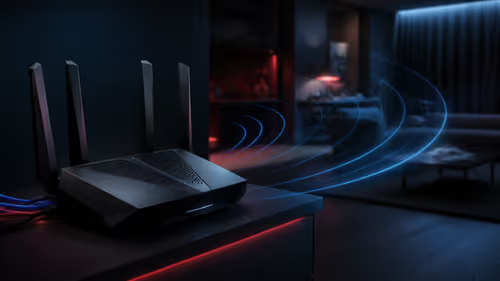
ASUS calls the ROG GT-BN98 the first Wi-Fi 8 gaming router. SA buyers should fix coverage and client limits before paying for a future wireless standard.
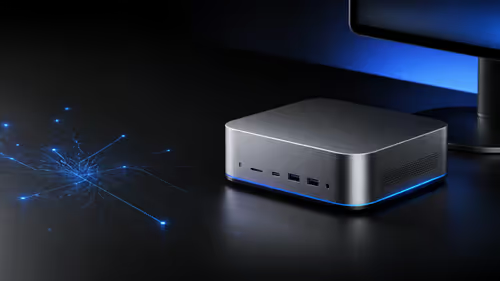
Apple's M6 Mac mini adds faster AI, graphics and networking in the same compact format. SA buyers should wait for a rand listing before comparing value.
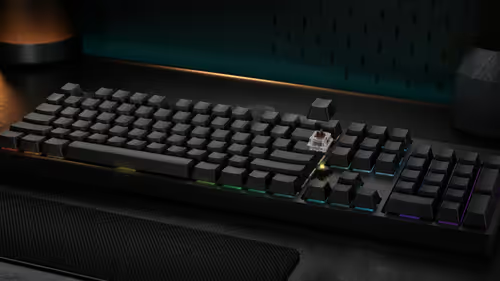
The Vulcan II XP adds hot-swappable switches, sound damping and gaming controls to a full-size wired board. SA buyers should compare feel before features.

Microsoft says Windows on Arm now has over 7,000 verified apps and games. SA buyers should still check each driver, game and work tool before switching.

Xbox Insiders can test disc-to-digital from 31 August 2026. Supported Xbox One and Series X discs gain a digital entitlement, but older discs, regions and title coverage still need exact checks.
ViewSonic's XG2738 pairs QHD QD-OLED with 240Hz and automatic panel care. SA buyers should compare warranty, brightness, ports and burn-in protection against today's R9,999-plus OLED shelf.

NVIDIA's final Windows 10 Game Ready driver is due in October 2026. SA gamers can keep using their GPU, but new game optimisations move on while critical security fixes continue quarterly.

JBL's new Quantum 520, 520X and 120 headsets cover wireless, Xbox-certified and wired use. SA buyers should compare connection, comfort and microphone needs before paying for a new badge.