A flagship board should solve problems a mid-range platform cannot, not merely display more connections. In the mid-range versus flagship AM5 decision, a strong gaming PC can begin at either tier if the exact CPU, DDR5, storage and network plan fit.
Quick Answer
Choose mid-range when it covers every required device with sensible expansion; choose flagship when exceptional storage or networking will be used. The X870E Extreme sets a R24,899 reference through five SSD locations and three network routes, while PCIe 5.0 capability and E-ATX dimensions extend the comparison.
?? Write the pass list
Confirm the processor through Evetech's AMD CPU selection, DDR5, graphics fit, drives and case. Any board missing an essential item fails regardless of tier.
?? Price expansion
Five M.2 positions suit a storage-heavy system. One- or two-drive builds may not benefit enough.
Compare X870 motherboard designs by exact layout and service access.
Reserve credible growth
An open slot needs a plausible device and timing. Undefined headroom should receive limited value.
?? Price networking
Ten-gigabit LAN needs compatible local infrastructure. Wi-Fi 7 needs suitable wireless equipment and room conditions. A stable conventional route may meet a gaming-only build.
At R24,899, several premium features should be active together.
?? Compare full PCs
Use Evetech's broad AMD motherboard range to build a mid-range alternative. Keep the total budget equal and place the difference into graphics or storage.
The winner is the complete system that serves the target games and work.
Include E-ATX cost
The Extreme needs a compatible chassis. Count that physical requirement before declaring the flagship premium worthwhile.
Audit later
After a month, note which board features were used. Ownership evidence improves the next purchase.
Compare the storage timeline
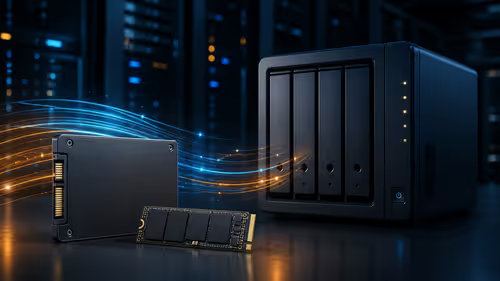
List launch drives and the next planned addition. A mid-range board can be sufficient when it offers suitable positions for both, while five M.2 routes help a storage-heavy workstation grow further.
Do not fill capacity just to validate a flagship choice. Install drives as their workloads become real and keep the layout documented.
Price network dependencies
Include router, switch, cable and endpoint requirements. Ten-gigabit LAN needs a complete compatible path, while Wi-Fi 7 depends on the room and wireless equipment.
This wider basket prevents a premium port from being valued as finished performance when the rest of the network will remain unchanged.
Keep gaming balance visible
Compare graphics, SSD capacity and cooling at the same total system price. The flagship must enable tasks that outweigh any compromise created elsewhere.
Find the first missing requirement
Start with the least expensive candidate and move upward only when an essential CPU, storage, network or case requirement is absent. Write down the missing item and the cost of solving it another way.
This creates a clear point where flagship spending begins to earn value. If the mid-range board passes every real requirement, the higher tier must compete against the graphics, SSD capacity or display improvement purchased with the difference.
If several add-in workarounds, storage compromises and network limitations appear, the Extreme can become the cleaner system choice. The decision follows accumulated constraints rather than the label attached to either tier.
Frequently Asked Questions
When is mid-range sufficient'
It is sufficient when the exact CPU, DDR5, devices, network and expansion plan all fit.
What makes the Extreme flagship'
Its R24,899 package combines broad M.2 capacity, modern expansion and advanced networking.
Who benefits from five M.2 positions'
Users with several defined storage roles or credible staged growth.
Does mid-range reduce frame rates'
Not automatically. The complete build and game determine performance.
What physical trade-off applies'
The Extreme is E-ATX and requires a suitable case.
Ready to choose an AM5 tier without prestige pricing'
Compare Evetech's motherboards inside two equal-budget systems and fund flagship breadth only where the workload proves it useful.