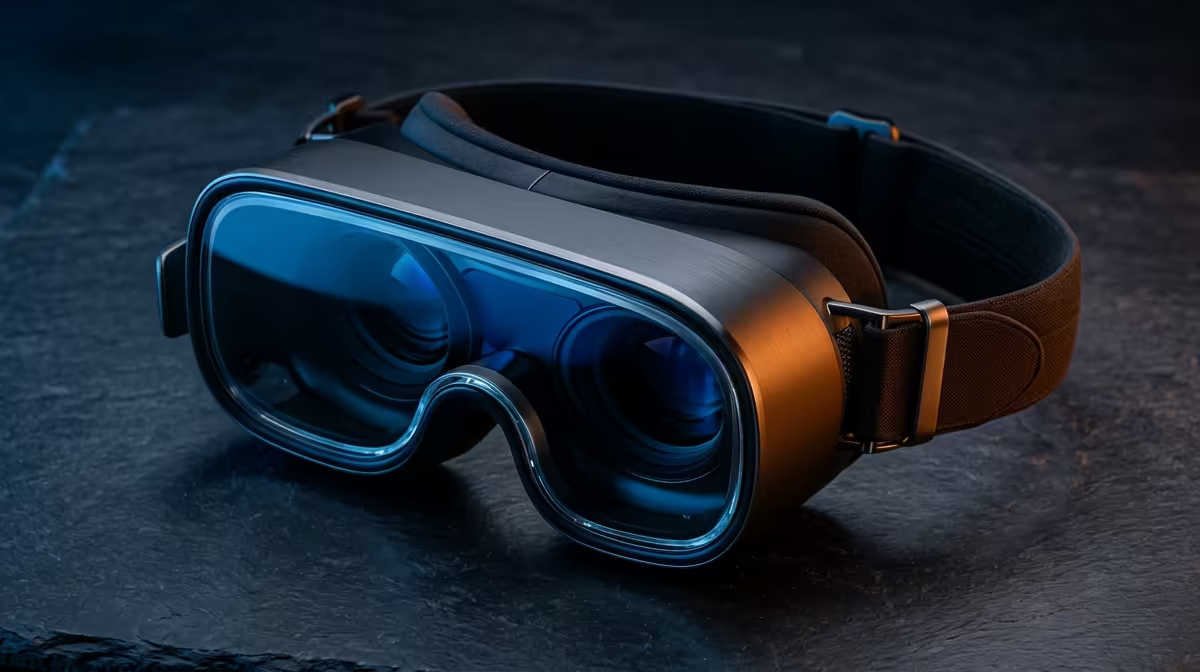
PC VR in 2026 looks very different from the tethered-headset era. The centre of gravity has shifted to standalone headsets running PC games over a Link connection, with Meta trimming its hardware spend and Valve stepping back in. For SA gamers the smartest path to PC VR is rarely a dedicated wired headset anymore, it is a capable standalone paired with a PC you may already own.
Quick Answer
Yes, PC VR is still worth it in 2026, but the rig has changed. The best-value setup for most SA gamers is a Quest 3 connected to an existing RTX gaming PC over Link, not a separate tethered headset. You get high-end PC titles plus standalone games from one device, and you skip the cost of a dedicated wired rig.
How the landscape shifted
For years PC VR meant a headset cabled directly to a tower with external sensors around the room. That model has faded. Standalone headsets grew powerful enough to render solid VR on their own, then gained the ability to stream PC games wirelessly or over a USB cable. Meta has scaled back its heavy hardware subsidies, and Valve re-entering the space has renewed interest without forcing anyone back to bulky tethered kit.
The result is a single device that plays both worlds: untethered standalone titles when you want simplicity, and full PC VR libraries when you want graphics horsepower. That flexibility is why a standalone-plus-PC combo now beats a dedicated wired headset for most people. If augmented reality is more your interest, the AR glasses category at Evetech is worth a look alongside the VR options.
What you actually need to build
The headset is only half the rig. PC VR leans hard on the GPU, because the machine must push separate full-resolution images to each eye at a high refresh rate -- drop below that target and nausea follows quickly. An RTX card is the heart of it. A mid-range current-gen RTX GPU handles most PC VR titles well, and a higher-end card gives you headroom for demanding sims and higher render resolutions.
Beyond the GPU, a current-generation processor with multiple cores, 16 GB of RAM at minimum, and an SSD to keep load times short round out the build. If you already game on an RTX PC, the system is likely ready. Adding a Quest 3 connected over Link is often the only remaining step.
Is it worth the spend in 2026?
For SA gamers the value case is strong precisely because you avoid duplicate hardware. Buying a dedicated tethered headset means paying for a device that only works chained to your PC. A standalone headset earns its keep twice: it plays VR on its own and doubles as your PC VR display over Link. That makes the money go further on local pricing.
The honest caveat is that VR remains a GPU-hungry hobby. If your current card struggles, the upgrade is the real cost, not the headset. To see which graphics cards SA builders are buying for high-frame-rate work, the accessories best sellers listing gives a quick pulse on popular supporting gear.
Frequently Asked Questions
Do I need a separate wired headset for PC VR in 2026?
No. A standalone headset like the Quest 3 connects to a PC over Link, giving you full PC VR without a dedicated tethered device. For most gamers that is the better-value route.
What GPU do I need for PC VR?
A current-generation mid-range RTX card runs most PC VR titles smoothly, while higher-end cards add headroom for demanding sims and higher render resolutions. In a VR build, the graphics card carries more weight than any other component.
Can I use my existing gaming PC for VR?
Usually yes, if it has a reasonably modern RTX GPU, a multi-core CPU, at least 16GB of RAM, and an SSD. Many gaming PCs are VR-ready without any upgrade.
Is wireless PC VR good enough now?
Wireless Link over a strong local network is very usable in 2026, though a USB cable still gives the most consistent latency. Both approaches let one headset serve standalone and PC VR duty.
Ready to build or upgrade a VR-ready rig? Browse the RTX graphics cards at Evetech to find the GPU your headset needs, and explore the AR and VR gear that rounds out the setup.