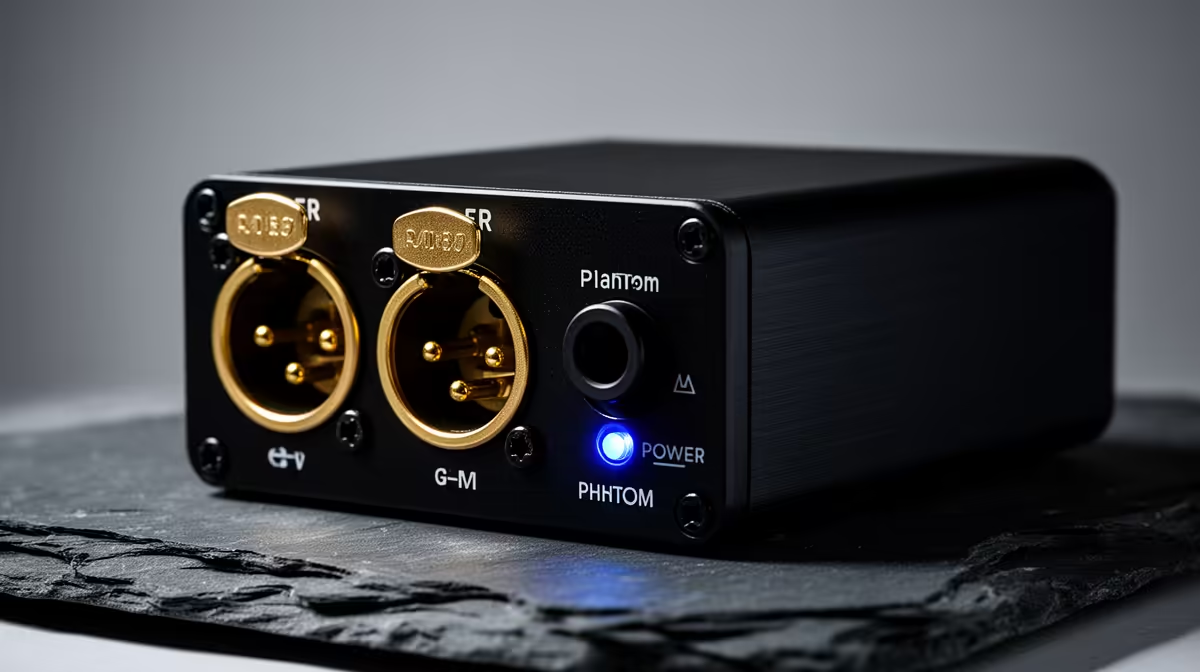
The short answer to whether a USB audio mixer needs 48V phantom power for dual XLR microphones is that it depends entirely on what kind of mics are plugged in. Phantom power is not a switch you flip for every recording. It is a requirement of specific microphone types, and understanding which types need it prevents both silent capsules and unnecessary worry about mics that run perfectly without it.
Quick Answer
Condenser microphones need 48V to activate their capsules and produce any signal. Dynamic microphones generate their own signal and run fine without phantom power. On a dual-XLR USB mixer, whether you need phantom power depends entirely on whether one or both of your mics are condensers.
🔌 Which Microphone Types Require Phantom Power
Condenser mics use a charged capsule to transduce sound. That charge requires an external voltage source, and 48V phantom power is the standardised way to deliver it over the same balanced XLR cable that carries audio. Switch phantom power off on a condenser input and the capsule cannot produce sound. The mic is not broken; it is unpowered.
Dynamic microphones work differently. A moving coil inside a magnetic field generates signal from sound pressure, with no external supply needed. A dynamic plugged into a channel with phantom power switched off performs exactly as it would with phantom power on, because the design does not interact with that voltage.
On a dual-XLR mixer with two condensers, you need phantom power on both channels. Two dynamics: leave it off entirely. One of each: enable phantom power for the condenser's channel. If the mixer has a single phantom switch covering both channels, enabling it for the condenser is safe for any standard balanced dynamic on the adjacent channel.
⚡ What Phantom Power Does to a Dynamic Mic
For standard balanced dynamic microphones, phantom power has no effect on the audio and no risk to the hardware. The 48V travels equally down both conductors of the balanced connection. The mic's input transformer sees that equal voltage on both lines and, because transformers respond only to differences rather than voltages common to both, the 48V cancels out completely.
Ribbon microphones are the exception. They use a thin metallic strip as a transducer element, and some older or unbalanced ribbons can be damaged by phantom power. Standard cardioid or supercardioid dynamics are not ribbons and carry no such risk. If a mic is specifically described as a ribbon, check its documentation before enabling 48V.
🔧 Getting the Order of Operations Right
Set channel gain controls to zero and disable phantom power before connecting the microphones. Plug both XLR cables in. If either mic is a condenser, enable phantom power now and wait approximately five seconds for the capsule to charge. Then raise gain on both channels until the level meters show signal during a test sentence, targeting peaks around -12 dBFS.
Skipping the wait and raising gain immediately after enabling phantom power can produce a loud thump through monitors as the capsule charges. It will not damage the hardware in most cases, but the thump is startling and can stress speakers at high volume.
Frequently Asked Questions
Will phantom power make my dynamic mic produce a stronger signal?
No. Phantom power has no interaction with a balanced dynamic's output. Level, tone, and noise floor remain identical whether 48V is present on the channel or not. Any level change you notice when enabling it is coincidental.
Can phantom power damage a standard dynamic microphone?
Not for a balanced cardioid or supercardioid dynamic from any recognised manufacturer. The common-mode voltage cancels at the input transformer. The risk applies only to ribbon mics, particularly older or unbalanced designs.
Why is my condenser completely silent even with gain turned up?
The capsule needs 48V before it can transduce sound. A condenser with phantom power off produces nothing regardless of how high the gain is set. Enable phantom power, wait a few seconds for the charge to settle, and test again before concluding the mic or input has a fault.
Do two condensers running simultaneously draw too much power from a USB mixer?
Each condenser draws approximately 10 milliamps. Two together draw around 20 milliamps, which sits well within the phantom power budget of any USB mixer rated for dual condenser use. Bus-powered units handle this load without voltage sag under normal conditions.
Should phantom power be switched off before unplugging an XLR microphone?
Yes. Disconnecting a condenser while 48V is live can produce a loud pop as the charge releases. Mute the channel, disable phantom power, wait a few seconds, then unplug the cable. That sequence protects the monitors and is gentler on the capsule.
Ready to set up your dual-XLR recording chain? Browse the USB audio mixer and microphone range at Evetech to find a phantom-power-capable unit that matches your condenser or dynamic mic setup.