


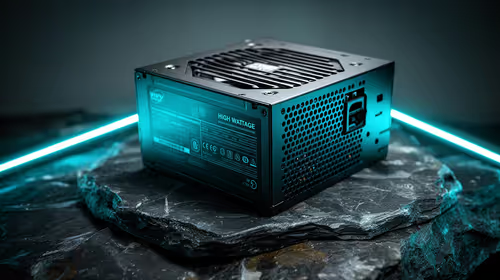
550W PSU Planning for RTX 5080 Super Builds in SA
550W for RTX 5080 Super needs a full-build check, not a simple yes. Review GPU guidance, CPU draw, transient load, connectors, PSU quality, and upgrade plans before deciding.
Read moreA 2304-CUDA-core GPU provides compute resources, but software support determines how they are used. Priced at R12,099, the A1000 surrounds that count with Ampere architecture, 8GB GDDR6 and a 128-bit memory interface.

A CUDA core count is useful only after a task reaches code that can use it. A modeller rotating a viewport, an engineer running a supported compute operation and an artist launching a render may exercise the GPU differently. The 2304 CUDA cores in the RTX A1000 describe available parallel resources, not a universal speed result.
The A1000's 2,304 CUDA cores contribute to CAD, 3D design, engineering and content-creation tasks that use NVIDIA parallel processing, within a card rated up to 6.74 TFLOPS FP32.
A 2304-CUDA-core GPU can offer parallel resources to creative or engineering operations that support CUDA. PNY's A1000 costs R12,099 and uses the Ampere architecture. Project data uses 8GB GDDR6, with 128-bit describing the memory interface. Task timing remains application-specific.
CUDA cores are processing elements within an NVIDIA GPU design. Software can divide suitable work across many operations, but the application must first support that execution path. A larger count is therefore not a promise that every menu command, simulation or export becomes faster.
The architecture matters because core counts from different designs should not be treated as interchangeable units. Other resources, clock behaviour, memory traffic and software implementation affect the outcome. This card uses Ampere architecture; no benchmark follows from that name alone.
Begin with the exact operation that consumes time. In rendering, distinguish scene preparation from the final compute stage. In engineering work, separate interactive modelling from a GPU-enabled solver or visualisation task. In content creation, test effects and export steps individually.
Use the application's own device selection and diagnostic views to confirm that the GPU is engaged. Repeat a fixed project and compare elapsed time only after confirming the same settings and output. That method turns a core-count discussion into evidence that belongs to the actual workflow.
The A1000's 2304 cores operate alongside 8GB GDDR6, with a 128-bit interface forming part of the memory design. A compute task can still slow down or fail if its working data does not fit the available capacity. Likewise, spare memory does not prove that the compute stage has enough resources.
At R12,099, the card is one option in Evetech's workstation GPU range. Compare the A1000 with the documented needs of the creative or engineering application.
Create a small test pack containing one typical file and one difficult file. Record the application version, device setting, project options and completion time. If a colleague repeats the trial, the result should be comparable without relying on memory or impression.
For workflows that combine graphics with local AI tasks, the AI-focused PC range can widen the platform comparison. Check the model or feature requirements directly. A CUDA count may be relevant, but it does not establish model support, capacity or end-to-end responsiveness by itself.
A neutral result is useful. It may show that the operation does not use CUDA, that another component dominates, or that the tested project is too small to reveal a difference. Check device selection and stage timing before concluding that the hardware has no value.
Keep the unchanged result beside the test conditions. The team can then redirect attention to memory, CPU preparation or storage instead of chasing a larger core count. Professional evaluation improves when an experiment is allowed to reject the original hypothesis.
CUDA is only one part of this particular processor mix. The A1000 also carries 18 RT cores for ray-tracing operations and 72 Tensor cores, with quoted ceilings of 13.2 TFLOPS for ray tracing and 53.8 TFLOPS for Tensor work. Projects that use those paths can draw on dedicated resources, while 8GB GDDR6 and 192GB/sec bandwidth serve the active graphics data feeding them.
The useful question is whether the chosen application exposes work that its CUDA path can execute in parallel.
It identifies the number of CUDA processing elements in the RTX A1000. It does not state how quickly a particular application will complete a named task.
No. Graphics memory, interface design, architecture, application support and the rest of the workstation all influence practical use.
Not without comparable measurements. Renderer version, scene, settings, memory demand and other hardware can all change the duration.
For R12,099, PNY combines an Ampere A1000 with 2304 CUDA cores. Its memory section is 8GB GDDR6 over 128 bits.
Ready to compare compute resources with software support? Review Evetech's workstation graphics range and shortlist cards only after identifying the operation your application can accelerate.
It identifies the number of CUDA processing elements in the RTX A1000. It does not state how quickly a particular application will complete a named task.
No. Graphics memory, interface design, architecture, application support and the rest of the workstation all influence practical use.
Not without comparable measurements. Renderer version, scene, settings, memory demand and other hardware can all change the duration.
For R12,099, PNY combines an Ampere A1000 with 2304 CUDA cores. Its memory section is 8GB GDDR6 over 128 bits.
550W for RTX 5080 Super needs a full-build check, not a simple yes. Review GPU guidance, CPU draw, transient load, connectors, PSU quality, and upgrade plans before deciding.
Read more
8000Hz polling is overrated for most SA gamers because gains can be tiny next to battery drain and monitor limits. Mbombela players should weigh mouse feel, game support, and system stability before chasing the number.
Read more
Magnetic switches are taking over SA gaming keyboards because actuation can be tuned. For Sandton gamers, rapid trigger, reset control, and profile depth can help, but layout, key feel, and software quality still matter.
Read more
Polokwane oled monitor value questions need cautious SA context because pricing can move with availability, exchange rates, specs, and warranty support. Treat the trend as a planning signal, not a fixed price promise.
Read more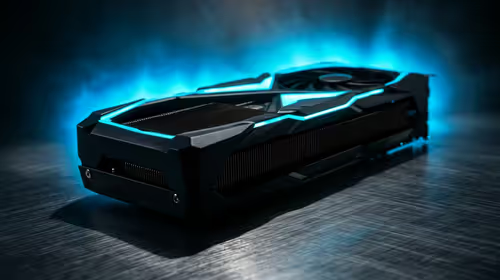
Arc B580 budget builds for Midrand gamers can shift with exchange rates, supply, specs, and model tier. Treat the title as a buying prompt, then compare SA warranty, timing, and build priorities.
Read more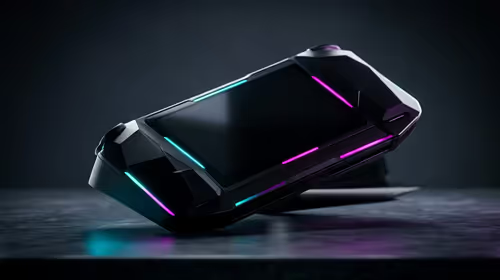
ROG Ally X may beat the LCD Steam Deck for SA gamers who value stronger handheld performance, more memory, and Windows flexibility. Compare battery life, controls, game libraries, and Polokwane support needs before deciding.
Read more
Minisforum's M2 Pro pairs Core Ultra X7, Arc B390 graphics and 32GB onboard memory in 1.8 litres. SA buyers should weigh its fixed memory and $1,439 launch offer against local mini PCs.

Lenovo says Legion Go failures linked to BIOS N3CN42WW are not user error. Affected SA owners should stop retrying the update, preserve proof and open a support case.

Smart monitors can add apps and convenience, but they also add privacy settings and unwanted-software risk. SA buyers should audit the operating system before paying for extras.

A fake 113GB GTA VI ISO reportedly used empty padding around a small malware payload. SA gamers should delete unofficial builds, keep Windows security active and wait for official channels.
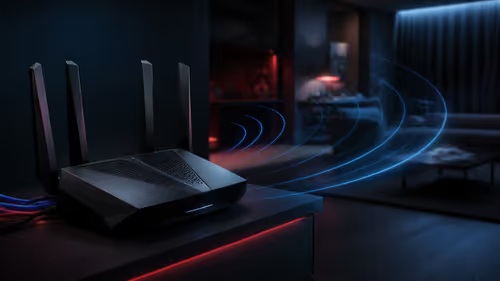
ASUS calls the ROG GT-BN98 the first Wi-Fi 8 gaming router. SA buyers should fix coverage and client limits before paying for a future wireless standard.
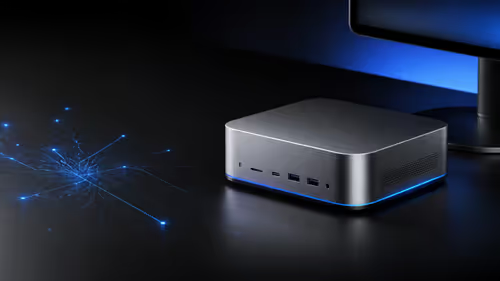
Apple's M6 Mac mini adds faster AI, graphics and networking in the same compact format. SA buyers should wait for a rand listing before comparing value.
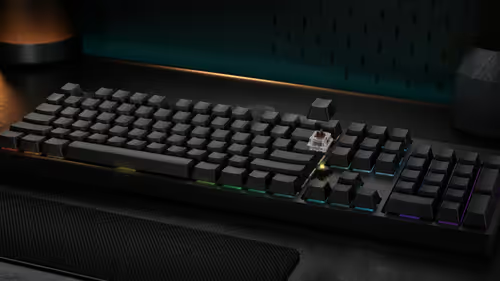
The Vulcan II XP adds hot-swappable switches, sound damping and gaming controls to a full-size wired board. SA buyers should compare feel before features.

Microsoft says Windows on Arm now has over 7,000 verified apps and games. SA buyers should still check each driver, game and work tool before switching.

Xbox Insiders can test disc-to-digital from 31 August 2026. Supported Xbox One and Series X discs gain a digital entitlement, but older discs, regions and title coverage still need exact checks.
ViewSonic's XG2738 pairs QHD QD-OLED with 240Hz and automatic panel care. SA buyers should compare warranty, brightness, ports and burn-in protection against today's R9,999-plus OLED shelf.

NVIDIA's final Windows 10 Game Ready driver is due in October 2026. SA gamers can keep using their GPU, but new game optimisations move on while critical security fixes continue quarterly.

JBL's new Quantum 520, 520X and 120 headsets cover wireless, Xbox-certified and wired use. SA buyers should compare connection, comfort and microphone needs before paying for a new badge.