


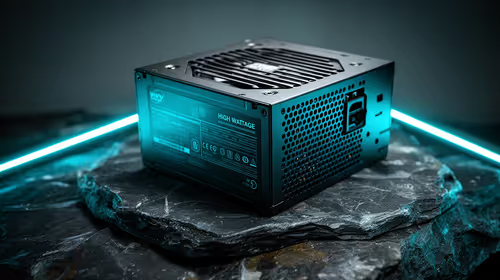
550W PSU Planning for RTX 5080 Super Builds in SA
550W for RTX 5080 Super needs a full-build check, not a simple yes. Review GPU guidance, CPU draw, transient load, connectors, PSU quality, and upgrade plans before deciding.
Read moreA 90 TOPS AI laptop provides substantial local capability for software designed to use it. Priced at R37,999, the Prestige combines Core Ultra 9 386H processing and 32GB memory with 1TB storage, convertible touch and a 2.8K 120Hz OLED panel.

TOPS becomes meaningful only when software can use the underlying AI acceleration. The 90 TOPS AI laptop label describes a compute capability, not an automatic speed result for every user. At R37,999, the MSI Prestige 16 Flip AI+ pairs that AI-PC figure with a Core Ultra 9 386H and 32GB memory for application-led testing.
A 90-TOPS AI PC can accelerate supported local AI features, but everyday value depends on the software, model and task. The R37,999 configuration uses a Core Ultra 9 386H. It also assigns 32GB LPDDR5X to active work and 1TB NVMe to local storage. Compare an enabled feature with its normal route while holding output quality constant.
TOPS expresses trillions of operations per second for relevant AI computation. It does not state application response time, model compatibility, graphics performance or battery duration. The figure needs a supported workload before it can influence a purchase.
List the AI functions used each week: transcription, image assistance, search, summarisation or another application-specific tool. Confirm whether each runs locally, uses the AI hardware and produces the required result.
Choose a repeatable file and record task settings, application version, processing route and elapsed time. Check output correctness before rewarding a shorter duration. A feature that changes quality or still depends on a network service has answered a different question.
The Core Ultra 9 386H is the processor in this model, but no workload benchmark follows from the name. Use the MSI professional notebook range when comparing complete configurations under the same test.
Local models share 32GB of LPDDR5X with the wider application mix. Project assets, programs and caches occupy the 1TB NVMe drive. Watch each resource during a representative session, noting both the highest memory reading and remaining storage.
If the task fails, separate capacity, software support and compute stages. More TOPS cannot compensate for an incompatible feature or a project that does not fit its working resources.
Run the chosen feature for a week and count completed tasks, corrections and time saved. The 2-in-1 design and 16-inch 2.8K OLED touchscreen may change how users review results, while neither establishes AI speed.
Creative candidates can be compared through Evetech's creator laptop selection. Keep Thunderbolt devices and cables in a separate compatibility sheet, and test battery behaviour directly if local AI will be used away from power.
For each chosen feature, write the input type, privacy requirement, processing location and number of manual corrections. Run it across three ordinary tasks rather than one demonstration. A useful local feature should produce repeatable output without adding more review work than it saves.
Revisit the log after an application update because support and routing can change. Keep the original project and quality condition so a new result remains comparable with the earlier one.
Give every trial two totals: minutes spent producing the first result and minutes required to correct it. An AI-assisted draft that arrives quickly but needs extensive repair has not necessarily improved the routine. Note privacy requirements as well, especially when the chosen feature sends material away from the device.
After several comparable jobs, calculate the median end-to-end time. That evidence is more useful than treating 90 TOPS as a universal speed score.
After the evidence log covers several ordinary jobs, decide whether the feature stays in the routine. Keep it only if it reduces total effort, improves a required result or makes an offline task possible. Remove a trial that merely moves waiting time into setup or correction. Revisit the decision after a meaningful software update, using the saved inputs and acceptance rule.
No. It describes AI compute capability. A benchmark or application result needs a defined workload, settings and complete system.
Not necessarily. Support and processing routes vary by feature and application. Confirm the path used by the exact tool.
Memory holds active work, while storage holds applications, models and project data. Capacity problems are separate from compute throughput.
No. Battery duration depends on the complete system and workload, and this model's runtime must be measured for the intended use.
Ready to turn an AI-PC figure into an application result? Compare Evetech laptops after choosing a supported feature, fixed input and output-quality check that every candidate must pass.
No. It describes AI compute capability. A benchmark or application result needs a defined workload, settings and complete system.
Not necessarily. Support and processing routes vary by feature and application. Confirm the path used by the exact tool.
Memory holds active work, while storage holds applications, models and project data. Capacity problems are separate from compute throughput.
No. Battery duration depends on the complete system and workload, and this model's runtime must be measured for the intended use.
550W for RTX 5080 Super needs a full-build check, not a simple yes. Review GPU guidance, CPU draw, transient load, connectors, PSU quality, and upgrade plans before deciding.
Read more
8000Hz polling is overrated for most SA gamers because gains can be tiny next to battery drain and monitor limits. Mbombela players should weigh mouse feel, game support, and system stability before chasing the number.
Read more
Magnetic switches are taking over SA gaming keyboards because actuation can be tuned. For Sandton gamers, rapid trigger, reset control, and profile depth can help, but layout, key feel, and software quality still matter.
Read more
Polokwane oled monitor value questions need cautious SA context because pricing can move with availability, exchange rates, specs, and warranty support. Treat the trend as a planning signal, not a fixed price promise.
Read more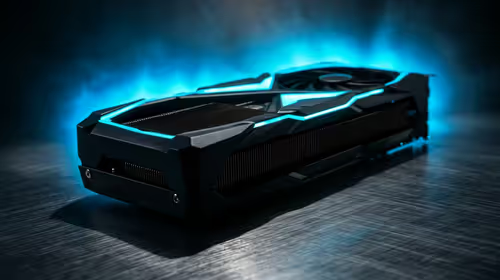
Arc B580 budget builds for Midrand gamers can shift with exchange rates, supply, specs, and model tier. Treat the title as a buying prompt, then compare SA warranty, timing, and build priorities.
Read more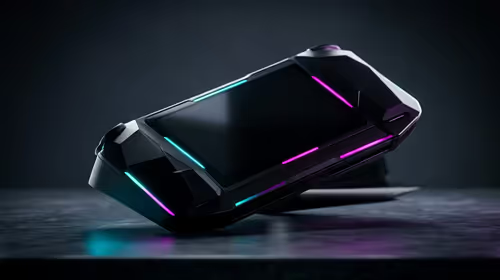
ROG Ally X may beat the LCD Steam Deck for SA gamers who value stronger handheld performance, more memory, and Windows flexibility. Compare battery life, controls, game libraries, and Polokwane support needs before deciding.
Read more
Minisforum's M2 Pro pairs Core Ultra X7, Arc B390 graphics and 32GB onboard memory in 1.8 litres. SA buyers should weigh its fixed memory and $1,439 launch offer against local mini PCs.

Lenovo says Legion Go failures linked to BIOS N3CN42WW are not user error. Affected SA owners should stop retrying the update, preserve proof and open a support case.

Smart monitors can add apps and convenience, but they also add privacy settings and unwanted-software risk. SA buyers should audit the operating system before paying for extras.

A fake 113GB GTA VI ISO reportedly used empty padding around a small malware payload. SA gamers should delete unofficial builds, keep Windows security active and wait for official channels.
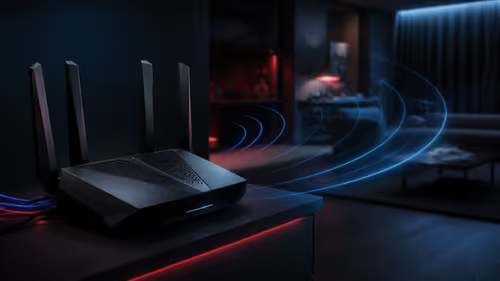
ASUS calls the ROG GT-BN98 the first Wi-Fi 8 gaming router. SA buyers should fix coverage and client limits before paying for a future wireless standard.
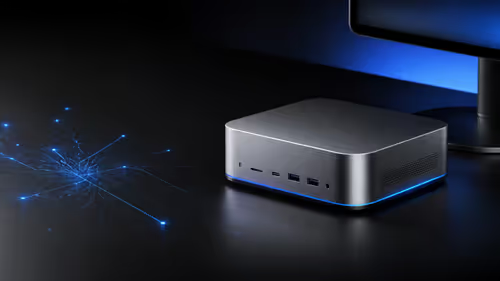
Apple's M6 Mac mini adds faster AI, graphics and networking in the same compact format. SA buyers should wait for a rand listing before comparing value.
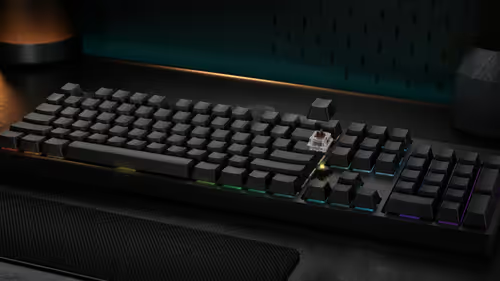
The Vulcan II XP adds hot-swappable switches, sound damping and gaming controls to a full-size wired board. SA buyers should compare feel before features.

Microsoft says Windows on Arm now has over 7,000 verified apps and games. SA buyers should still check each driver, game and work tool before switching.

Xbox Insiders can test disc-to-digital from 31 August 2026. Supported Xbox One and Series X discs gain a digital entitlement, but older discs, regions and title coverage still need exact checks.
ViewSonic's XG2738 pairs QHD QD-OLED with 240Hz and automatic panel care. SA buyers should compare warranty, brightness, ports and burn-in protection against today's R9,999-plus OLED shelf.

NVIDIA's final Windows 10 Game Ready driver is due in October 2026. SA gamers can keep using their GPU, but new game optimisations move on while critical security fixes continue quarterly.

JBL's new Quantum 520, 520X and 120 headsets cover wireless, Xbox-certified and wired use. SA buyers should compare connection, comfort and microphone needs before paying for a new badge.