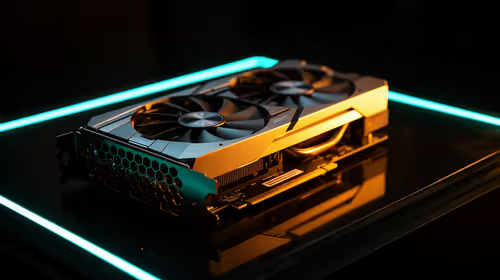
Most spec sheets list AI engine counts as a bragging number without explaining what they actually change day to day, which leaves creators guessing whether the figure matters at all. On a 24gb creator graphics card carrying 160 of Intel's XMX engines, that number translates into something specific: dedicated hardware handling denoising, upscaling and generative fill so the main rendering pipeline never has to slow down for them.
Quick Answer
The 160 Intel XMX engines on this card accelerate AI denoising, upscaling and generative fill tasks inside supported creative applications, running them separately from standard rendering work. The ASRock Pro B60 Creator pairs those engines with 24GB of GDDR6 for R14,399, keeping AI processing off the main Xe2-HPG render core entirely. That separation is what prevents AI features from slowing down everything else running at the same time.
🧠 What XMX Engines Are Actually Built For
Unlike general-purpose rendering cores, XMX engines are purpose-built for the matrix operations that AI models rely on, which is why they handle tasks like noise reduction and image upscaling more efficiently than routing the same work through standard shader cores. Having 160 of them onboard means those AI tasks get dedicated hardware rather than borrowing capacity from whatever else the card is doing.
Why This Distinction Matters For Creative Software
Creative applications increasingly bake AI features directly into everyday workflows, from automatic masking to AI-assisted colour matching. Running those features on dedicated engines rather than the main render pipeline is what keeps a timeline or viewport responsive while an AI task is active in the background.
🎨 Where This Shows Up In Real Editing And Rendering Work
Denoising a grainy render pass, upscaling lower-resolution source footage, or generating fill content for an image all lean on the same kind of AI inference these engines are designed to accelerate. Because that work happens separately from the card's Xe2-HPG core, a render or edit can continue at full speed while an AI task runs in parallel rather than competing for the same execution resources.
💾 Why Memory Capacity Still Matters Alongside The Engines
AI-accelerated hardware still needs somewhere to hold its model weights and working data, which is where the 24GB GDDR6 pool and 192-bit memory bus come in. Without enough memory backing them, even 160 dedicated engines would end up starved of the data they need to actually run efficiently.
Full specifications for this configuration are on the B60 Creator page, and it sits among other options within workstation graphics cards at Evetech. Anyone comparing across the brand can also check ASRock's GPU range for other configurations.
Frequently Asked Questions
What exactly do XMX engines accelerate in creative apps?
They accelerate AI-specific tasks such as denoising, upscaling and generative fill, running them on dedicated hardware rather than the card's main rendering pipeline.
Does having 160 XMX engines mean faster rendering overall?
Not directly for standard rendering, since that work runs on the Xe2-HPG core; the engines specifically speed up AI-assisted features running alongside it.
Why do AI features need separate hardware instead of sharing the render core?
Sharing the same execution path would mean AI tasks and standard rendering compete for the same resources, causing slowdowns in both; dedicated engines avoid that contention entirely.
Is 24GB of memory necessary for these AI engines to work well?
Yes, the engines still need memory to hold model data and working sets, so a generous GDDR6 pool prevents them from being starved of data.
Which creative applications actually use XMX-style AI acceleration?
Most modern editing and rendering software with built-in AI features, including denoising, upscaling and generative tools, can take advantage of dedicated AI hardware where supported.
Ready to see what 160 XMX engines speed up?
Explore the 24GB creator GPU from ASRock among Evetech's workstation graphics cards, tagged at R14,399, made to accelerate the AI features inside modern creative apps.