Quick Answer
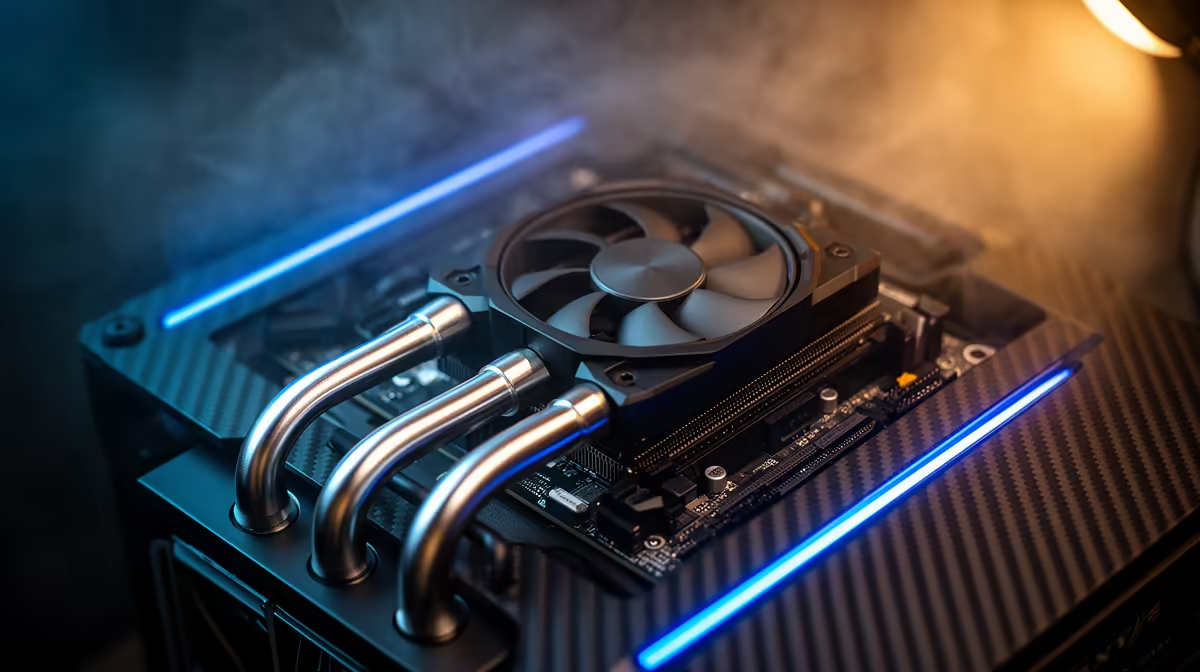
An embedded VRM fan on an AIO CPU cooler is a small secondary fan built into the pump head or cold plate assembly. It directs airflow directly over the motherboard VRM heatsinks, which otherwise receive little airflow when a closed-loop liquid cooler covers the CPU socket area.
Why VRM Cooling Becomes a Problem With AIOs 🔧
On a traditional air cooler, the large heatsink fan creates a column of airflow that spills onto the surrounding motherboard components, including the VRM (voltage regulator module) heatsinks that sit just above the CPU socket. An AIO cooler replaces that column of air with a pump head and liquid lines, leaving the VRM area with minimal active airflow. Under heavy all-core loads on high-TDP CPUs like the Ryzen 9 9950X (170 W) or Core Ultra 9 285K (253 W PL2), VRM temperatures can climb above 90 C without supplemental airflow, causing VRM thermal throttling even when the CPU itself is cool. This is especially relevant in compact mid-tower builds with limited case airflow.
How the Embedded VRM Fan Solves the Problem 🌀
Brands like Corsair (iCUE LINK series) and some NZXT units embed a small secondary fan, typically 40 mm to 60 mm, into the pump head. This fan spins at moderate speed and blows air laterally across the VRM heatsinks. In testing on Z890 and X870E motherboards, embedded VRM fan AIOs reduce VRM temperatures by 10 C to 20 C compared to equivalent AIOs without the feature under sustained overclocked loads. The fan adds a small amount of noise (rated around 20 to 25 dBA at typical speeds) but runs quietly enough that it is inaudible under gaming conditions for most users.
Do You Actually Need an Embedded VRM Fan? 💡
For most gaming builds with a Ryzen 7 9700X or Core Ultra 5 245K at stock settings, adequate case airflow handles VRM temperatures without any issue. The embedded VRM fan becomes meaningful for overclocked flagship CPUs, ITX builds with restricted airflow, or motherboards with slim VRM heatsinks. If your build targets a Ryzen 9 9950X or Core Ultra 9 285K with manual overclocking, the feature is a genuine advantage. In South Africa, premium AIO units with embedded VRM fans are stocked at Evetech at around R2,800 to R4,500 depending on radiator size.
Check Your Motherboard VRM Heatsink Size ⚡
Budget and mid-range motherboards often have small single-piece VRM heatsinks that heat soak quickly under full load. If you are pairing an AIO with a mid-range B650 or B760 board and a high-TDP CPU, either choose an AIO with an embedded VRM fan or add a dedicated case fan near the VRM zone.
FAQ
Does the embedded VRM fan make the AIO significantly louder?
At typical gaming workloads, no. The small fan runs at low RPM and adds minimal noise. Under full sustained overclocked loads it spins up, but the radiator fans are already louder at that point.
Which motherboard sockets benefit most from VRM fan AIOs?
AM5 boards running Ryzen 9 9900X or 9950X and LGA1851 boards running Core Ultra 9 285K benefit most, particularly B-series motherboards with smaller VRM heatsinks.
Are embedded VRM fan AIOs compatible with all cases?
Yes, the embedded fan adds no extra mounting complexity. It is part of the pump head assembly and installs exactly like a standard AIO, with the secondary fan simply pointing at the VRM area once mounted.
Cooling a high-TDP CPU on a mid-range board?
Explore AIO coolers with integrated VRM airflow solutions at Evetech, covering AM5 and LGA1851 socket builds.