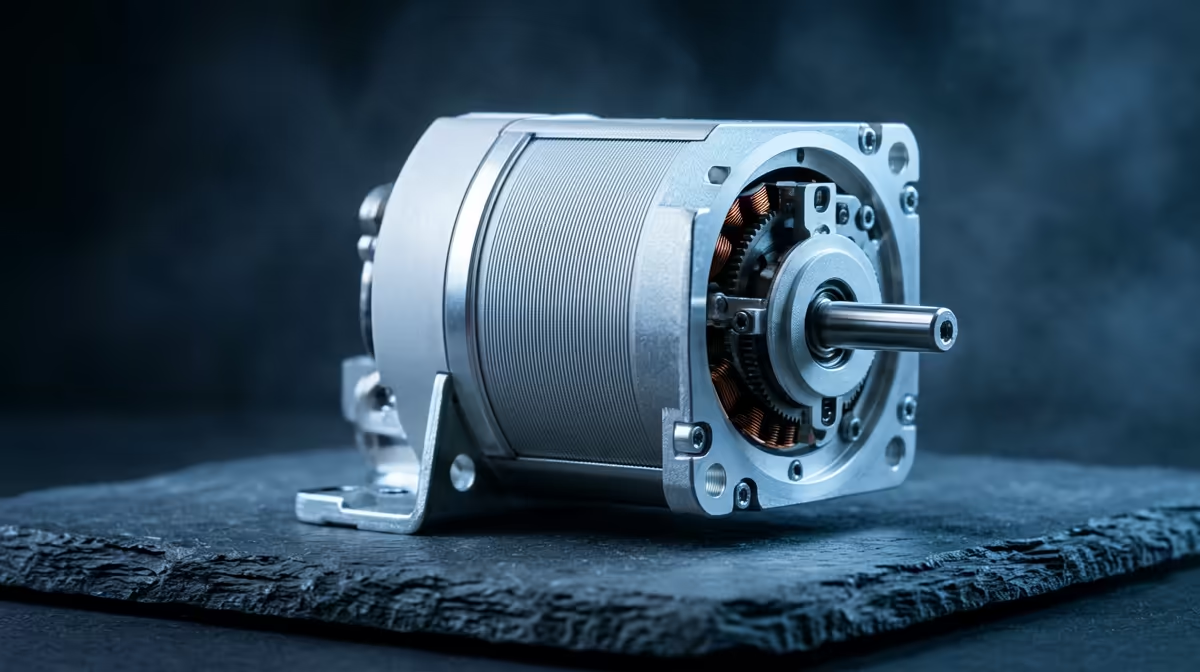
A stepper motor is the workhorse that moves each axis of your 3D printer in tiny, exact increments instead of spinning freely like an ordinary DC motor. Its rotor advances one fixed step at a time, so the printer's controller always knows precisely where the print head and bed are sitting, down to a fraction of a millimetre, without any sensor watching the shaft.
Quick Answer
Most desktop 3D printers use 1.8 degree stepper motors, which means 200 steps per full revolution. The controller pulses the motor one step at a time and counts those pulses to position the X, Y, Z and extruder axes accurately, all without position feedback hardware.
How the Fixed Step Actually Works
Inside the motor are toothed electromagnets arranged around the rotor. When the driver energises the coils in sequence, the rotor snaps to the next aligned position and holds there. A 1.8 degree motor divides one rotation into 200 of these resting positions, so the firmware can command exactly 200 pulses to turn the shaft once.
Because the motion is mechanical and repeatable, the firmware does not need an encoder to confirm where the axis ended up. It assumes the motor obeyed every pulse, which is why this is called open loop control. The trade off is that if the head jams or the belt skips, the printer keeps counting pulses while the real position drifts, and you get a layer shift.
Microstepping for Smoother, Quieter Motion
Modern boards rarely run a motor at full steps. A driver like the TMC2209 splits each physical step into many smaller electrical sub steps, commonly 16 or 32 microsteps. At 16 microsteps, a 200 step motor effectively resolves 3,200 positions per revolution.
Microstepping does not make the motor stronger or hugely more precise on its own, but it smooths the motion and cuts the buzzing whine older printers were known for. Pair that with a NEMA 17 frame size, the standard on most consumer machines, and you get enough holding torque to drive belts and lead screws without losing steps during fast travel moves. You can browse a full range of machines on the 3D printers page to see which driver and motor combinations ship on current models.
Torque, Heat and Why Cooling Matters
Stepper motors run hottest when holding position under load, since the coils stay energised even when the axis is stationary. NEMA 17 motors typically sit warm to the touch during a long print, which is normal. Problems start when torque is marginal for the mass being moved, which is why heavier direct drive extruders sometimes need a slightly stronger motor than a lightweight Bowden setup. Keeping belts tensioned and the gantry square does more for print accuracy than chasing exotic motors. A few spare parts and tools from the accessories best sellers range cover most of that maintenance.
Frequently Asked Questions
How many steps does a typical 3D printer stepper motor have?
The common standard is 200 full steps per revolution, derived from a 1.8 degree step angle. Some high resolution motors use a 0.9 degree angle for 400 steps, though these are less common on budget machines.
What does open loop control mean for my prints?
It means the printer trusts that the motor moved exactly as commanded, with no sensor verifying the result. This works reliably until something physically blocks an axis, at which point the printer cannot detect the error and a layer shift appears.
Is a NEMA 17 motor enough for a 3D printer?
Yes, NEMA 17 is the standard frame size for the X, Y and extruder axes on virtually all consumer printers. It provides ample holding torque for typical belt and lead screw mechanisms.
Does microstepping improve print accuracy?
Microstepping mainly improves smoothness and reduces noise rather than dramatically boosting positional accuracy. The mechanical resolution is still limited by belts, pulleys and frame rigidity.
Ready to put precise stepper driven motion to work? Compare current machines and upgrade parts on the Evetech 3D printers page and start your next build.