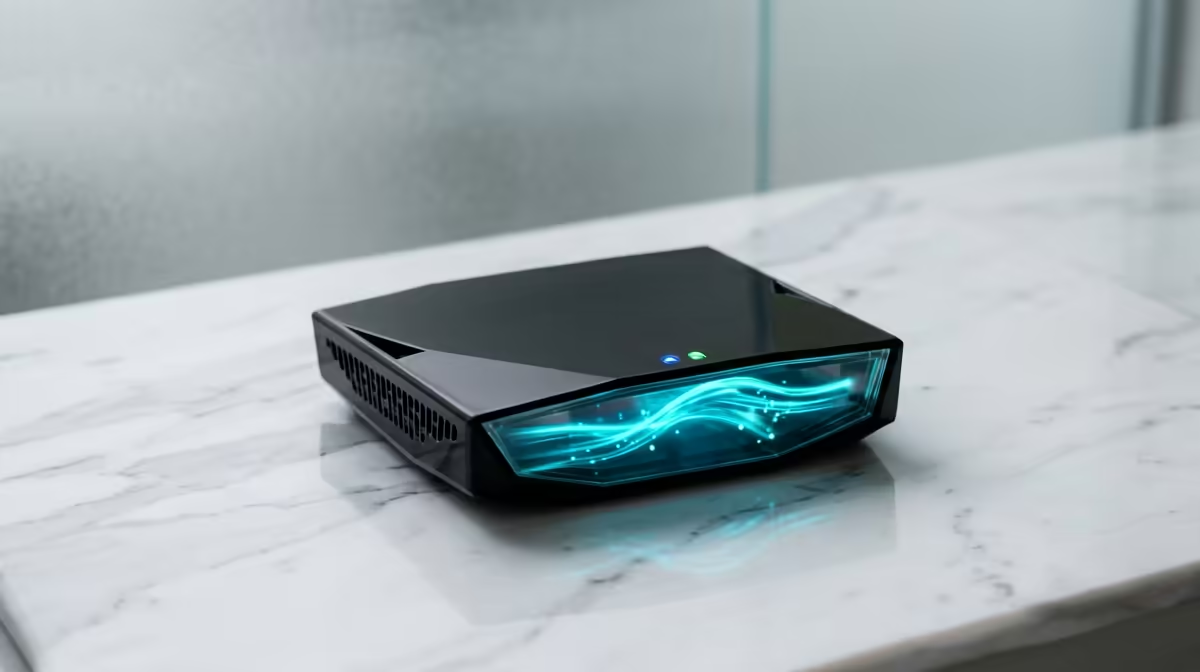
When two access points cover the same room, older Wi-Fi makes them fight: each one treats the other as noise and backs off, wasting airtime. Coordinated multi-AP in Wi-Fi 8 (the IEEE 802.11bn standard) flips that behaviour. Instead of competing, neighbouring access points talk to each other and share the channel intelligently, which is the headline upgrade for dense homes and offices running mesh networks.
Quick Answer
Coordinated multi-AP lets nearby Wi-Fi 8 access points cooperate rather than interfere, using four schemes: coordinated beamforming (Co-BF), coordinated spatial reuse (Co-SR), coordinated TDMA (Co-TDMA), and coordinated restricted target wake time (Co-RTWT). Together they cut the self-interference that clogs networks where multiple APs overlap, making the whole mesh faster and more responsive.
Why Multiple Access Points Interfere
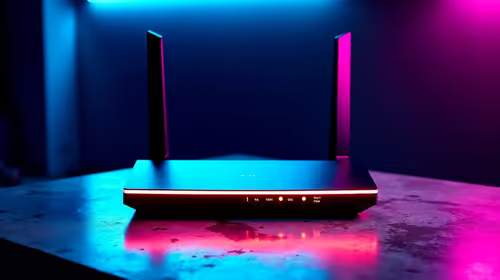
Picture a large home with two or three mesh nodes. Their coverage areas overlap so you get signal everywhere, but in those overlap zones the access points hear each other. Traditional Wi-Fi handles this with politeness: when one AP senses another transmitting, it waits. That avoids collisions but leaves airtime sitting idle, and in a busy network that idle time is exactly what makes streaming stutter and video calls drop. Multi-AP coordination, the marquee feature of Wi-Fi 8, replaces that wait-your-turn model with active cooperation. If you are planning mesh coverage, the networking range at Evetech is where the access points and routers live.
The Four Coordination Schemes
Wi-Fi 8 does not use one trick. It defines four, each solving overlap from a different angle.
Coordinated beamforming (Co-BF) lets APs aim their signals so they actively cancel, or null, the interference they would otherwise cause to each other's clients. Two access points can then transmit on the same channel at the same time without drowning each other out.
Coordinated spatial reuse (Co-SR) allows simultaneous transmissions on the same channel from overlapping networks by managing power and timing, lifting total throughput and trimming delay.
Coordinated TDMA (Co-TDMA) shares transmission opportunities between APs in scheduled slots, squeezing more out of the limited airtime and improving latency for real-time apps like calls and gaming.
Coordinated restricted target wake time (Co-RTWT) works at a higher level, coordinating schedules and channel assignments across APs rather than shaping individual packets.
Where each one operates
Three of these, Co-BF, Co-SR, and Co-TDMA, act at the transmission-opportunity level and directly shape how packets are exchanged. Co-RTWT sits above that, arranging the wider timetable so the others have room to work. You do not configure these by hand; the hardware negotiates them. The accessories best-seller list at Evetech is a useful stop for the cabling and extras that support a multi-node setup.
Frequently Asked Questions
Do I need Wi-Fi 8 hardware to benefit from coordinated multi-AP?
Yes. These coordination schemes are part of the 802.11bn standard, so both your access points and ideally your client devices need to support Wi-Fi 8 to take full advantage. Mixed networks with older devices still work but will not gain the cooperation benefit.
Is coordinated multi-AP the same as mesh networking?
Not quite. Mesh describes the layout of multiple linked access points. Coordinated multi-AP is the technology that lets those nodes actively cooperate on the same channel instead of merely handing devices between them. It makes mesh meaningfully better in dense setups.
Which scheme matters most for gaming and video calls?
Coordinated TDMA is the standout for real-time traffic. By scheduling transmission slots across access points, it reduces the latency spikes that hurt online gaming and live calls, especially when several devices share overlapping coverage.
Will coordinated multi-AP help in a small flat with one router?
The benefit is smallest there. These features shine when multiple access points overlap. A single-router home gains more from Wi-Fi 8's other improvements than from the multi-AP coordination specifically.
Planning a mesh upgrade that will actually scale with Wi-Fi 8? Explore the current networking gear at Evetech and build coverage that cooperates instead of competing.