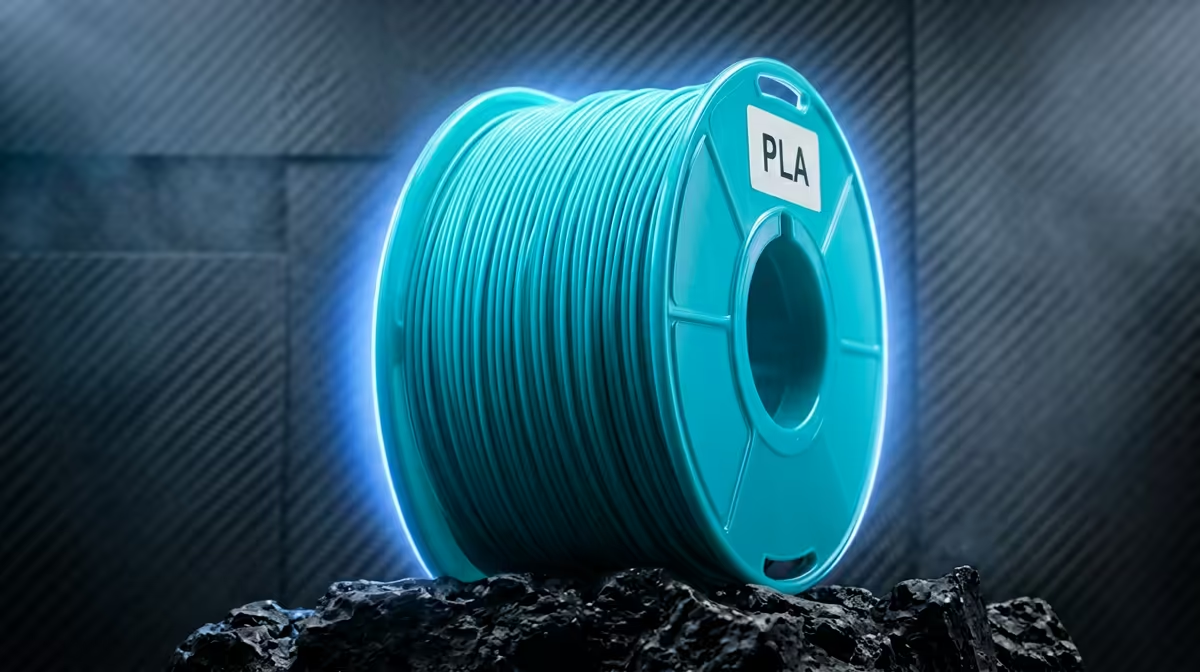
If your first roll of filament jams, strings, or warps off the bed, the plastic itself is often the culprit, not your printer. PLA filament is the polymer that solved most of those headaches for newcomers. Made from plant starches like maize and sugarcane, it melts at low temperatures, sticks to the bed without a heated enclosure, and forgives the small mistakes every first-time printer makes. That is why almost every starter FDM machine ships with a sample spool of it.
Quick Answer
PLA prints cleanly between 190C and 220C with almost no warping, which makes it the easiest filament to learn on. The catch is heat: it begins to soften at roughly 60C, so anything left in a hot car or near a sunny window can sag.
Why PLA Is the Default Beginner Plastic
PLA forgives almost everything. It needs a low nozzle temperature, so cheaper hotends handle it without trouble, and it barely shrinks as it cools. That low shrinkage is the whole reason you can run it without a heated chamber and still get a flat first layer. Bed adhesion is strong on plain glass or a textured PEI sheet, and the fumes are mild and faintly sweet rather than acrid.
Compare that to engineering plastics that demand an enclosure, a hardened nozzle, and a bed running above 100C, and the appeal is obvious. You spend your first weeks learning slicer settings and design, not fighting the material. Most entry-level machines on the Evetech 3D printers range are tuned for PLA out of the box.
Where the 60C Limit Bites
The same low melting point that makes PLA easy is also its ceiling. Its glass-transition temperature, the point where it goes soft and rubbery, sits around 60C. A car parked in the Highveld sun in summer can pass that easily, so a phone bracket or a hook left inside will droop and lose its shape.
That rules PLA out for anything mechanical that runs warm, outdoor parts in direct sun, or enclosures around heat sources. For those jobs, PETG or ABS make more sense. For desk organisers, prototypes, miniatures, cosplay props, and indoor decor, PLA is more than enough. Keeping spare nozzles and a spool or two on hand from the printing accessories shelf saves a wasted evening when one runs out mid-print.
Storing and Drying PLA
PLA absorbs moisture from the air slowly, and damp filament prints with popping sounds and rough surfaces. Keep spools sealed with a silica gel pack between sessions. If a roll has been open for months in a humid coastal flat, a few hours in a filament dryer or a low oven brings it back. Brittle snapping as it feeds is the usual sign it has dried out too far or aged on the shelf.
Frequently Asked Questions
What temperature should I print PLA at?
Most PLA prints well between 190C and 220C, with 200C to 210C a safe starting point for the first layer. Run a temperature tower if you switch brands, since pigments and additives shift the ideal point slightly.
Is PLA strong enough for functional parts?
For indoor brackets, clips, and prototypes, yes. PLA is rigid and holds detail well, but it is brittle under sudden impact and softens with heat, so it is a poor choice for load-bearing or outdoor parts.
Does PLA need a heated bed?
Not strictly, but a bed at 50C to 60C improves first-layer adhesion and reduces the chance of corners lifting. Many beginners run a thin layer of glue stick on glass for the same effect.
Is PLA biodegradable?
PLA is made from renewable plant sources and is industrially compostable, but it will not break down meaningfully in a home compost heap or a landfill. Treat failed prints as recyclable plastic where facilities exist.
Why is my PLA stringing between parts?
Stringing usually means the nozzle is too hot or retraction is set too low. Drop the temperature in 5C steps and increase retraction distance until the wispy threads stop.
New to 3D printing and not sure which machine suits a PLA-first workflow? Browse the starter printers and consumables on the Evetech 3D printers range and get rolling this weekend.