


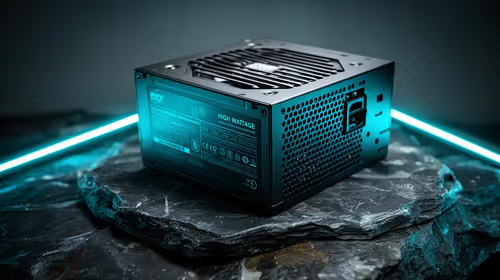
550W PSU Planning for RTX 5080 Super Builds in SA
550W for RTX 5080 Super needs a full-build check, not a simple yes. Review GPU guidance, CPU draw, transient load, connectors, PSU quality, and upgrade plans before deciding.
Read morePrioritise supported GPU count, display count and the exact synchronisation functions your installation needs. PNY RTX Pro Sync is R19,599 and combines Genlock, Frame Lock and Mosaic for up to eight RTX Pro GPUs serving 32 synchronised displays.

A professional display synchronization purchase should begin with a requirement sheet, not a feature count. The right professional display synchronization solution must fit the planned GPU scale, the number of coordinated screens and the precise roles assigned to Genlock, Frame Lock and the multi-display canvas.
A professional synchronisation purchase should cover platform support, GPU and screen scale, physical integration and the required coordinated-canvas functions; RTX PRO Sync answers all four areas explicitly.
Look first at supported GPU quantity, synchronised display capacity and whether the solution provides the lock and arrangement functions your design needs. The R19,599 PNY option covers Genlock, Frame Lock and Mosaic. Its two capacity figures are eight RTX Pro GPUs and 32 displays.
Replace broad goals such as "smooth wall" with observable outcomes. State which screens must act together, whether imagery crosses their boundaries and which graphics processors produce those outputs. Add a pass condition for moving content, mode changes and the audience positions that matter.
This document keeps the shopping exercise honest. It also separates synchronization from panel choice. Use Evetech's PC monitor category for the display layer once resolution, size and room placement have their own requirements.
For the buying sheet, use one maximum column showing eight NVIDIA RTX Pro GPUs and a second showing 32 synchronised displays. Both deserve attention because a screen total alone says nothing about how rendering and outputs are divided across processors.
Do not treat maximum capacity as recommended size. Put the actual GPU and display totals beside the ceilings, include foreseeable growth, and reject unnecessary headroom that has no approved use. Compare processors in the workstation graphics card range only after applications and outputs have been assigned.
On this shortlist, Genlock means reference alignment. Frame Lock handles agreement among frames produced through the participating graphics hardware. NVIDIA Mosaic deals with the arranged multi-display canvas. Put three rows on the buying sheet and require a reason for every checked row.
The PNY RTX Pro Sync card covers all three functions at R19,599. That makes it a credible candidate when the project needs those roles together, but it does not decide the signal distribution, physical support or commissioning method.
Keep the synchronization component separate from GPUs, monitors, installation and content systems. Ask vendors or integrators to show where every item meets a written requirement, then reserve a test period for the complete visual path.
Use representative moving material across the most demanding boundaries. Record the active processors, display grouping and selected functions when the system passes. Supporting components can then be compared through Evetech's graphics card accessories page without changing the approved plan on impulse.
A product demonstration is useful when it follows the buyer's own pass conditions. Bring the planned screen and GPU totals, identify the critical visual boundary, and ask to see the relevant lock or Mosaic role in a comparable system. A polished loop that never crosses that boundary proves very little about the intended installation.
Record unanswered design questions rather than filling them with assumptions. Connection details, physical installation and the precise commissioning method should be resolved by the project team before purchase. This leaves the R19,599 decision attached to demonstrated synchronization functions and a capacity fit.
It supports Windows 10, Windows 11 and Linux, reaches eight GPUs and two cards per system, and manages 32 displays or projectors through Mosaic. The box also includes six sync cables rather than only the card: four measure 12 inches and two measure 24 inches. Together, that capacity and cable bundle settle the core package before the buyer evaluates the exact chassis and visual workload.
Confirm the intended GPU count and synchronised screen total. The PNY option tops out at eight RTX Pro GPUs and 32 displays.
They serve different coordination roles: reference timing and cross-GPU frame alignment. A good requirement sheet records whether each role is necessary.
No. Include Mosaic when the project needs its arranged multi-display canvas. Independent screen tasks may call for a different approach.
It buys the PNY synchronization card. The screens, GPUs and project work remain distinct parts of the acquisition.
It should use comparable GPU and screen boundaries, show the exact synchronization roles on the buyer's requirement sheet and replay content that could reveal failure. Record any difference between the demonstration and the planned installation so the project team knows which conditions still require confirmation during commissioning.
Ready to turn requirements into a shortlist? Compare Evetech's professional graphics, monitor and accessory categories with your capacity table and acceptance conditions beside you.
Confirm the intended GPU count and synchronised screen total. The PNY option tops out at eight RTX Pro GPUs and 32 displays.
They serve different coordination roles: reference timing and cross-GPU frame alignment. A good requirement sheet records whether each role is necessary.
No. Include Mosaic when the project needs its arranged multi-display canvas. Independent screen tasks may call for a different approach.
It buys the PNY synchronization card. The screens, GPUs and project work remain distinct parts of the acquisition.
It should use comparable GPU and screen boundaries, show the exact synchronization roles on the buyer's requirement sheet and replay content that could reveal failure. Record any difference between the demonstration and the planned installation so the project team knows which conditions still require confirmation during commissioning.
550W for RTX 5080 Super needs a full-build check, not a simple yes. Review GPU guidance, CPU draw, transient load, connectors, PSU quality, and upgrade plans before deciding.
Read more
8000Hz polling is overrated for most SA gamers because gains can be tiny next to battery drain and monitor limits. Mbombela players should weigh mouse feel, game support, and system stability before chasing the number.
Read more
Magnetic switches are taking over SA gaming keyboards because actuation can be tuned. For Sandton gamers, rapid trigger, reset control, and profile depth can help, but layout, key feel, and software quality still matter.
Read more
Polokwane oled monitor value questions need cautious SA context because pricing can move with availability, exchange rates, specs, and warranty support. Treat the trend as a planning signal, not a fixed price promise.
Read more
Arc B580 budget builds for Midrand gamers can shift with exchange rates, supply, specs, and model tier. Treat the title as a buying prompt, then compare SA warranty, timing, and build priorities.
Read more
ROG Ally X may beat the LCD Steam Deck for SA gamers who value stronger handheld performance, more memory, and Windows flexibility. Compare battery life, controls, game libraries, and Polokwane support needs before deciding.
Read more
Minisforum's M2 Pro pairs Core Ultra X7, Arc B390 graphics and 32GB onboard memory in 1.8 litres. SA buyers should weigh its fixed memory and $1,439 launch offer against local mini PCs.

Lenovo says Legion Go failures linked to BIOS N3CN42WW are not user error. Affected SA owners should stop retrying the update, preserve proof and open a support case.

Smart monitors can add apps and convenience, but they also add privacy settings and unwanted-software risk. SA buyers should audit the operating system before paying for extras.

A fake 113GB GTA VI ISO reportedly used empty padding around a small malware payload. SA gamers should delete unofficial builds, keep Windows security active and wait for official channels.
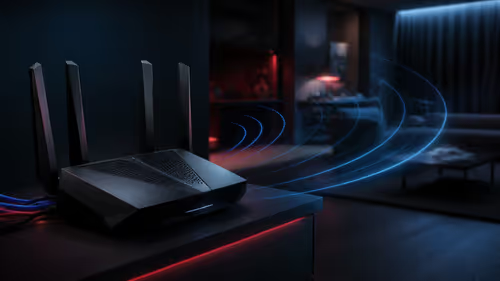
ASUS calls the ROG GT-BN98 the first Wi-Fi 8 gaming router. SA buyers should fix coverage and client limits before paying for a future wireless standard.
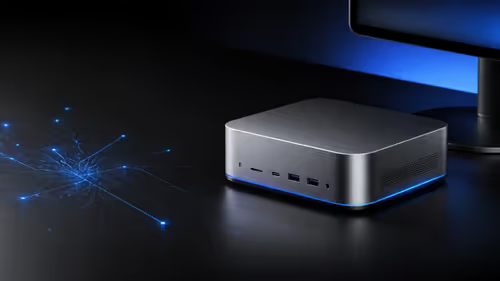
Apple's M6 Mac mini adds faster AI, graphics and networking in the same compact format. SA buyers should wait for a rand listing before comparing value.
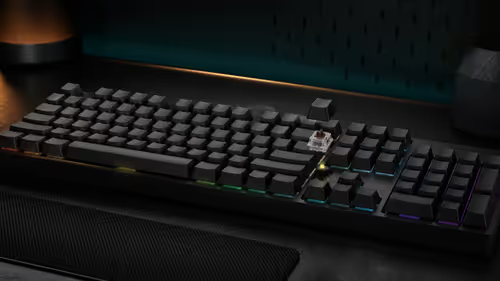
The Vulcan II XP adds hot-swappable switches, sound damping and gaming controls to a full-size wired board. SA buyers should compare feel before features.

Microsoft says Windows on Arm now has over 7,000 verified apps and games. SA buyers should still check each driver, game and work tool before switching.

Xbox Insiders can test disc-to-digital from 31 August 2026. Supported Xbox One and Series X discs gain a digital entitlement, but older discs, regions and title coverage still need exact checks.
ViewSonic's XG2738 pairs QHD QD-OLED with 240Hz and automatic panel care. SA buyers should compare warranty, brightness, ports and burn-in protection against today's R9,999-plus OLED shelf.

NVIDIA's final Windows 10 Game Ready driver is due in October 2026. SA gamers can keep using their GPU, but new game optimisations move on while critical security fixes continue quarterly.

JBL's new Quantum 520, 520X and 120 headsets cover wireless, Xbox-certified and wired use. SA buyers should compare connection, comfort and microphone needs before paying for a new badge.