"Best" changes meaning between a broadcast display, a simulation environment and an AV presentation wall. A defensible multi-display synchronization choice is the one whose timing roles, canvas support and capacity match the project's acceptance tests - not the option with the most ambitious label.
Quick Answer
RTX PRO Sync directly serves broadcast, simulation and AV environments that need high-fidelity video or interactive 3D graphics held together across large display arrays.
PNY RTX Pro Sync is a strong candidate where Genlock, Frame Lock and Mosaic all match the professional visual brief. The R19,599 card has a 32-screen allowance alongside room for eight NVIDIA RTX Pro GPUs. Each broadcast, simulation or AV team should still test its own complete system.
📡 Let broadcast define its timing need
A broadcast project should identify the timing reference, the equipment expected to follow it and the moments when frame disagreement would be visible. Genlock and Frame Lock have different roles, so write separate pass conditions rather than one broad synchronization requirement.
Observe real transitions and moving content through the intended signal path. If end-to-end delay matters, the project must set and measure its own threshold; the presence of lock functions does not create a universal latency result.
🧪 Make simulation tests workload-specific
A simulation team should map which graphics processor produces each visual region and where content crosses GPU boundaries. PNY's supported architecture can contain up to eight RTX Pro GPUs, giving larger environments a clear outer limit.
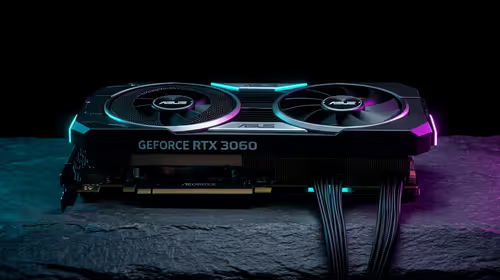
Choose processors from Evetech's workstation graphics card range after the applications and outputs are allocated. Test the complete workload under representative conditions instead of treating maximum GPU count as performance evidence.
🎭 Judge AV by audience experience
For presentation and venue visuals, define the arranged canvas and observe it from important seats. NVIDIA Mosaic supports the multi-display surface, while Genlock and Frame Lock cover coordination roles. Panel edges, viewing distance and physical alignment remain part of the room design.
Evetech's PC monitor category can be reviewed against the canvas geometry. The PNY RTX Pro Sync card places a 32-screen limit behind its R19,599 price.
⚖️ Use a common scorecard
Across all three use cases, score functional fit, scale, testability and total project cost. Give critical failures more weight than optional conveniences. A component is not "best" if it misses one non-negotiable outcome, however attractive its capacity looks.
Wait until the core design wins its scorecard before reviewing Evetech's graphics card accessories. This reduces the chance that an accessory choice quietly changes the approved architecture.
Ask each discipline for one disqualifier
The broadcast team might reject a design that cannot follow its required timing reference. Simulation specialists may disqualify an option whose graphics allocation cannot support their planned output map. AV owners could refuse a wall whose canvas fails from key audience positions.
Place these disqualifiers above the weighted score. An option that fails one cannot recover by collecting points for capacity it will never use. Then ask each discipline to provide a representative test and an owner who will sign off the result.
This process makes the word "best" traceable. The winner is best for a named project because it survives its most consequential tests, not because another installation used the same synchronization card.
Its measurable system scale is eight professional NVIDIA GPUs, two synchronisation cards and 32 displays or projectors through Mosaic. The included hardware consists of the principal card, four 12-inch cables and two 24-inch cables. That makes it a substantial SA candidate at R19,599, although the word 'best' still requires named alternatives and project-specific latency or certification evidence.
Frequently Asked Questions
Is RTX Pro Sync automatically best for every project?
No. It should win only when its synchronization functions, GPU boundary and display ceiling satisfy the project's measured needs.
What roles are available for evaluation?
The PNY card includes Genlock, Frame Lock and NVIDIA Mosaic, covering reference timing, frame coordination and arranged display presentation.
Are latency results guaranteed?
No fixed measurement follows from the feature names. Broadcast, simulation and AV teams should set their own threshold and test the complete path.
Does R19,599 represent full project value?
It is the card price. Total value depends on the surrounding GPUs, screens, installation and whether the named functions solve real risks.
How should the three use cases share one scorecard?
Keep common columns for function, scale, cost and repeatability, but let each discipline define its own disqualifier and representative content. Broadcast, simulation and AV can then be compared consistently without pretending that one successful test proves all three workloads. The winning design must survive the specific failure that matters in its intended environment. Record who owns the final sign-off for that use.
Ready to find the best fit for your professional visual brief?
Score Evetech's graphics and display options against use-specific pass conditions before naming a winner.