


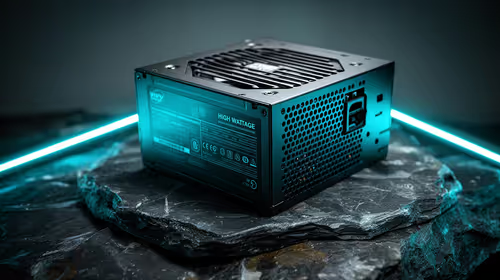
550W PSU Planning for RTX 5080 Super Builds in SA
550W for RTX 5080 Super needs a full-build check, not a simple yes. Review GPU guidance, CPU draw, transient load, connectors, PSU quality, and upgrade plans before deciding.
Read moreResolution, screen size, colour depth and measured accuracy matter most for creative work. At R7,199, the UColor O2 has a 16-inch 2880x1800 OLED canvas with 10-bit colour and 500-nit HDR. Colour-critical workflows should assess gamut coverage and calibration separately.

Creative work benefits from a portable screen when it expands the workspace without weakening colour judgement, connection reliability or file review. Portable monitor features for creative work should be scored against the final output. The UPERFECT UColor O2 costs R7,199.
Creative work benefits from the UColor O2's 100% DCI-P3, 10-bit colour, pure OLED blacks, 100,000:1 contrast and detailed 2880x1800 canvas.
Prioritise readable resolution, measured colour behaviour, a stable host link and a size that fits the working environment. For R7,199, the UColor O2 provides a 16-inch 2880x1800 OLED panel with 10-bit colour, HDR and 120Hz. Creative suitability still depends on gamut, calibration, application scaling and the exact USB-C path.
Write down whether the project ends on web, print, video or another display. That decision defines the colour measurements and reference process required. OLED and 10-bit support can shape the viewing experience, but neither states gamut coverage or colour error.
Use a trusted file and compare output on the established delivery reference. Do not alter the artwork simply to match an unmeasured portable panel.
Browse portable monitors at Evetech with the same output standard attached to every candidate.
At 2880x1800, the UColor O2 can present detailed content and interface space. Set scaling for legible menus, then arrange the canvas, timeline, layers or reference panes used together. The best scale is the one that reduces switching without introducing blurry controls.
Test a difficult application before assuming every creative interface renders cleanly at the chosen density.
The 120Hz setting may help timeline movement or animation preview, while the 500-nit HDR specification concerns another display path. Test motion with fixed content, then evaluate HDR using appropriate material and a saved SDR baseline.
No named HDR standard or bright-room result should be inferred. Place the screen in the intended studio or travel location and judge it there.
Using the exact workstation port and cable, verify stable power, native video and the intended sound route separately. Reconnect after sleep and check that the colour and scaling profile returns. If the monitor travels, protect its 6.5mm body from pressure and loose accessories.
Compare fixed creator options in Evetech's PC-monitor range when mobility is secondary to a permanent reference display.
Open the reference file on the measured studio display first, then move it to the portable panel without editing. Record differences in neutral tones, shadow detail and application scale. Return the window to the reference and confirm the file itself did not change.
This sequence lets the UColor O2 serve review and workspace duties without silently taking authority for final colour before its measurements justify that role.
Choose the location with the most difficult light, smallest table or least convenient host port. Recreate the creative session there, including connection, scaling and file access. A portable workflow that works only in the main studio has not solved the travel requirement.
Record the failure condition and a safe fallback. The answer may be a different panel angle, an SDR review profile or returning final approval to the fixed reference.
A larger canvas, new camera file or different delivery medium can alter workspace and colour requirements. Keep the old reference pack, then add one sample from the new format. Measure only the affected rows rather than restarting the entire monitor evaluation.
If memory, rendering or export becomes slower, keep that result with the host and application. The portable display does not create a benchmark for the rest of the creative system.
Save the application scale and colour workflow separately; one can be comfortable while the other remains unsuitable for final delivery decisions.
The 16:10 ratio adds vertical room for timelines, layers, code or reference panels, and wide-angle OLED consistency helps during shared review. Integrated brightness control adapts the screen between office and travel conditions. Professional approval still needs the creator's own measured calibration tolerance, but the gamut, bit depth, contrast and resolution directly establish a high-end portable editing proposition.
No. Bit depth and gamut coverage are separate measurements, and calibration adds another requirement.
It can provide detailed workspace, but scaling and application rendering decide how much remains comfortably usable.
It may make compatible motion smoother. Test the actual application and content rather than assuming a productivity gain.
Only after it passes the measurement and calibration requirements of the delivery workflow.
Ready to choose a portable screen around the final output? Compare Evetech creator displays with your colour target, applications and connection route defined first.
No. Bit depth and gamut coverage are separate measurements, and calibration adds another requirement.
It can provide detailed workspace, but scaling and application rendering decide how much remains comfortably usable.
It may make compatible motion smoother. Test the actual application and content rather than assuming a productivity gain.
Only after it passes the measurement and calibration requirements of the delivery workflow.
550W for RTX 5080 Super needs a full-build check, not a simple yes. Review GPU guidance, CPU draw, transient load, connectors, PSU quality, and upgrade plans before deciding.
Read more
8000Hz polling is overrated for most SA gamers because gains can be tiny next to battery drain and monitor limits. Mbombela players should weigh mouse feel, game support, and system stability before chasing the number.
Read more
Magnetic switches are taking over SA gaming keyboards because actuation can be tuned. For Sandton gamers, rapid trigger, reset control, and profile depth can help, but layout, key feel, and software quality still matter.
Read more
Polokwane oled monitor value questions need cautious SA context because pricing can move with availability, exchange rates, specs, and warranty support. Treat the trend as a planning signal, not a fixed price promise.
Read more
Arc B580 budget builds for Midrand gamers can shift with exchange rates, supply, specs, and model tier. Treat the title as a buying prompt, then compare SA warranty, timing, and build priorities.
Read more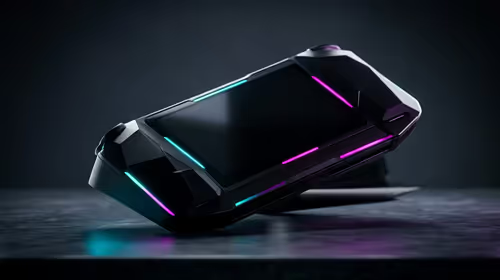
ROG Ally X may beat the LCD Steam Deck for SA gamers who value stronger handheld performance, more memory, and Windows flexibility. Compare battery life, controls, game libraries, and Polokwane support needs before deciding.
Read more
Minisforum's M2 Pro pairs Core Ultra X7, Arc B390 graphics and 32GB onboard memory in 1.8 litres. SA buyers should weigh its fixed memory and $1,439 launch offer against local mini PCs.

Lenovo says Legion Go failures linked to BIOS N3CN42WW are not user error. Affected SA owners should stop retrying the update, preserve proof and open a support case.

Smart monitors can add apps and convenience, but they also add privacy settings and unwanted-software risk. SA buyers should audit the operating system before paying for extras.

A fake 113GB GTA VI ISO reportedly used empty padding around a small malware payload. SA gamers should delete unofficial builds, keep Windows security active and wait for official channels.
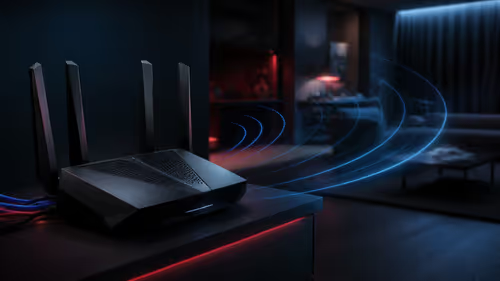
ASUS calls the ROG GT-BN98 the first Wi-Fi 8 gaming router. SA buyers should fix coverage and client limits before paying for a future wireless standard.
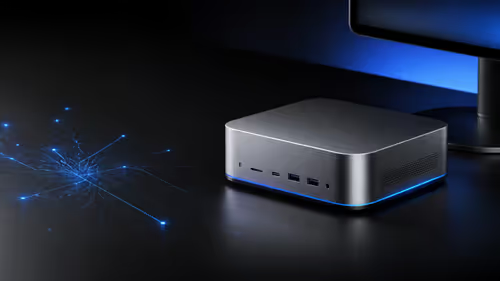
Apple's M6 Mac mini adds faster AI, graphics and networking in the same compact format. SA buyers should wait for a rand listing before comparing value.
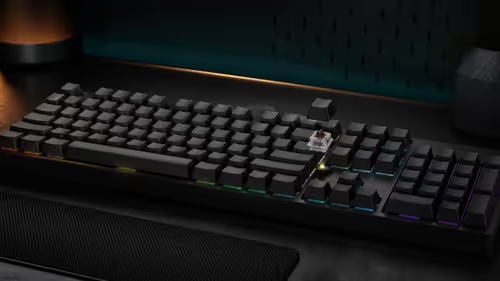
The Vulcan II XP adds hot-swappable switches, sound damping and gaming controls to a full-size wired board. SA buyers should compare feel before features.

Microsoft says Windows on Arm now has over 7,000 verified apps and games. SA buyers should still check each driver, game and work tool before switching.

Xbox Insiders can test disc-to-digital from 31 August 2026. Supported Xbox One and Series X discs gain a digital entitlement, but older discs, regions and title coverage still need exact checks.
ViewSonic's XG2738 pairs QHD QD-OLED with 240Hz and automatic panel care. SA buyers should compare warranty, brightness, ports and burn-in protection against today's R9,999-plus OLED shelf.

NVIDIA's final Windows 10 Game Ready driver is due in October 2026. SA gamers can keep using their GPU, but new game optimisations move on while critical security fixes continue quarterly.

JBL's new Quantum 520, 520X and 120 headsets cover wireless, Xbox-certified and wired use. SA buyers should compare connection, comfort and microphone needs before paying for a new badge.