


550W PSU Planning for RTX 5080 Super Builds in SA
550W for RTX 5080 Super needs a full-build check, not a simple yes. Review GPU guidance, CPU draw, transient load, connectors, PSU quality, and upgrade plans before deciding.
Read moreGaming, work and travel prioritise different portable-monitor features, so rank each use case before buying. The R2,499 UPERFECT offers 120Hz, 14ms response, FHD IPS, 100% sRGB, 178-degree viewing, anti-glare treatment and hardware low blue light.

A screen can be excellent at one role and awkward at another. Ranking portable monitor features for gaming, work and travel requires three separate scorecards, followed by a compromise that reflects how often each scenario actually occurs.
For gaming, work and travel, the monitor offers 120Hz motion, 100% sRGB colour, paper-like anti-glare comfort and a 2.79-pound protected portable build.
Gaming should emphasise usable refresh and motion behaviour, work should favour legible layout and colour needs, and travel should include the complete setup burden. For R2,499, the NxtLED One Plus brings 120Hz, 14ms response, Full HD IPS, 100% sRGB and 178-degree viewing.
Start with the source's ability to output 1920x1080 at 120Hz. The panel can update at that rate only when the device, connection and game produce a compatible mode.
Keep the 14ms response number separate from refresh frequency. Test a familiar fast scene, camera pan and control sequence, then record motion clarity and input feel independently. Neither figure promises a particular frame rate or competitive result.
Reflection control can matter during dark games. Put its paper-like surface and Omni Visible glare treatment to work where play will happen, with the most difficult lamp or window present.
Compare other gaming and media candidates through the Evetech portable monitor selection.
Full HD provides a 1920x1080 grid across 18.5 inches. Open the owner's normal spreadsheet, browser, document and communication tools, then set scaling for readable text rather than forcing the maximum number of windows.
The panel covers 100% sRGB. That may be useful for sRGB-based content, but colour-critical work still needs an appropriate accuracy and calibration process. General office tasks may rank comfortable layout above measured colour.
Hardware low blue light can join a viewing routine with sensible room illumination, distance and breaks. It does not guarantee comfort through an entire working day.
Diagonal size does not reveal body dimensions, weight or bag fit. Confirm those values for the exact monitor, then add support, cables, power equipment and protection to the travel list.
Rehearse the setup on the smallest expected surface. Cable bends, the source device and a comfortable viewing distance all consume space beyond the 18.5-inch diagonal.
The 178-degree viewing specification may help flexible placement, yet the user's neck position and reflections still determine a sensible seat. Try the actual travel angle instead of relying on the maximum number.
Give each scenario a frequency and consequence score. A daily work improvement can outweigh an occasional gaming benefit, while frequent travel may make connection simplicity more important than either.
Write one must-pass test per role and reject candidates that fail any essential row. Optional features can then break ties without hiding a practical problem.
Choose a defined stand, cable or protective item from the Evetech monitor accessories category only after the missing job is clear. R2,499 represents value when the whole arrangement passes the dominant role and remains acceptable in the other two.
Revisit the score after one simulated week. Alternate the planned gaming, work and travel routines, then count how often each advertised capability was actually used. This catches a shortlist built around an occasional scenario while a daily inconvenience receives too little weight.
Keep the three role scores visible rather than averaging them too early. A single essential failure should not disappear inside several modest wins.
Gaming benefits from the Full HD 120Hz panel and blur-reduction intent; work gains vivid accurate colour, wide 178-degree viewing and stable brightness; travel gains the textured chassis, slim bezel and included case. DC dimming, flicker-free output and hardware low blue light cross all three roles. Connectivity still has to match the source, but the screen's role in each activity is concrete.
Build one carry list for the chosen role and remove anything unused after several trips. Portability improves when the monitor, protective case, proven cables and power arrangement remain predictable.
Begin with compatible 1920x1080 output at 120Hz, then assess the 14ms pixel response as a separate behaviour.
Open the normal application set, choose readable scaling and count genuinely useful windows rather than theoretical capacity.
Include body size, measured weight, support, signal cables, power, protection and the surface used at the destination.
Weight each role by frequency and consequence, then require every essential task to pass before optional benefits are scored.
Ready to rank the screen by three real usage patterns? Build the scorecards, then compare portable monitors and carefully chosen setup accessories through Evetech.
Begin with compatible 1920x1080 output at 120Hz, then assess the 14ms pixel response as a separate behaviour.
Open the normal application set, choose readable scaling and count genuinely useful windows rather than theoretical capacity.
Include body size, measured weight, support, signal cables, power, protection and the surface used at the destination.
Weight each role by frequency and consequence, then require every essential task to pass before optional benefits are scored.
550W for RTX 5080 Super needs a full-build check, not a simple yes. Review GPU guidance, CPU draw, transient load, connectors, PSU quality, and upgrade plans before deciding.
Read more
8000Hz polling is overrated for most SA gamers because gains can be tiny next to battery drain and monitor limits. Mbombela players should weigh mouse feel, game support, and system stability before chasing the number.
Read more
Magnetic switches are taking over SA gaming keyboards because actuation can be tuned. For Sandton gamers, rapid trigger, reset control, and profile depth can help, but layout, key feel, and software quality still matter.
Read more
Polokwane oled monitor value questions need cautious SA context because pricing can move with availability, exchange rates, specs, and warranty support. Treat the trend as a planning signal, not a fixed price promise.
Read more
Arc B580 budget builds for Midrand gamers can shift with exchange rates, supply, specs, and model tier. Treat the title as a buying prompt, then compare SA warranty, timing, and build priorities.
Read more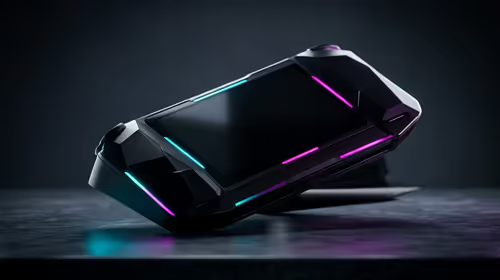
ROG Ally X may beat the LCD Steam Deck for SA gamers who value stronger handheld performance, more memory, and Windows flexibility. Compare battery life, controls, game libraries, and Polokwane support needs before deciding.
Read more
Minisforum's M2 Pro pairs Core Ultra X7, Arc B390 graphics and 32GB onboard memory in 1.8 litres. SA buyers should weigh its fixed memory and $1,439 launch offer against local mini PCs.

Lenovo says Legion Go failures linked to BIOS N3CN42WW are not user error. Affected SA owners should stop retrying the update, preserve proof and open a support case.

Smart monitors can add apps and convenience, but they also add privacy settings and unwanted-software risk. SA buyers should audit the operating system before paying for extras.

A fake 113GB GTA VI ISO reportedly used empty padding around a small malware payload. SA gamers should delete unofficial builds, keep Windows security active and wait for official channels.
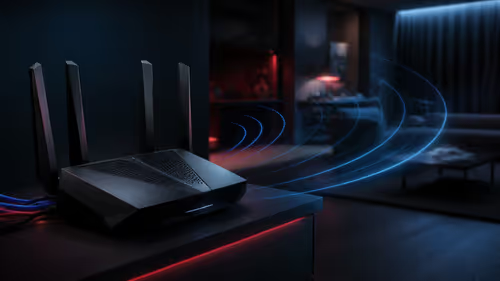
ASUS calls the ROG GT-BN98 the first Wi-Fi 8 gaming router. SA buyers should fix coverage and client limits before paying for a future wireless standard.
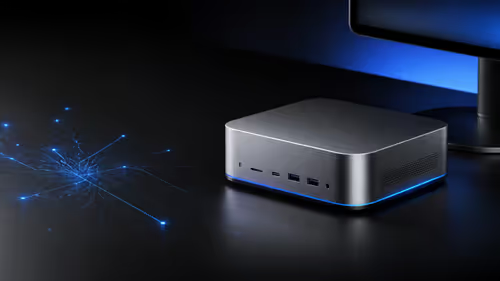
Apple's M6 Mac mini adds faster AI, graphics and networking in the same compact format. SA buyers should wait for a rand listing before comparing value.
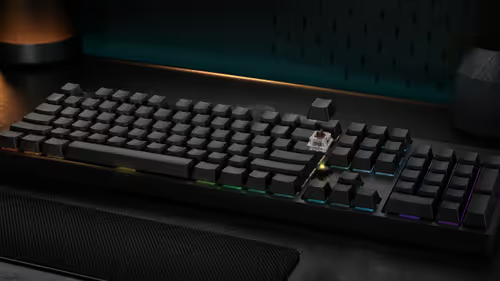
The Vulcan II XP adds hot-swappable switches, sound damping and gaming controls to a full-size wired board. SA buyers should compare feel before features.

Microsoft says Windows on Arm now has over 7,000 verified apps and games. SA buyers should still check each driver, game and work tool before switching.

Xbox Insiders can test disc-to-digital from 31 August 2026. Supported Xbox One and Series X discs gain a digital entitlement, but older discs, regions and title coverage still need exact checks.
ViewSonic's XG2738 pairs QHD QD-OLED with 240Hz and automatic panel care. SA buyers should compare warranty, brightness, ports and burn-in protection against today's R9,999-plus OLED shelf.

NVIDIA's final Windows 10 Game Ready driver is due in October 2026. SA gamers can keep using their GPU, but new game optimisations move on while critical security fixes continue quarterly.

JBL's new Quantum 520, 520X and 120 headsets cover wireless, Xbox-certified and wired use. SA buyers should compare connection, comfort and microphone needs before paying for a new badge.