


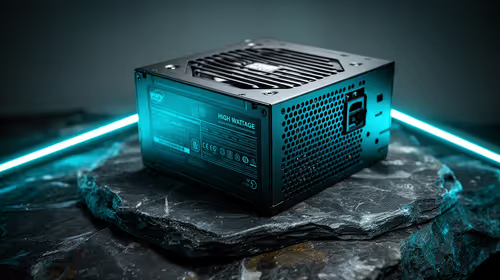
550W PSU Planning for RTX 5080 Super Builds in SA
550W for RTX 5080 Super needs a full-build check, not a simple yes. Review GPU guidance, CPU draw, transient load, connectors, PSU quality, and upgrade plans before deciding.
Read moreThe best portable-monitor resolution depends on screen size, source support and the content being displayed. The R1,799 J314 provides 2160x1440 QHD on a 14-inch IPS panel, giving buyers exact figures for a travel, work or media comparison.
The best travel resolution balances detail, source support, scaling and physical screen area. Choosing a portable monitor resolution for work and media means testing the pixel grid with real layouts rather than assuming the largest number always creates the most usable view.
For travel and work, the J314's 2160x1440 resolution delivers 185-PPI clarity and a taller 3:2 workspace without pushing the screen beyond 0.47kg.
R1,799 buys the J314's 2160x1440 pixel grid across a 14-inch IPS screen. It becomes a strong resolution choice when source output and comfortable scaling preserve useful space without undermining travel requirements.
For work, open the normal document, reference and communication windows. For media, use familiar content and inspect detail at the expected distance.
The 2160x1440 pixel grid can support both, but interface scaling changes visible workspace. Fine text that is technically present yet uncomfortable to read has little value.
Compare resolutions in the Evetech portable screen department using the same applications and source.
The J314 remains 14 inches diagonally. Resolution does not enlarge the panel or prove outside dimensions.
Test viewing distance and destination surface. A compact work area may benefit from the physical size even when some users prefer a larger panel elsewhere.
Two input formats are present: Type-C and Mini HDMI. The precise laptop, phone or console still needs a compatible video output and cable.
Power, drivers and configuration remain independent checks. A matching connector does not establish that the 2160x1440 option will appear automatically.
Use monitor accessories from Evetech only after the required cable or adapter function is identified.
The monitor weighs 1.4kg before cables, power and protection. Resolution does not determine this weight; it is a separate portability figure.
The IPS panel also carries 1500:1 contrast and 30ms response. Those characteristics may influence viewing, while resolution answers the pixel-density and workspace question.
At R1,799, the J314's QHD grid is worthwhile when it survives the source, scaling and carrying tests. Another resolution can be better when those needs point elsewhere.
Create one resolution test pack with a long document, detailed image and typical media clip. Use identical files at the same scale and distance when comparing candidates.
Record two outcomes per item: whether the detail is visible and whether the layout remains comfortable. A dense pixel grid that forces tiring text does not automatically win the work test.
Include the destination in the result. A 14-inch screen may serve a compact table differently from a larger desk, while travel frequency changes the importance of the 1.4kg load.
Finally, save the source mode and cable used. If QHD fails on another device later, the known configuration provides a baseline instead of turning the resolution decision into guesswork.
Keep the resolution result tied to the source model. Another phone or laptop should repeat output and scaling checks rather than inherit the earlier pass without its own evidence from that specific connection route.
Repeat the test after packing and reconnecting the display. The same QHD result should be available through the route the traveller will actually use.
If the source defaults to another mode, document the steps required to restore 2160x1440 and decide whether that setup effort is acceptable.
Review media and work separately. Detail that helps one application may not justify the carrying burden for a user focused on another task.
Full HD can remain sufficient for basic media and may simplify source scaling, while this 2K panel specifically benefits text, spreadsheets, code and creative detail. The 14-inch size keeps the pixels dense, and 100% sRGB extends usefulness beyond office documents. Choose resolution through repeated tasks and viewing comfort; a larger number creates value only when the owner uses the added information.
Consider battery impact on the connected laptop as well. Higher resolution can increase the source workload even when the portable panel itself remains physically light.
Choose 2K for tasks that repeatedly expose its denser text and extra vertical canvas.
Task density should decide whether the resolution upgrade is worthwhile.
The 14-inch IPS panel uses 2160x1440 resolution, with source support and scaling determining the practical result.
No. Text comfort, viewing distance, application design and physical desk space vary between users and locations.
Resolution counts pixels, while 14 inches describes physical area. Both influence how content feels in use.
No. The J314 has a separate 1.4kg monitor weight before any travel accessories are added.
Choosing a portable resolution that must work beyond the specification sheet? Test source output, scaling and the complete travel kit, then compare monitors and connection accessories through Evetech.
The 14-inch IPS panel uses 2160x1440 resolution, with source support and scaling determining the practical result.
No. Text comfort, viewing distance, application design and physical desk space vary between users and locations.
Resolution counts pixels, while 14 inches describes physical area. Both influence how content feels in use.
No. The J314 has a separate 1.4kg monitor weight before any travel accessories are added.
550W for RTX 5080 Super needs a full-build check, not a simple yes. Review GPU guidance, CPU draw, transient load, connectors, PSU quality, and upgrade plans before deciding.
Read more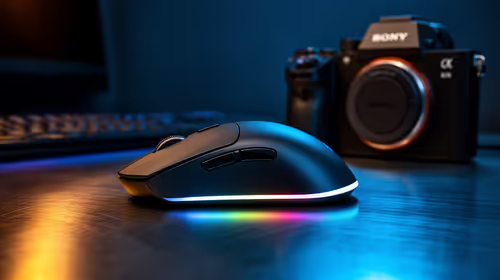
8000Hz polling is overrated for most SA gamers because gains can be tiny next to battery drain and monitor limits. Mbombela players should weigh mouse feel, game support, and system stability before chasing the number.
Read more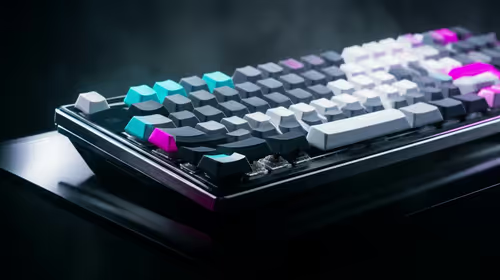
Magnetic switches are taking over SA gaming keyboards because actuation can be tuned. For Sandton gamers, rapid trigger, reset control, and profile depth can help, but layout, key feel, and software quality still matter.
Read more
Polokwane oled monitor value questions need cautious SA context because pricing can move with availability, exchange rates, specs, and warranty support. Treat the trend as a planning signal, not a fixed price promise.
Read more
Arc B580 budget builds for Midrand gamers can shift with exchange rates, supply, specs, and model tier. Treat the title as a buying prompt, then compare SA warranty, timing, and build priorities.
Read more
ROG Ally X may beat the LCD Steam Deck for SA gamers who value stronger handheld performance, more memory, and Windows flexibility. Compare battery life, controls, game libraries, and Polokwane support needs before deciding.
Read more
Minisforum's M2 Pro pairs Core Ultra X7, Arc B390 graphics and 32GB onboard memory in 1.8 litres. SA buyers should weigh its fixed memory and $1,439 launch offer against local mini PCs.

Lenovo says Legion Go failures linked to BIOS N3CN42WW are not user error. Affected SA owners should stop retrying the update, preserve proof and open a support case.

Smart monitors can add apps and convenience, but they also add privacy settings and unwanted-software risk. SA buyers should audit the operating system before paying for extras.

A fake 113GB GTA VI ISO reportedly used empty padding around a small malware payload. SA gamers should delete unofficial builds, keep Windows security active and wait for official channels.
ASUS calls the ROG GT-BN98 the first Wi-Fi 8 gaming router. SA buyers should fix coverage and client limits before paying for a future wireless standard.
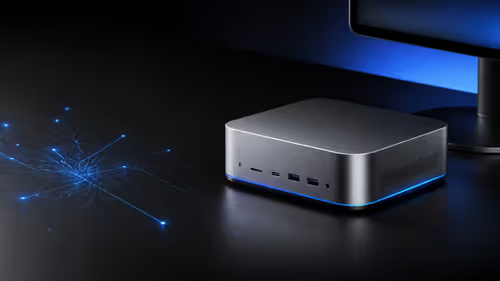
Apple's M6 Mac mini adds faster AI, graphics and networking in the same compact format. SA buyers should wait for a rand listing before comparing value.
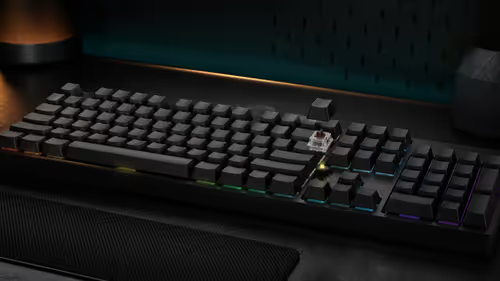
The Vulcan II XP adds hot-swappable switches, sound damping and gaming controls to a full-size wired board. SA buyers should compare feel before features.

Microsoft says Windows on Arm now has over 7,000 verified apps and games. SA buyers should still check each driver, game and work tool before switching.

Xbox Insiders can test disc-to-digital from 31 August 2026. Supported Xbox One and Series X discs gain a digital entitlement, but older discs, regions and title coverage still need exact checks.
ViewSonic's XG2738 pairs QHD QD-OLED with 240Hz and automatic panel care. SA buyers should compare warranty, brightness, ports and burn-in protection against today's R9,999-plus OLED shelf.

NVIDIA's final Windows 10 Game Ready driver is due in October 2026. SA gamers can keep using their GPU, but new game optimisations move on while critical security fixes continue quarterly.

JBL's new Quantum 520, 520X and 120 headsets cover wireless, Xbox-certified and wired use. SA buyers should compare connection, comfort and microphone needs before paying for a new badge.