


550W PSU Planning for RTX 5080 Super Builds in SA
550W for RTX 5080 Super needs a full-build check, not a simple yes. Review GPU guidance, CPU draw, transient load, connectors, PSU quality, and upgrade plans before deciding.
Read moreSamsung, SK Hynix and Micron produce the vast majority of the world's DRAM, so their production decisions set the baseline every retailer, including in South Africa, prices against. When all three shift capacity toward AI memory at once, RAM pricing only goes up.
Samsung, SK hynix and Micron remain the three dominant global DRAM suppliers in 2026. Samsung's first-quarter report put its own revenue share at 38.4 per cent, while SK hynix cited a 29.1 per cent first-quarter share from IDC. Micron remains the other major supplier. That concentration makes each company's capacity and product mix matter across the market.
The big three set much of the supply baseline because they own advanced DRAM design and high-volume manufacturing. They do not set the final price of a South African memory kit alone. Module brands, contracts, exchange rate, logistics, inventory and seller costs sit between a DRAM die and the shelf.
Evetech's DDR5 memory catalogue shows the finished consumer products built from that upstream market. The best-selling memory kits give a local view of capacities and speeds buyers can choose now.
Advanced DRAM needs expensive fabs, process research, high yields and customer qualification. Those barriers make rapid entry difficult.
Samsung, SK hynix and Micron serve consumer, mobile, graphics, server and HBM markets. A production or investment choice in one part of the portfolio can affect supply expectations elsewhere.
Their market rank can change by quarter. The durable fact is concentration, not one permanent leader.
Each supplier decides capital spending, node transitions, product mix and customer commitments. Samsung said it was expanding HBM4 capacity and pursuing an AI-focused memory strategy. SK hynix highlighted HBM and high-capacity server products, while Micron described strong AI-era memory demand and record investment.
Similar demand signals can lead several firms towards HBM without proving they coordinate price or output. Do not turn market concentration into an unsupported collusion claim.
Supply also depends on yields and packaging. Planned wafer starts are not the same as finished sellable bits.
Other DRAM producers can serve regional, legacy or growing markets and add supply. Module makers can switch qualified dies and build different kits.
They cannot replace the big three's advanced global output overnight. Fab scale, patents, tools and customer qualification take time.
Watch actual bit shipments and product availability rather than one announced factory number.
Memory-chip contracts influence the module maker's cost. Binning, PCB, heat spreader, validation and warranty add another layer. Exchange rate, freight and local stock add more.
A premium RGB kit can move differently from a basic kit using the same capacity. Speed and latency bins carry their own supply.
The concentrated upstream market explains sensitivity, but the final rand figure remains a chain result.
Samsung, SK hynix and Micron are the dominant suppliers in the current global market.
No. Similar responses to AI demand do not establish coordination. Claims need evidence beyond market structure.
They can add useful supply, but advanced capacity and qualification cannot scale to replace the major producers at once.
Follow the big three's actual capacity and shipment signals, then compare finished DDR5 kits through the full local cost chain.
Samsung, SK hynix and Micron are the dominant suppliers in the current global market.
No. Similar responses to AI demand do not establish coordination. Claims need evidence beyond market structure.
They can add useful supply, but advanced capacity and qualification cannot scale to replace the major producers at once. {{PRODUCTS: { facets: { query: "memory" }, limit: 12, title: "Memory Kits", style: "4" } }}
550W for RTX 5080 Super needs a full-build check, not a simple yes. Review GPU guidance, CPU draw, transient load, connectors, PSU quality, and upgrade plans before deciding.
Read more
8000Hz polling is overrated for most SA gamers because gains can be tiny next to battery drain and monitor limits. Mbombela players should weigh mouse feel, game support, and system stability before chasing the number.
Read more
Magnetic switches are taking over SA gaming keyboards because actuation can be tuned. For Sandton gamers, rapid trigger, reset control, and profile depth can help, but layout, key feel, and software quality still matter.
Read more
Polokwane oled monitor value questions need cautious SA context because pricing can move with availability, exchange rates, specs, and warranty support. Treat the trend as a planning signal, not a fixed price promise.
Read more
Arc B580 budget builds for Midrand gamers can shift with exchange rates, supply, specs, and model tier. Treat the title as a buying prompt, then compare SA warranty, timing, and build priorities.
Read more
ROG Ally X may beat the LCD Steam Deck for SA gamers who value stronger handheld performance, more memory, and Windows flexibility. Compare battery life, controls, game libraries, and Polokwane support needs before deciding.
Read more
Minisforum's M2 Pro pairs Core Ultra X7, Arc B390 graphics and 32GB onboard memory in 1.8 litres. SA buyers should weigh its fixed memory and $1,439 launch offer against local mini PCs.

Lenovo says Legion Go failures linked to BIOS N3CN42WW are not user error. Affected SA owners should stop retrying the update, preserve proof and open a support case.

Smart monitors can add apps and convenience, but they also add privacy settings and unwanted-software risk. SA buyers should audit the operating system before paying for extras.

A fake 113GB GTA VI ISO reportedly used empty padding around a small malware payload. SA gamers should delete unofficial builds, keep Windows security active and wait for official channels.
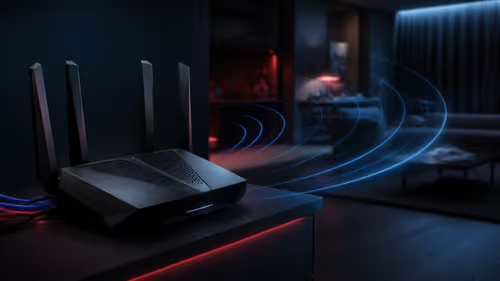
ASUS calls the ROG GT-BN98 the first Wi-Fi 8 gaming router. SA buyers should fix coverage and client limits before paying for a future wireless standard.
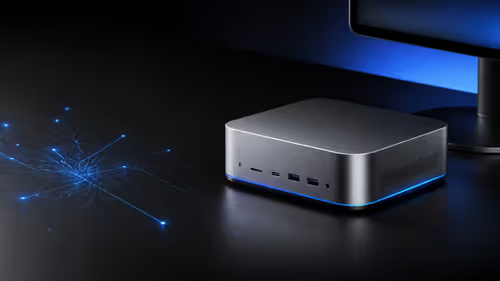
Apple's M6 Mac mini adds faster AI, graphics and networking in the same compact format. SA buyers should wait for a rand listing before comparing value.
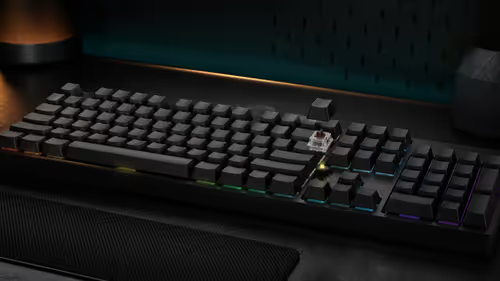
The Vulcan II XP adds hot-swappable switches, sound damping and gaming controls to a full-size wired board. SA buyers should compare feel before features.

Microsoft says Windows on Arm now has over 7,000 verified apps and games. SA buyers should still check each driver, game and work tool before switching.

Xbox Insiders can test disc-to-digital from 31 August 2026. Supported Xbox One and Series X discs gain a digital entitlement, but older discs, regions and title coverage still need exact checks.

ViewSonic's XG2738 pairs QHD QD-OLED with 240Hz and automatic panel care. SA buyers should compare warranty, brightness, ports and burn-in protection against today's R9,999-plus OLED shelf.

NVIDIA's final Windows 10 Game Ready driver is due in October 2026. SA gamers can keep using their GPU, but new game optimisations move on while critical security fixes continue quarterly.

JBL's new Quantum 520, 520X and 120 headsets cover wireless, Xbox-certified and wired use. SA buyers should compare connection, comfort and microphone needs before paying for a new badge.