



550W PSU Planning for RTX 5080 Super Builds in SA
550W for RTX 5080 Super needs a full-build check, not a simple yes. Review GPU guidance, CPU draw, transient load, connectors, PSU quality, and upgrade plans before deciding.
Read moreBiodegradable PLA can make sense when its plant-based material and project role match a maker's priorities. ELEGOO Galaxy PLA adds a glossy, angle-shifting finish in a 1kg, 1.75mm spool for R499.

Material choice can reflect environmental priorities without pretending that a printed object disappears the moment it is discarded. Biodegradable PLA filament gives South African makers a plant-based option, while responsible project planning still depends on using only the material the object requires and following appropriate local disposal guidance.
Biodegradable PLA makes sense when its plant-based formulation, print purpose and desired finish align with the project. For R499, the ELEGOO Galaxy package contains 1kg of 1.75mm material with a glossy angle-shifting surface for beginners and professionals. The biodegradable description should inform the choice, not replace durable design or waste planning.
ELEGOO Galaxy PLA is biodegradable and plant-based. Those are direct characteristics of this spool, and they can matter to a maker comparing material families. They do not describe the complete life of every printed item, which may also include supports, failed trials, coatings or other assembled parts.
Use the 3D printing filament range to compare named materials rather than applying one environmental assumption to every spool carrying the PLA label.
The most immediate material saving happens before printing: use a representative test, check orientation and avoid making a large object the first experiment. A short calibration piece can expose surface or fit problems before they consume far more filament.
Consider whether the object needs to be solid, whether hidden decorative surfaces add value and whether several prototypes can be reduced to one focused test. These decisions improve resource use without promising a disposal or degradation outcome.
The Galaxy finish is glossy, with colour changes that appear as the object moves. It is most useful on pieces whose exposed surfaces are part of the reason for printing them. A carefully planned display object can use that effect fully; an unseen internal component cannot.
Printer efficiency also begins with compatibility and a sound baseline. Browse Evetech's 3D printer range when planning hardware, then follow the chosen machine's PLA guidance. Better preparation supports both cleaner results and fewer discarded attempts.
Environmental intent can be weakened when a print combines unnecessary supports, disposable trial pieces and unrelated materials without planning. List every component and finishing step before choosing the Galaxy spool. This reveals which parts are plant-based PLA and which require separate handling.
Use the smallest test that can settle geometry or surface questions, then keep successful prototypes as references where possible. A durable, useful object that was planned carefully may represent better material discipline than several rushed prints carrying the same biodegradable label. The maker controls design choices immediately, while disposal conditions remain a matter for appropriate local guidance.
Review the design after use, not only after printing. If a decorative piece was never viewed from the angles that reveal the shimmer, its next version may need different orientation or a calmer material. If it stayed useful and visually relevant, preserve the model and setup. Environmental care includes learning from completed objects so the same avoidable design mistake is not printed repeatedly.
The material choice is concrete: Galaxy PLA is plant-derived and biodegradable while still delivering the accessible printing behaviour associated with traditional PLA. That gives South African makers a decorative option that combines formulation and appearance in one spool. It should not be stretched into a promise about how a finished object behaves in every disposal environment, but the underlying PLA choice is real.
Its visual contribution is equally specific. High gloss, deep-space lustre and rich colour transitions suit pieces that remain visible after printing. A maker can therefore connect the environmental preference to a genuine project role instead of buying biodegradable filament whose surface adds nothing to the intended model.
Use a compact representative test to settle orientation and surface response before committing to the complete piece. That reduces avoidable waste while proving that the visible curves or facets can use the Galaxy movement. For shared workshops, label the spool by both formulation and finish so the next maker understands why it was selected.
Yes. The 1.75mm Galaxy material is both plant-based and biodegradable.
No. Makers should follow appropriate local guidance and consider every material or coating used in the completed object.
Print a focused sample, settle orientation early and avoid using decorative material on surfaces that will remain hidden.
It is beginner and professional friendly, so project purpose matters more than experience level when deciding whether to use it.
Ready to align material choice with a useful project? Explore Evetech's PLA and printer ranges, then plan the smallest reliable path from test piece to finished object.
Yes. The 1.75mm Galaxy material is both plant-based and biodegradable.
No. Makers should follow appropriate local guidance and consider every material or coating used in the completed object.
Print a focused sample, settle orientation early and avoid using decorative material on surfaces that will remain hidden.
It is beginner and professional friendly, so project purpose matters more than experience level when deciding whether to use it.
550W for RTX 5080 Super needs a full-build check, not a simple yes. Review GPU guidance, CPU draw, transient load, connectors, PSU quality, and upgrade plans before deciding.
Read more
8000Hz polling is overrated for most SA gamers because gains can be tiny next to battery drain and monitor limits. Mbombela players should weigh mouse feel, game support, and system stability before chasing the number.
Read more
Magnetic switches are taking over SA gaming keyboards because actuation can be tuned. For Sandton gamers, rapid trigger, reset control, and profile depth can help, but layout, key feel, and software quality still matter.
Read more
Polokwane oled monitor value questions need cautious SA context because pricing can move with availability, exchange rates, specs, and warranty support. Treat the trend as a planning signal, not a fixed price promise.
Read more
Arc B580 budget builds for Midrand gamers can shift with exchange rates, supply, specs, and model tier. Treat the title as a buying prompt, then compare SA warranty, timing, and build priorities.
Read more
ROG Ally X may beat the LCD Steam Deck for SA gamers who value stronger handheld performance, more memory, and Windows flexibility. Compare battery life, controls, game libraries, and Polokwane support needs before deciding.
Read more
Minisforum's M2 Pro pairs Core Ultra X7, Arc B390 graphics and 32GB onboard memory in 1.8 litres. SA buyers should weigh its fixed memory and $1,439 launch offer against local mini PCs.

Lenovo says Legion Go failures linked to BIOS N3CN42WW are not user error. Affected SA owners should stop retrying the update, preserve proof and open a support case.

Smart monitors can add apps and convenience, but they also add privacy settings and unwanted-software risk. SA buyers should audit the operating system before paying for extras.

A fake 113GB GTA VI ISO reportedly used empty padding around a small malware payload. SA gamers should delete unofficial builds, keep Windows security active and wait for official channels.

ASUS calls the ROG GT-BN98 the first Wi-Fi 8 gaming router. SA buyers should fix coverage and client limits before paying for a future wireless standard.

Apple's M6 Mac mini adds faster AI, graphics and networking in the same compact format. SA buyers should wait for a rand listing before comparing value.
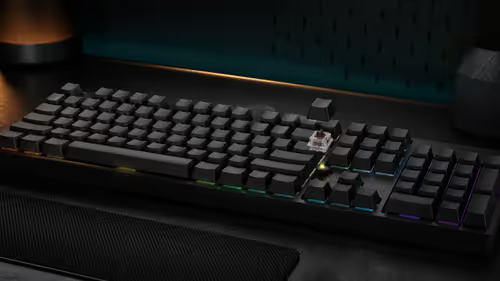
The Vulcan II XP adds hot-swappable switches, sound damping and gaming controls to a full-size wired board. SA buyers should compare feel before features.

Microsoft says Windows on Arm now has over 7,000 verified apps and games. SA buyers should still check each driver, game and work tool before switching.

Xbox Insiders can test disc-to-digital from 31 August 2026. Supported Xbox One and Series X discs gain a digital entitlement, but older discs, regions and title coverage still need exact checks.

ViewSonic's XG2738 pairs QHD QD-OLED with 240Hz and automatic panel care. SA buyers should compare warranty, brightness, ports and burn-in protection against today's R9,999-plus OLED shelf.

NVIDIA's final Windows 10 Game Ready driver is due in October 2026. SA gamers can keep using their GPU, but new game optimisations move on while critical security fixes continue quarterly.

JBL's new Quantum 520, 520X and 120 headsets cover wireless, Xbox-certified and wired use. SA buyers should compare connection, comfort and microphone needs before paying for a new badge.