


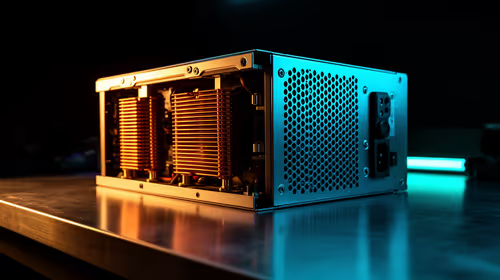
1000W PSU Planning for RTX 5090 Builds in SA
1000W for RTX 5090 needs a full-build check, not a simple yes. Review GPU guidance, CPU draw, transient load, connectors, PSU quality, and upgrade plans before deciding.
Read moreMatch high-end gaming pcs need more airflow and to your build by checking case size, radiator slots, and fan headers. The guide pairs each spec with a SA gamer scenario. Built for SA gaming PC buyers. Plan your build.
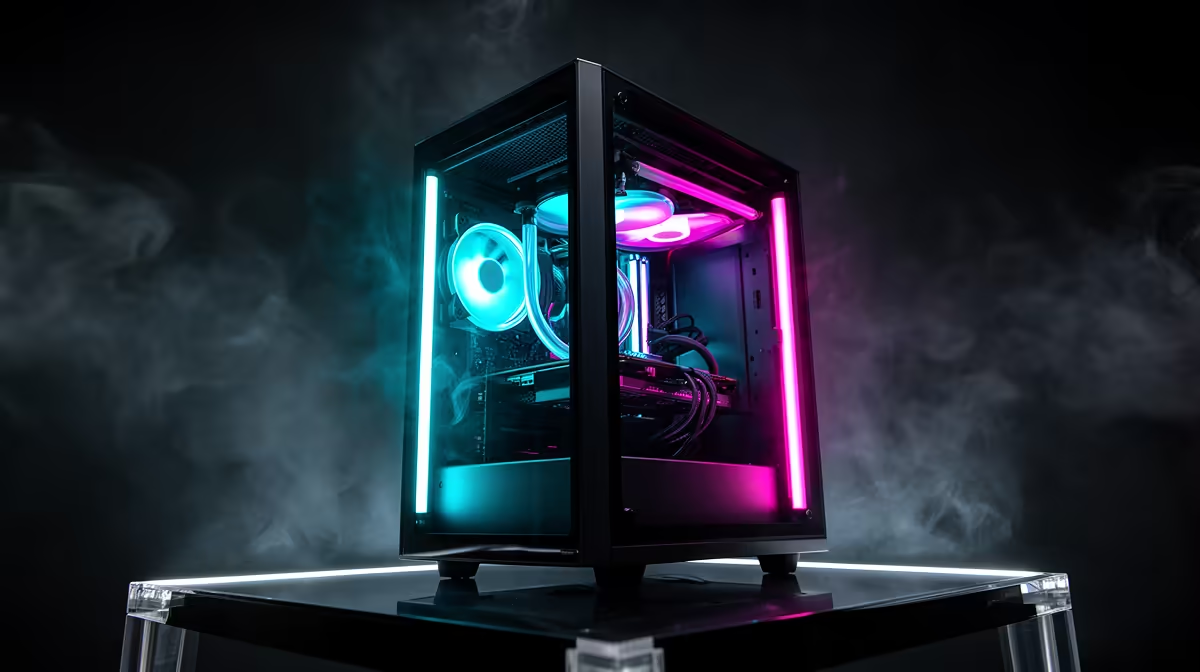
High-end gaming PCs need more airflow because flagship components generate dramatically more heat than mid-range hardware. An RTX 5090 paired with a Ryzen 9 9950X can draw over 700W under sustained load. That thermal output requires a case with a high-flow front mesh panel, multiple large intake fans, and enough internal volume to prevent hot air from recirculating across components.
A mid-range gaming PC using a Ryzen 5 7600X and RTX 5070 draws approximately 280W combined under gaming load. A high-end system pairing a Core i9-14900K with an RTX 5090 can reach 750W or more. At 750W the case becomes the primary thermal constraint, and inadequate airflow causes both CPU and GPU to reduce boost clocks to stay within safe temperature limits.
GPU thermal throttling on a flagship card in a poorly ventilated case can reduce frame rates by 10 to 20 percent versus the same card in an optimal airflow environment. For a GPU costing R18,000 to R25,000 in South Africa, leaving 15 percent of performance on the table due to inadequate case airflow is a costly oversight.
Internal space enables proper component separation. In a cramped mid-tower, GPU exhaust heat rises directly into the CPU cooler's intake zone, raising CPU temperatures by 5 to 10 degrees Celsius even when both have adequate direct airflow. Full-tower and large mid-tower cases position the GPU further from the CPU cooler through chassis height, reducing this thermal cross-contamination.
Cable routing space behind the motherboard tray also matters for airflow. A cable bundle protruding from the tray edge into the main chamber disrupts the laminar airflow path from front intakes to rear and top exhausts. Cases with 25mm or more of behind-tray routing space keep cables fully hidden, maintaining a clear airflow corridor.
South Africa's Highveld region, including Johannesburg and Pretoria, routinely reaches ambient temperatures above 32 to 36 degrees Celsius during November through February. A flagship gaming PC that maintains 80 degrees Celsius on the GPU in a 20-degree room will see GPU temperatures climb to 92 to 96 degrees in a 36-degree room with identical fan settings unless case airflow is aggressive enough to compensate.
South African high-end builders should plan fan curves with summer ambient temperatures as the design condition, not temperate indoor conditions assumed by international benchmarks.
Set your high-end PC's fan curves for peak South African summer conditions as a baseline. Aim for GPU temperatures below 85 degrees Celsius at 35-degree ambient. This typically means running case fans at 1,100 to 1,300 RPM during summer gaming sessions rather than the 900 RPM that suffices during winter.
For CPUs up to 125W sustained TDP like the Ryzen 7 9700X, a quality tower air cooler manages temperatures within boost clock limits. For 170W-plus CPUs like the Ryzen 9 9950X, a 360mm or 420mm AIO is strongly recommended for sustained workloads.
At minimum five: three front intakes and two top or rear exhausts. Preferred is six to seven fans covering front, top, rear, and optionally bottom positions to keep the GPU below 85 degrees and the CPU below 80 degrees under sustained loads at up to 28 degrees Celsius ambient.
Not necessarily. Larger fans running at lower RPM move the same air with less noise than smaller fans spinning faster. A case with three 140mm front intakes at 1,000 RPM is quieter than three 120mm fans at 1,300 RPM at equivalent airflow.
Building a high-end system that stays cool under pressure? Evetech stocks high-airflow full-tower and mid-tower cases designed for flagship GPU and CPU combinations, with mesh front panels and multiple fan positions to handle 700W-plus thermal loads.
1000W for RTX 5090 needs a full-build check, not a simple yes. Review GPU guidance, CPU draw, transient load, connectors, PSU quality, and upgrade plans before deciding.
Read more
RTX 5080 Super with a 750W PSU is more comfortable than lower wattage if the unit is quality. SA builders should still confirm GPU guidance, CPU draw, connector type, airflow, and upgrade room.
Read more
How to fix FPS drops after a RX 9070 XT starts with driver cleanup, chipset updates, thermals, and power checks. For SA gaming PCs, confirm PCIe seating, monitor refresh, frame caps, and per-game graphics settings before replacing parts.
Read more
How to fix low FPS Windows 11 Wi-Fi 7 issues starts by checking whether the problem is frame rate or network lag. Test ping, drivers, power settings, Ethernet, and game FPS before adjusting visuals.
Read more
AM5 is smart for SA builders because it supports newer Ryzen CPUs, DDR5 memory, and a longer upgrade path. Compare board cost, cooling, gaming needs, and local part availability before choosing your next PC platform.
Read more
AM5 gives Randburg gaming builders a longer upgrade path. For SA buyers, DDR5 support, newer board features, and future CPU options can justify the platform. Weigh board cost, cooler support, BIOS maturity, and upgrade timing before choosing.
Read more
RTX 5090 on a 550W PSU leaves almost no practical room for OC plans. Treat the setup as constrained, with CPU draw, power spikes, cable quality, thermals, and stability checks more important than chasing extra clocks.
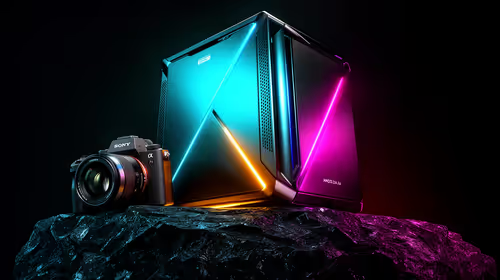
FPS drops on a Ryzen 9 9950X3D build often have a fixable cause. Check settings, drivers, thermals, background tasks, network conditions, and bottlenecks before assuming a part must be replaced.

The difference between PCIe 5.0 and PCIe 4.0 for SA gamers is mostly bandwidth headroom. Compare GPU slot needs, NVMe speed, motherboard support, and upgrade timing before paying extra for a newer platform.

Gaming PC stuck pixel checks in South Africa should confirm the monitor fault first. Use colour tests, screenshot comparison, cable swaps, display menu checks, and clear photos before deciding on support.

AMD's current driver now lists a Radeon RX 9050 4GB, while product coverage details a narrowed memory system. SA buyers should weigh the low VRAM ceiling against current local Radeon options.

Samsung Display has demonstrated a 16-inch 2.5K OLED laptop panel running at 300Hz. SA buyers should wait for a named notebook, full panel specifications and a local price before planning an upgrade.

Microsoft says some Windows 11 game crashes after recent updates are linked to RGB-related drivers. Affected SA gamers should confirm the update and driver before using the published registry workaround.
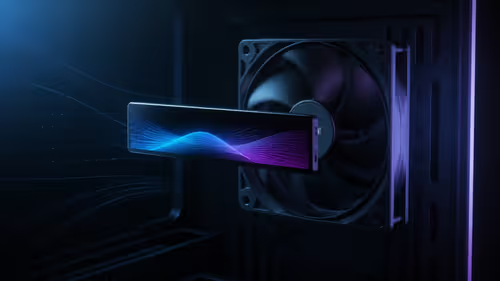
Thermalright's Fan Frame Vision-1 adds a 640x172 status screen to a standard 120mm fan. SA builders should check clearance, USB routing and local support before treating it as an easy upgrade.
1000W for RTX 5090 needs a full-build check, not a simple yes. Review GPU guidance, CPU draw, transient load, connectors, PSU quality, and upgrade plans before deciding.
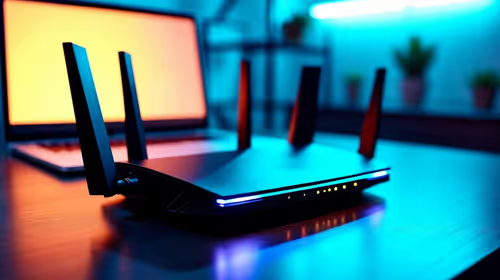
Wi-Fi 6E vs Wi-Fi 6 matters for 4K video editing when files move across a network. The real-world difference between Wi-Fi 6E and Wi-Fi 6 for video editing in 4K depends on NAS access, cloud uploads, router range, and SA creator workflows.
RTX 5080 Super with a 750W PSU is more comfortable than lower wattage if the unit is quality. SA builders should still confirm GPU guidance, CPU draw, connector type, airflow, and upgrade room.
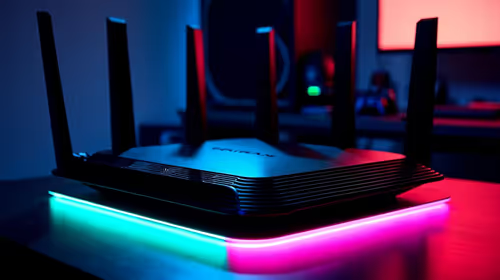
Wi-Fi 6E vs Wi-Fi 6 for Video Editing in 4K comes down to router support, latency, client devices, band support, and home network layout. SA buyers should match the choice to their setup instead of assuming one option always wins.