Quick Answer
Big fans are only one part of thermal performance. A high-performance PC case also needs a well-designed airflow path, a separate cable management chamber, adequate component spacing, a filtered intake that does not over-restrict airflow, and structural rigidity that prevents vibration amplification. A case with all these elements at moderate fan speeds outperforms one with massive fans but poor internal layout.
Airflow Path Design: Channelling, Not Just Moving Air 🌀
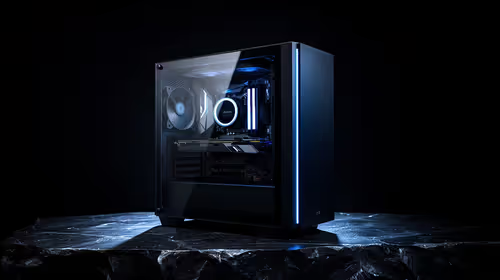
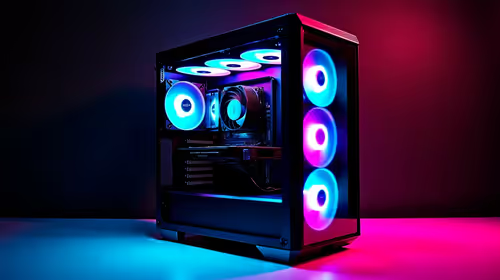
The effectiveness of any fan depends on how well the case channels the air it moves. A case with a high-porosity mesh front, a clear mid-chamber path from intake to GPU, and rear and top exhaust slots aligned with the natural thermal rise of hot air will cool components 6C to 12C better than a case where fans simply push air in random directions around obstructing cable bundles, drive cages, and unshrouded PSUs. The airflow path must carry cool intake air directly across the GPU heatsink and CPU cooler before exhausting it. Cases that route air around PSU housings, across horizontal drive bays, or through narrow cable gaps before it reaches the GPU create dead zones and turbulent recirculation that negate the fan volume.
Structural Vibration and Noise Management 🔇
A high-performance build with multiple high-speed fans generates vibration that propagates through the case panels and chassis rails. A rigid case with thick panel construction (0.9mm steel or heavier) absorbs and dampens this vibration rather than resonating with it. Cheaper cases built from 0.5mm steel flex under fan vibration and create a low-frequency hum that adds 3 to 5 dB(A) to the acoustic baseline. Silicone anti-vibration fan mounting pads, included with many quality cases and fans, decouple the fan frame from the chassis to prevent vibration transmission at source. For an SA gaming setup in a shared living space or bedroom, vibration control in the case structure is as important as fan noise specification in keeping the system acoustically reasonable.
Component Spacing and Thermal Isolation 🔧
High-performance components generate significant heat that must not recirculate. A case with adequate spacing between the GPU and the front radiator prevents hot GPU exhaust from being pulled back into the radiator intake. Spacing between the CPU cooler and the top case panel allows the fan to operate without the stall effect of air being forced into a confined space. PSU thermal isolation from the main chamber (achieved through a PSU shroud or separate lower compartment) prevents the PSU from drawing warm GPU exhaust and reduces overall operating temperature of the power supply.
Remove the Drive Bay for Better Airflow ⚡
If your case includes a removable 3.5-inch drive bay rack in the main airflow channel and you are using NVMe storage exclusively, remove the bay entirely. This opens 30mm to 60mm of unobstructed path between the GPU and front intake fans, often dropping GPU temps by 4C to 7C under load at no additional cost.
FAQ
Do larger case fans always improve cooling?
Not always. If the case airflow path is obstructed by cables or drives, adding larger fans amplifies turbulence without meaningfully improving component temperatures. Fix the airflow path before upgrading fan size.
Does case material (steel vs aluminium) affect thermal performance?
Minimally. Both materials conduct heat similarly at case panel thicknesses used in PC building. The larger effect is from panel design (open mesh vs solid) rather than material.
Can I improve cooling in a cheaper case without buying a new one?
Yes. Remove unused drive bays, route cables behind the motherboard tray, add a dust filter to the intake, and optimise your fan curve. These steps cost little to nothing and can recover 3C to 8C in most cases.
Upgrading your PC case for better performance? Evetech stocks high-airflow PC cases designed for gaming and workstation builds at a range of price points. Check the current selection and find a chassis engineered for genuine thermal performance.